Neuroscientists love studying arm movements. How does motor cortex control reaching? How are arm directions encoded? We've learned tons about "reach toward the coffee cup" type movements. But here's the thing: you do something much more complicated than reaching multiple times a day, and almost nobody studies it. You eat. Your tongue is performing complex 3D maneuvers every time you chew, swallow, or lick, and according to a study in eLife, your brain has a dedicated direction-sensing system for keeping track of where your tongue is pointed.
Yes, tongue-direction neurons are a real thing.
The Tragically Overlooked Tongue
Motor cortex directional tuning is a classic neuroscience finding. Neurons have favorite movement directions, like tiny cheerleaders rooting for "go left!" or "reach upward!" Each neuron fires most strongly when movement goes in its preferred direction. Add up the activity of many neurons, and you get a population code that precisely represents movement direction.
This has been studied extensively for arm movements. Less extensively for, say, legs. And almost not at all for the tongue and mouth, despite the fact that eating and speaking are arguably more important for daily survival than pointing at things.
The tongue has been the nerdy wallflower at the motor control dance, sitting in the corner while everyone clusters around the popular arm muscles.
Finally, Someone Paid Attention
The researchers recorded from orofacial sensorimotor cortex (the brain region that controls the face and mouth) while animals performed natural feeding and drinking behaviors. Not some artificial laboratory task where they stick out their tongue for juice rewards, but actual eating and drinking. Revolutionary concept.
They tracked tongue position in three dimensions while simultaneously recording what neurons were doing. This let them ask: do neurons in orofacial cortex show directional tuning for tongue movements the same way arm-area neurons show directional tuning for reaching?
Three-Dimensional Tongue Navigation
The answer is yes, and it's pretty elegant. Neurons in orofacial cortex showed clear directional preferences for tongue movements in all three dimensions. Some neurons fired enthusiastically for upward tongue movements. Others preferred leftward. Still others liked forward or backward or diagonal directions.
This is exactly the same organizational principle we see for arm reaching. The brain appears to use a common neural code for representing movement direction, regardless of whether the body part is an arm or a tongue.
During natural feeding and drinking (not contrived lab tasks), the tongue moves in complex 3D trajectories to position food and liquid properly. Cortical neurons track this directionality with impressive precision. Your brain knows exactly which way your tongue is pointed, updating this information in real time as you eat.
Why This Matters
First, it extends our understanding of motor control. If the same directional coding principles apply across body parts, that suggests a fundamental organizational logic in motor cortex. Arms, tongues, probably toes if anyone ever studies them: all might speak the same directional language.
Second, it has clinical implications. Stroke or injury affecting orofacial cortex can impair eating and swallowing (dysphagia), which is a serious medical problem. Understanding how the brain normally controls tongue movements could help with rehabilitation or even brain-machine interfaces for people with severe motor impairments.
Third, it's just interesting. We use our tongues constantly. Every meal, every sip of coffee, every conversation. And until now, we barely understood how the brain controls this. The fact that it's using the same elegant directional code as arm movements suggests the brain is more unified in its solutions than the balkanized study of different body parts might suggest.
Think About This Next Time You Eat
Your brain is running a real-time 3D tracking system for your tongue position. Neurons are firing in direction-specific patterns as you manipulate food, route liquids, and coordinate the complex choreography of chewing and swallowing.
All that machinery working flawlessly in the background while you barely notice. Evolution did some nice work on tongue control. Science is finally catching up to appreciate it.
Reference: Bhattacharyya S, et al. (2025). 3D directional tuning in the orofacial sensorimotor cortex during natural feeding and drinking. eLife. doi: 10.7554/eLife.101325 | PMID: 41117217
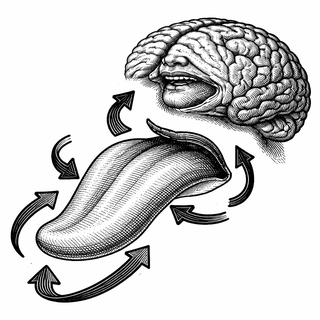
Disclaimer: The image accompanying this article is for illustrative purposes only and does not depict actual experimental results, data, or biological mechanisms.