
When you grow neurons in a dish, they do what neurons do: they reach out, make connections, and form networks. The problem? They form whatever network they feel like. You wanted to study a specific circuit architecture? Too bad, your neurons have other plans. A study in ACS Nano changes this by introducing a method to place individual human neurons exactly where you want them. And then, because scientists are scientists, they used it to study something called ephaptic coupling, a phenomenon so niche that most neuroscientists quietly pretend it doesn't exist.
The "Random Network" Problem in Neural Research
Here's the frustrating reality of growing neurons in a lab. You seed cells onto a dish, provide nutrients, and wait. The neurons grow axons and dendrites, find each other, form synapses, and create a network. Every single experiment produces a different random architecture. It's like trying to study traffic patterns when the roads keep rearranging themselves overnight.
This randomness makes it incredibly hard to study how specific circuit structures affect function. Does a particular connection pattern matter, or is it just one of many random configurations that happened to show up in this dish? You can't really know because you can't control the architecture.
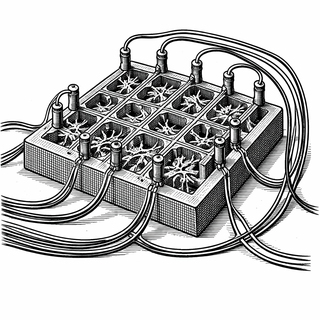
The researchers solved this with an elegant one-two punch: laser-written microstructure templates plus soft lithography to create tiny scaffolds that position neurons exactly where you specify. Every cell goes precisely where you want it. You want this neuron here and that one there, connected through this specific channel? Done.
Single-Cell Precision: Not Just a Dish, an Engineered Circuit
The platform allows exact placement of human neurons within confined microenvironments. Combined with multielectrode arrays for recording, researchers can now stimulate specific neurons and record from defined circuit elements. They're not just watching random activity; they're probing engineered circuits.
Think about the difference between observing a random potluck dinner where everyone brought whatever they felt like versus hosting a meticulously planned tasting menu where every dish arrives in sequence. Same ingredients, wildly different ability to understand what's happening.
This level of control approaches what exists in actual brain tissue, where every connection has been precisely specified by development. Less biological chaos, more deliberate architecture.
Ephaptic Coupling: The Neural Phenomenon Nobody Talks About
So what did the researchers do with this shiny new capability? They studied ephaptic coupling, and explaining this requires a brief trip into neural communication territory.
Normally, neurons talk to each other through synapses. One neuron releases neurotransmitters, another neuron detects them, signal transmitted. It's the standard textbook story, and it's real.
But there's another way neurons can influence each other: through electric fields. When a neuron fires, it generates tiny electrical fields in the surrounding tissue. If another neuron is close enough, those fields can actually affect its activity. No physical contact, no neurotransmitters, just electromagnetic influence. It's like how if you're standing close enough to a speaker, you can feel the bass even without touching it.
This ephaptic coupling has been proposed to synchronize neural activity and might contribute to conditions like epilepsy. But studying it has been nearly impossible because in regular cultures, you can't separate ephaptic effects from synaptic effects. Everything's connected every which way.
Finally Testing the Theory
With controlled axonal proximity in defined microchannels, the researchers could systematically vary ephaptic coupling strength while keeping everything else constant. Bring neurons closer? Stronger coupling. Farther apart? Weaker coupling. Clean, controlled, testable.
They confirmed theoretical predictions that had been hanging around for decades: stronger ephaptic coupling slowed down action potential velocity, increased synchronization between neurons, and lowered the threshold for stimulation. The predictions were right; they just needed the technology to test them properly.
Beyond the Obscure Stuff
The platform isn't just for testing niche electromagnetic phenomena. It opens doors for studying synaptic interactions with proper controls, investigating myelination in defined circuits, and modeling diseases where circuit architecture matters.
Want to know if a particular neurodegenerative disease affects specific types of connections? Build those connections deliberately and watch what happens. Need to test whether a drug affects certain circuit configurations? Make the circuits you want to test.
It's the difference between observing nature and running experiments. Both are valuable, but controlled experiments answer questions that observation alone cannot.
Building What We Want to Study
For neuroscience, this represents a shift from "let's see what these neurons do" to "let's build specific circuits and understand how they work." It's a move from ecology toward engineering, and it opens up questions that were previously too uncontrolled to answer properly.
The neurons still do the biological work, but now researchers can set the stage exactly how they want. Finally, a way to build the circuits we want to study rather than accepting whatever random architecture the neurons decide to create on any given day.
Reference: Bhatti M, et al. (2025). Reproducible Human Neural Circuits Printed with Single-Cell Precision Reveal the Functional Roles of Ephaptic Coupling. ACS Nano. doi: 10.1021/acsnano.5c11482 | PMID: 41139300
Disclaimer: The image accompanying this article is for illustrative purposes only and does not depict actual experimental results, data, or biological mechanisms.