
Here's an awkward truth: the organ we're using to solve climate change is also making it worse. Neuroscience - the field dedicated to understanding the three-pound universe between your ears - has a dirty little secret. All those brain scans, supercomputer analyses, and globe-trotting conference trips? They come with a carbon receipt that would make your Uber driver wince.
A new paper in Nature Human Behaviour by Puhlmann, Koppold, Feld, and a crew of 14 other researchers is calling the field out, and offering a surprisingly elegant fix: open science (Puhlmann et al., 2026).
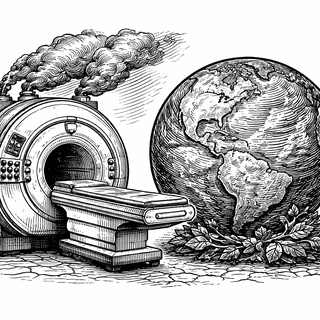
The Inconvenient Brain Scan
Let's talk numbers, because they're wild. A single MRI scanner - the workhorse of modern neuroscience - devours 80,000 to 170,000 kilowatt-hours per year. That's the energy appetite of up to 34 four-person households. And here's the kicker: even when nobody's inside the tube, the machine sips 7 to 9 kilowatts continuously just to keep its superconducting magnets chilled. Your MRI scanner has a higher resting metabolic rate than you do.
Then there's the conference problem. The Society for Neuroscience annual meeting - neuroscience's version of Coachella, but with more posters and fewer flower crowns - generates somewhere between 38,000 and 69,600 metric tons of CO2 equivalent when you count all attendees. Over 92% fly in, and air travel accounts for more than 99% of the emissions (Kay et al., 2023). That's roughly the annual output of 16,000 cars, all so people can stand in a convention center hallway eating stale pretzels and squinting at someone's fMRI activation map.
And we haven't even touched the computing. Processing 257 subjects through a standard fMRI pipeline generates about 4.46 kg of CO2, and only 4% of the output data actually gets used in the final analysis. The rest just... sits there, warming servers and the planet (Souter et al., 2024).
The 3Rs: Not Just for Lab Mice Anymore
Puhlmann and colleagues borrow a famous framework from animal research ethics - Replace, Reduce, Refine - and repurpose it for the planet. It's a clever move, and it works better than you'd expect.
Replace means asking yourself: do I actually need to collect new data, or can I reanalyze what already exists? Neuroscience has been building massive open datasets for years. If someone already scanned 10,000 brains and shared the data, maybe you don't need to fire up the MRI again. Run a simulation. Reanalyze an existing dataset. Your hypothalamus will thank you.
Reduce targets the bloat. Run only the analyses you preregistered instead of torturing your data until it confesses to something publishable. Schedule your heavy computing during off-peak hours when the electrical grid is running cleaner. Consider whether you really need to fly to San Diego, or whether a virtual poster session would do the job just as well. (Spoiler: decentralized conference hubs could slash travel emissions by up to 78%.)
Refine is about doing things better so you don't have to do them twice. Sharpen your methods. Optimize your measurement precision. Share your code so other labs don't waste months reinventing your preprocessing pipeline. A study found that only 7-9% of publications in psychoneuroendocrinology journals were preregistered (Meier et al., 2022). That means the vast majority of studies are still running exploratory analyses and calling them confirmatory - which is both scientifically shaky and a waste of computational resources.
Better for the Planet, Better for Science
Here's the part that should make every researcher sit up: these aren't sacrifices. Open data sharing, preregistration, and transparent methods don't just cut emissions - they make the science more reliable. The replication crisis taught us that over 70% of researchers have tried and failed to reproduce someone else's results. Open science tackles both problems at once: less waste, more trust.
The authors aren't asking neuroscientists to hang up their lab coats and become climate activists (though maybe attend one fewer conference per year). They're pointing out that the tools for greener science and better science are the same tools. Share your data. Preregister your analyses. Reuse what already exists. Stop running the same preprocessing pipeline 47 different ways to see which one gives you a p-value under 0.05.
Neuroscience is in the business of understanding the human mind. It would be a special kind of irony if the field destroyed the planet while figuring out how the brain works. The fix isn't complicated - it just requires scientists to do what they should have been doing all along, only now with the added motivation that the actual Earth is at stake.
References
-
Puhlmann, L. M. C., Koppold, A., Feld, G. B., Lonsdorf, T. B., Hilger, K., Vogel, S., ... & Hartmann, H. (2026). Sustainable neuroscience through open science. Nature Human Behaviour. https://doi.org/10.1038/s41562-026-02426-3
-
Kay, C., Kuper, R., & Becker, E. A. (2023). Recommendations emerging from carbon emissions estimations of the Society for Neuroscience annual meeting. eNeuro, 10(10), ENEURO.0476-22.2023. https://doi.org/10.1523/ENEURO.0476-22.2023
-
Souter, N. E., Lannelongue, L., Samuel, G., Racey, C., Colling, L. J., Bhagwat, N., Selvan, R., & Rae, C. L. (2024). Ten recommendations for reducing the carbon footprint of research computing in human neuroimaging. Imaging Neuroscience, 2, 1-15. https://doi.org/10.1162/imag_a_00043
-
Meier, M., Lonsdorf, T. B., Lupien, S. J., Stalder, T., Laufer, S., Sicorello, M., Linz, R., & Puhlmann, L. M. C. (2022). Open and reproducible science practices in psychoneuroendocrinology: Opportunities to foster scientific progress. Comprehensive Psychoneuroendocrinology, 11, 100144. https://doi.org/10.1016/j.cpnec.2022.100144
-
Lannelongue, L., Aronson, H.-E. G., Bateman, A., Birney, E., Caez, T., Carvajal-Patino, J., ... & Inouye, M. (2023). GREENER principles for environmentally sustainable computational science. Nature Computational Science, 3, 514-521. https://doi.org/10.1038/s43588-023-00461-y
Disclaimer: The image accompanying this article is for illustrative purposes only and does not depict actual experimental results, data, or biological mechanisms.