
The brain loves a good plot twist, and the climbing fibers of your cerebellum just delivered one. For decades, neuroscientists had these neural pathways pegged as error reporters. You reach for a coffee cup and misjudge the distance? Climbing fibers fire to say "Whoops, try again." They were basically thought of as the brain's complaint department, logging mistakes so you could do better next time.
But according to a study in Cell Reports, that's not the whole story. Not even close. These fibers aren't just tattling about past mistakes. They're actually predicting the future.
First, Let's Talk About Why Climbing Fibers Are Such a Big Deal
If neurons had a celebrity gossip column, climbing fibers would be front-page news. These are the drama queens of the nervous system. Each single fiber wrapping around a Purkinje cell in the cerebellum creates one of the most powerful synaptic connections anywhere in the brain. When a climbing fiber fires, it doesn't whisper. It screams, triggering a massive calcium signal that basically resets whatever the Purkinje cell was doing.
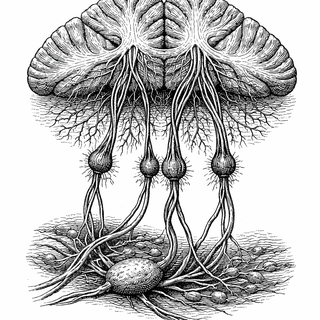
The classic story goes like this: climbing fibers come from a brain structure called the inferior olive, and they send teaching signals to the cerebellum. When something goes wrong with a movement, the climbing fiber fires to flag the error. The cerebellum learns from this signal, adjusts its internal models, and hopefully you don't spill coffee on yourself next time.
It's a neat theory. It's been in textbooks for years. And it turns out to be an oversimplification.
Some Fibers Are Just Gossips, Others Are Analysts
Researchers set up experiments where mice experienced different events: force perturbations pushing their limbs around, instructions to make specific movements, and rewards for completing tasks. Each event was followed by various motor responses, and the team imaged what the climbing fibers were doing throughout all of this.
Here's where it gets interesting. Some climbing fiber activations were what you might call "generic." They basically fired to say "Hey, something happened!" Not terribly informative. Like a friend who texts you "OMG" but won't tell you what's going on.
But other climbing fibers were doing something much more sophisticated. These "informative" signals encoded not just that an event occurred, but what consequences that event would have for behavior. They weren't just reporting news. They were providing analysis. Context. Meaning.
The more functionally complex a climbing fiber's response pattern, the more behaviorally relevant information it carried. Simple fibers gave simple signals. Complex fibers gave complex, useful predictions about what was coming next.
The Fortune-Telling Part (This Is Where It Gets Wild)
Here's the real surprise, the thing that made researchers do a double-take.
Some climbing fibers carried probabilistic information about behavioral context during idle waiting periods. Let that sink in. The mice weren't moving. Nothing had happened yet. But the climbing fibers were already firing patterns that predicted what was about to matter for upcoming behavior.
This isn't error signaling. You can't signal an error for something that hasn't occurred. This is anticipation. Prediction. The climbing fibers were essentially saying, "Based on context, here's what's probably about to be relevant, so you might want to get ready."
Think of it like a weather forecast for your motor system. The climbing fibers aren't just telling you "It's raining" after you're already wet. They're looking at the atmospheric conditions and saying, "Probably going to need that umbrella."
Why the Textbooks Need a Rewrite
This changes how we need to think about the olivocerebellar system, the pathway from the inferior olive through the climbing fibers to the cerebellum. The old model was tidy: errors happen, climbing fibers report them, cerebellum learns. Done.
The new picture is messier but more interesting. Climbing fibers aren't just backward-looking error signals. They're flexible conveyors of any information that might shape upcoming actions. They can signal errors when errors happen, sure. But they can also signal predictions, context, and probabilistic information about what the brain should be preparing for.
This makes intuitive sense if you think about it. The cerebellum helps coordinate movement, but coordinating movement requires knowing more than just "did I mess up last time." It requires anticipating what's coming, understanding context, and preparing appropriate responses before you need them. A purely reactive system would always be one step behind.
So What Does Your Cerebellum Actually Do?
We're still figuring that out. But this study suggests the climbing fiber input is richer than we thought. It's not just a teaching signal for motor learning. It's more like a running commentary on anything that might be relevant for what you're about to do.
The cerebellum sits at the back of your brain, looking kind of like a separate little brain structure, and it contains more neurons than the rest of the brain combined. For something that powerful, maybe it makes sense that its inputs would be doing more than just simple error reporting.
Your cerebellum isn't just learning from mistakes. It's actively predicting what's going to matter next and preparing accordingly. The drama queen fibers, it turns out, are also fortune tellers.
Reference: Scheer I, Prsa M. (2025). The olivocerebellar system differentially encodes the effect sensory events exert on behavior. Cell Reports. doi: 10.1016/j.celrep.2025.116444 | PMID: 41105515
Disclaimer: The image accompanying this article is for illustrative purposes only and does not depict actual experimental results, data, or biological mechanisms.