
You know that moment when the vending machine suddenly starts dispensing pretzels instead of the chips you've been hitting B4 for all week? Your brain doesn't just shrug and grab the pretzels. Somewhere in your skull, a tiny chemical alarm goes off, essentially screaming: "The rules have changed! Update everything!"
New research from a team at the University of Bordeaux has figured out exactly how this works - and it involves a brain region with a name that sounds like a rejected Star Trek planet (the orbitofrontal cortex) getting chemical text messages from a brainstem structure called the locus coeruleus.
The Brain's Flexibility Department
The orbitofrontal cortex, or OFC, sits right behind your eyes and basically runs your brain's "expectations vs. reality" department. It keeps track of what actions lead to what rewards - press this lever, get that treat; smile at the barista, maybe get extra foam. When these relationships suddenly flip, the OFC needs to update its internal rulebook fast.
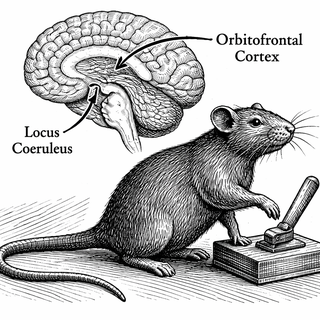
But the OFC doesn't work alone. It gets crucial updates from the locus coeruleus, a tiny brainstem nucleus that produces most of your brain's noradrenaline (also called norepinephrine). Think of the locus coeruleus as a very small but very important postal worker delivering "URGENT: THINGS HAVE CHANGED" notices throughout your brain.
What the Rats Taught Us
The researchers (Piccin et al., 2026) trained rats on an instrumental task - basically teaching them that certain actions produce certain food rewards. Then came reversal day: the rules flipped. What used to work suddenly didn't, and vice versa.
Using fiber photometry - a technique that lets scientists watch neurotransmitter activity in real-time - they tracked noradrenaline release in the OFC as the rats encountered these plot twists. Here's where it gets interesting: noradrenaline spiked specifically when rats received unexpected rewards right after the reversal. And rats whose brains showed bigger noradrenaline spikes? They adapted faster.
It's like the chemical equivalent of your brain going "Wait, WHAT?" - and the louder that "WHAT," the quicker you figure out the new rules.
Silencing the Messenger
To prove this wasn't just correlation, the team used optogenetics (controlling neurons with light) and chemogenetics (controlling neurons with designer drugs) to mess with the noradrenaline signal. When they quieted the locus coeruleus projections to the OFC, rats became stubborn. They kept pressing the old lever, expecting the old reward, like someone who refuses to accept that their favorite coffee shop changed the menu.
The chemogenetic inhibition hit hardest - these rats really struggled to let go of outdated expectations. It wasn't that they couldn't learn in the first place; they just couldn't update what they'd already learned.
Why This Matters Beyond Lab Rats
This isn't just about rodents being slow learners. The inability to flexibly update behaviors when circumstances change is a hallmark of several psychiatric conditions. People with addiction often struggle to adjust their behavior despite negative consequences. OCD involves getting stuck in repetitive patterns that no longer serve any purpose. ADHD is linked to noradrenergic dysfunction in exactly these brain circuits.
The noradrenaline system is already a target for medications treating ADHD - drugs like atomoxetine work by boosting noradrenaline signaling. This research suggests that understanding exactly when and where noradrenaline acts could lead to more precise treatments for conditions where cognitive flexibility goes haywire.
The Timing Is Everything
What's particularly elegant about this study is the temporal precision. The noradrenaline boost wasn't constant or random - it happened at specific moments when environmental feedback contradicted expectations. The locus coeruleus isn't just dumping chemicals all over the place; it's sending targeted signals at exactly the right time to help the OFC rewrite its rules.
Previous work from the same team and others has shown that noradrenaline in the OFC is essential for updating action-outcome associations when they change. This new study adds a crucial piece: it's not just whether noradrenaline shows up, but how much shows up at those critical moments that determines how quickly you'll adapt.
Your brain, it turns out, has a built-in "plot twist" detection system. And now we know a lot more about the chemical signals that make it work - which could eventually help when that system misfires.
References
-
Piccin A, Plat H, Tensaouti Y, Wolff M, Marchand AR, Coutureau E. Orbitofrontal noradrenaline acts as an early gate for reversal learning. Cell Reports. 2026. doi: 10.1016/j.celrep.2026.117105. PMID: 41838719
-
Fresno V, Bhattacharya S, Bhattacharya A, Bhattacharya S, Bhattacharya S, et al. Inhibition of noradrenergic signalling in rodent orbitofrontal cortex impairs the updating of goal-directed actions. eLife. 2023;12:e81623. doi: 10.7554/eLife.81623
-
Izquierdo A, Brigman JL, Bhattacharya S, et al. The neural basis of reversal learning: An updated perspective. Neuroscience. 2017;345:12-26. doi: 10.1016/j.neuroscience.2016.03.021. PMCID: PMC5018909
-
Uddin LQ. Cognitive and behavioural flexibility: neural mechanisms and clinical considerations. Nature Reviews Neuroscience. 2021;22(3):167-179. doi: 10.1038/s41583-021-00428-w. PMCID: PMC7856857
-
Sharma A, Couture J. An overview on neurobiology and therapeutics of attention-deficit/hyperactivity disorder. Pharmacology Biochemistry and Behavior. 2023. PMCID: PMC10501041
Disclaimer: The image accompanying this article is for illustrative purposes only and does not depict actual experimental results, data, or biological mechanisms.