
So you've been told your average blood pressure is fine. Great news! Except, plot twist: it might not be the whole story. Turns out, how much your blood pressure bounces around could matter just as much as where it lands on average. A new study in eLife built a mouse model to figure out exactly what all that fluctuation does to the brain's blood vessels, and the answer is "nothing good."
The Number Your Doctor Might Not Be Watching
When you get your blood pressure checked, you get two numbers and maybe a concerned nod or a satisfied "looks good." But that's just a snapshot, a single moment in a day where your blood pressure is constantly shifting. It goes up when you're stressed, down when you're relaxed, up again when that email from your boss lands, and so on.
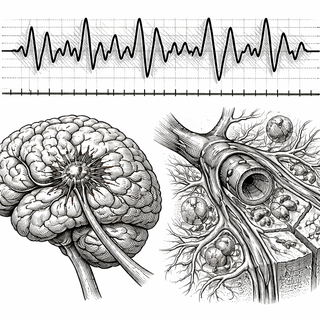
Epidemiological studies have been noticing something odd for a while now: people with highly variable blood pressure, big swings up and down throughout the day and week, tend to have worse cognitive outcomes than people with stable pressure. And here's the kicker: this holds true even when their average blood pressure is the same.
Two people could both average 130/80, but if one person's pressure is rock-steady and the other person's is bouncing between 110 and 150 all day, they're apparently not in the same boat. The bouncer is more likely to develop cognitive decline and dementia. That's a finding that doesn't quite fit with how we usually think about blood pressure management.
Building a Mouse That Has a Very Bad Day (Repeatedly)
To understand why fluctuating blood pressure damages brains, you need an animal model that actually has fluctuating blood pressure. This is harder than it sounds. Most hypertension models just give mice chronically high blood pressure, which is useful for studying hypertension but doesn't capture the variability question.
The researchers got creative. They used intermittent infusions of angiotensin II (a hormone that raises blood pressure) in middle-aged mice. By giving it in pulses rather than continuously, they created a pattern of blood pressure that swings up and down without staying chronically elevated. It's like giving the mice regular stress spikes rather than permanent hypertension.
Using radio telemetry, they tracked blood pressure continuously. The resulting pattern looked remarkably similar to what you see in humans with high blood pressure variability: a sine wave of rises and falls rather than a flat line at either normal or elevated levels.
The Blood Vessels Are Not Okay
Here's where things get interesting. Even though these mice didn't have sustained high blood pressure, their brain blood vessels showed real damage. The vessels' ability to respond appropriately was impaired. When the brain needs more blood flow (because neurons are working hard), blood vessels are supposed to dilate. This response was compromised in the variable blood pressure mice.
There were also structural changes. The neurovascular unit, which is the term for the intimate relationship between blood vessels and the neurons and support cells surrounding them, showed signs of disruption. This matters because the neurovascular unit is basically the brain's supply chain logistics. When it breaks down, neurons don't get what they need, waste doesn't get cleared efficiently, and things start going wrong in ways that eventually show up as cognitive problems.
The key insight is that you don't need chronically elevated pressure to cause this damage. The fluctuation itself is harmful. Think of it like this: if someone punched you once really hard, that would hurt. But if someone punched you at moderate strength over and over, the cumulative damage might actually be worse. The blood vessels are getting stressed, recovering partially, getting stressed again, and never quite getting back to baseline.
What This Means for Actual Humans
The clinical implications are pretty significant if these findings translate to people (and the epidemiological data suggests they do). It means that stabilizing blood pressure might be just as important as lowering it. A medication that reduces your average blood pressure but increases variability might not be doing you the favor you think it is.
This is particularly relevant for people with "white coat hypertension," where blood pressure spikes in medical settings but is normal at home. The conventional wisdom has been that this is benign because the average exposure to high pressure is low. But if the spikes themselves are causing vascular damage, that calculus changes.
Same goes for people with stress-related blood pressure swings. If your job or life situation causes your blood pressure to yo-yo throughout the day, you might be accumulating vascular damage even if you never cross the official hypertension threshold.
The research is still in early stages, and we don't yet have interventions specifically designed to reduce blood pressure variability (as opposed to just lowering average pressure). But understanding that the roller coaster matters, not just the overall height, is a significant shift in how we might think about cardiovascular health and brain protection.
Your blood vessels, it seems, really prefer a smooth ride.
Reference: Bhattacharyya S, et al. (2025). Blood pressure variability compromises vascular function in middle-aged mice. eLife. doi: 10.7554/eLife.104082 | PMID: 41123590
Disclaimer: The image accompanying this article is for illustrative purposes only and does not depict actual experimental results, data, or biological mechanisms.