
Picture the longest cells in your body - neurons that stretch from your brain all the way down your spine, basically running the entire length of your torso. Now imagine those cells slowly breaking down because the internal scaffolding that keeps them functional is going haywire. That's the reality for people with Spastic Paraplegia 4 (SPG4), and researchers just figured out exactly what's going wrong - plus a way to potentially fix it.
The Setup: When Your Cell's Highway System Breaks Down
Your neurons rely on microtubules, tiny tube-shaped structures that act like the cell's internal highway system. They're constantly being built, broken down, and rebuilt - it's controlled chaos that keeps everything running smoothly. A protein called spastin is supposed to manage this process by cutting microtubules at just the right times and places. Think of it as the highway maintenance crew that removes old sections so new ones can be built.
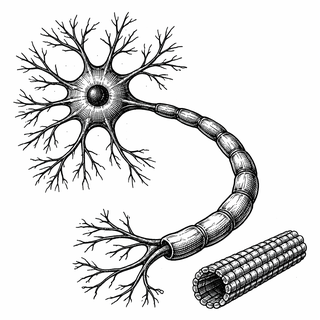
In SPG4, mutations in the gene that makes spastin throw a wrench into this whole operation. The result? The longest neurons in your body - the corticospinal motor neurons that control voluntary leg movement - start degenerating. Walking gets harder. Legs stiffen. And because these are the longest cells in the human body, they're also the most vulnerable when things go wrong.
Mini-Brains in a Dish (Yes, Really)
Here's where it gets interesting. A research team led by scientists at Drexel University wanted to understand exactly how different spastin mutations cause different symptoms. So they did something clever: they grew mini versions of the human motor cortex in the lab using stem cells from patients with SPG4.
These aren't full brains - more like tiny balls of organized brain tissue called organoids, specifically engineered to be rich in corticospinal motor neurons. The researchers created cell lines with two different types of SPAST mutations and compared them to healthy controls.
What they found was striking. Both mutations caused problems, but in distinctly different ways. The missense mutation (a small spelling error in the gene) led to overactive neurons, while the frameshift mutation (a bigger disruption that shifts how the gene is read) caused the opposite - sluggish, underactive cells. Both eventually led to the same destination: axon degeneration and neuron death. Different roads, same unhappy ending.
The Plot Twist: It's Not Just About Missing Spastin
The conventional wisdom was that SPG4 happens because cells simply don't have enough working spastin to cut their microtubules properly. But this study revealed something more nuanced. The mutant form of spastin (specifically the longer M1 isoform) appears to be actively causing trouble by cranking up the activity of an enzyme called HDAC6.
HDAC6 is the cell's microtubule "de-acetylator" - it strips away chemical tags that normally help stabilize microtubules and promote healthy transport along axons. When HDAC6 goes into overdrive, microtubules become hypoacetylated, and the whole cellular transport system starts falling apart.
The Fix That Actually Worked
Armed with this insight, the researchers tried something straightforward: what if we just block HDAC6? They used a compound called tubastatin A, which specifically inhibits HDAC6, and applied it to the diseased organoids.
The results were genuinely encouraging. Tubastatin A restored normal microtubule acetylation levels and rescued the degenerating axons. Even better, when they tested it in transgenic mice carrying SPG4 mutations, the drug improved their walking ability and reduced corticospinal tract degeneration.
This matters because HDAC6 inhibitors already exist and have been explored for other neurological conditions like Alzheimer's disease and Charcot-Marie-Tooth disease. Having a proven mechanism and a drugable target is exactly what you need to start thinking about actual treatments.
What This Means for Patients
SPG4 affects an estimated 2 to 6 people per 100,000, making it the most common form of hereditary spastic paraplegia. Currently, there's no cure - just physical therapy and drugs to manage spasticity. Some children with severe mutations lose the ability to walk by age 10.
This research offers something concrete: a therapeutic target and proof that hitting it actually works in human cells and animal models. That's a long way from a pill you can take, but it's exactly the kind of foundation that makes clinical development possible.
The organoid approach itself is also valuable. Being able to model patient-specific disease in a dish means researchers can test drugs more efficiently and potentially predict which treatments will work for which mutations. Personalized neurology might not be science fiction forever.
References
-
Mohan N, Ramakrishnan S, Sun X, et al. Modeling spastic paraplegia 4 with corticospinal motor neuron-enriched cortical organoids reveals genotype-phenotype and HDAC6-targetable pathology. Cell Reports. 2026;45(3):117036. DOI: 10.1016/j.celrep.2026.117036
-
Chiara G, Bhatt NC, Liu M, et al. Intracerebroventricular SPAST-AAV9 gene therapy prevents manifestation of symptoms in a mouse model of SPG4 hereditary spastic paraplegia. Molecular Therapy. 2025. PMID: 41311060
-
Sardina F, Bhatt NC, De Angelis A, et al. Cul-4 inhibition rescues spastin levels and reduces defects in hereditary spastic paraplegia models. Brain. 2024;147(10):3534-3547. DOI: 10.1093/brain/awae118
-
Vemu A, Szczesna E, Fiano E, et al. Spastin is a dual-function enzyme that severs microtubules and promotes their regrowth to increase the number and mass of microtubules. PNAS. 2019;116(18):8979-8984. DOI: 10.1073/pnas.1818824116 PMCID: PMC6431158
-
Butler KV, Kalin J, Brochier C, et al. Rational design and simple chemistry yield a superior, neuroprotective HDAC6 inhibitor, tubastatin A. Journal of the American Chemical Society. 2010;132(31):10842-10846. DOI: 10.1021/ja102758v
Disclaimer: The image accompanying this article is for illustrative purposes only and does not depict actual experimental results, data, or biological mechanisms.