
Every cell in your body runs on messages. DNA writes the master plan, RNA carries the memo, and proteins do the actual work. But here's the thing nobody told you in high school biology: those RNA memos come with sticky notes attached. Little chemical tags that say things like "urgent - translate immediately" or "eh, you can trash this one." Without them, your cells are basically reading every email in their inbox with zero context. And in Parkinson's disease, it turns out someone's been ripping off all the sticky notes in the worst possible brain neighborhood.
Your Brain is Basically Addicted to These Tags
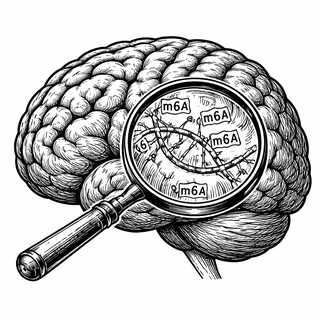
The tag in question is called m6A (N6-methyladenosine, if you're trying to impress a biochemist at happy hour). It's the most common chemical decoration on messenger RNA, and your brain cannot get enough of it. Over 30% of brain transcripts carry m6A modifications - more than any other organ in your body (Mathoux et al., 2021). These tags help regulate everything from memory formation to synaptic firing to neuronal development.
The system runs like a well-organized newsroom: "writers" (METTL3 and METTL14) stamp the tags on, "erasers" (FTO and ALKBH5) remove them, and "readers" interpret what the tagged messages mean. When this crew is humming along, your dopamine neurons are happy, your mitochondria are healthy, and your substantia nigra is doing its job. When they're not? Well.
Scientists Poked Around in Mouse Brains (As One Does) and Found Something Wild
A team led by Sun Liu and colleagues just published a stunner in The Journal of Clinical Investigation (Liu et al., 2025). They looked at the substantia nigra - the brain region that churns out dopamine and takes the hardest hit in Parkinson's - and found m6A levels were dramatically reduced in mouse models of the disease. The writer enzyme METTL3 was going quiet while the eraser ALKBH5 was working overtime. It's as if someone fired the entire editing department and promoted the intern with the delete key.
Then came the real surprise: they discovered a never-before-seen mutation in METTL3 (p.K480R) in actual Parkinson's patients. They engineered mice carrying this mutation, and those mice slowly, progressively developed Parkinson's - dopamine neuron death, alpha-synuclein pileup (that's the gunk that clogs Parkinson's brains), motor problems, even non-motor symptoms like anxiety and gut issues. The whole awful package. And levodopa, the standard Parkinson's drug, helped these mice - which means researchers finally have a mouse model that mimics the real disease instead of a speed-run cartoon version of it.
The Doom Spiral Your Mitochondria Didn't Sign Up For
Here's the plot twist. The team uncovered a pathogenic loop - a molecular doom spiral where everything makes everything else worse.
When m6A levels drop, the cell loses its grip on a protein called TFAM, which is essentially the project manager for building new mitochondria. No TFAM, no healthy power plants. And here's the cruel part: damaged mitochondria can't support the energy-hungry process of m6A modification. So m6A drops further, TFAM drops further, mitochondria collapse further, and the whole thing spirals into neuronal death. It's the biological equivalent of a restaurant getting bad reviews because nobody goes there, and nobody goes there because of the bad reviews.
We've known for years that mitochondrial dysfunction drives parkinsonism - a landmark Nature study showed that disrupting mitochondrial complex I alone can trigger progressive dopamine neuron loss (Gonzalez-Rodriguez et al., 2021). And multiple groups have documented m6A reductions across Parkinson's brain tissue (Zhou et al., 2023). But nobody had wired these two findings together into a self-reinforcing loop until now. That's the new bit. That's the "oh no" moment.
A Supplement Enters the Chat
Now for the part that'll make you lean forward. The team tried S-adenosylmethionine (SAMe) - a compound your body naturally makes, and one you can buy at most pharmacies - on their Parkinson's mice. SAMe is the cell's universal methyl donor, the raw ingredient needed to stick those m6A tags back onto RNA.
It worked. SAMe boosted m6A levels, broke the pathogenic loop, and eased Parkinson's symptoms.
Deep breath before you order a case from Amazon. This is mouse data. SAMe has a complicated history with Parkinson's - it can interact with levodopa and has shown mixed results in other contexts (Wang et al., 2025). But as proof that you can crack this doom cycle by restoring RNA methylation? That's a genuinely new therapeutic idea for a disease that desperately needs fresh ones.
Why Your Brain's Sticky Notes Might Change Everything
Parkinson's disease hits over 10 million people worldwide, and most cases are still labeled "idiopathic" - doctor-speak for "your guess is as good as ours." Current treatments replace lost dopamine after neurons are already dead. That's like mopping the floor while the pipe is still leaking.
This research points to a way upstream. Fix the RNA tagging machinery before neurons start dying, and maybe you can stop the leak itself. It's not just a new drug target - it's a whole new way of thinking about what goes wrong in the first place.
Your brain's spell-checker, it seems, was doing a lot more heavy lifting than anyone realized.
References
-
Liu, S., Ren, Q., Mo, G., Li, Z., Huang, H., Zhou, Y., ... & Xiao, S. (2025). m6A deficiency induces dopaminergic neurodegeneration and progressive parkinsonism through a pathogenic loop with mitochondria. The Journal of Clinical Investigation. DOI: 10.1172/JCI197183. PMID: 41842966
-
Gonzalez-Rodriguez, P., Zampese, E., Stout, K. A., Guzman, J. N., Ilijic, E., Yang, B., ... & Surmeier, D. J. (2021). Disruption of mitochondrial complex I induces progressive parkinsonism. Nature, 599(7886), 650-656. DOI: 10.1038/s41586-021-04059-0. PMID: 34732887
-
Wang, Y., Zhao, T., Yuan, C., & Chen, X. (2025). The role of N6-methyladenosine (m6A) RNA modification in the pathogenesis of Parkinson's disease. Biomolecules, 15(5), 617. DOI: 10.3390/biom15050617. PMCID: PMC12108881
-
Zhou, J., Han, Y., & Hou, R. (2023). Potential role of N6-methyladenosine modification in the development of Parkinson's disease. Frontiers in Cell and Developmental Biology, 11, 1321995. DOI: 10.3389/fcell.2023.1321995. PMCID: PMC10753761
-
Mathoux, J., Henshall, D. C., & Brennan, G. P. (2021). Regulatory mechanisms of the RNA modification m6A and significance in brain function in health and disease. Frontiers in Cellular Neuroscience, 15, 671932. DOI: 10.3389/fncel.2021.671932. PMCID: PMC8170084
Disclaimer: The image accompanying this article is for illustrative purposes only and does not depict actual experimental results, data, or biological mechanisms.