
You're walking down the street when a baseball comes hurtling toward your face. Before you've even consciously registered what's happening, you've already flinched, ducked, or thrown your hands up. Thank your superior colliculus - the tiny chunk of midbrain tissue that's been keeping vertebrates alive since before dinosaurs figured out feathers.
Meet Your Brain's Bouncer
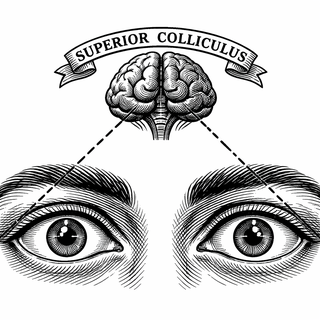
Tucked away in your midbrain, the superior colliculus (Latin for "upper hill," because neuroscientists apparently moonlight as landscape architects) is a paired structure about the size of your thumbnail. It sits there quietly processing visual information and making split-second decisions about whether something in your environment deserves immediate attention - preferably before that something crushes your skull.
For most of neuroscience history, researchers treated the superior colliculus like a simple relay station: visual information comes in, basic reflexes go out. But a new study from Monica Thieu and colleagues suggests this little structure has been seriously underestimated. It's not just detecting motion - it's recognizing what is moving toward you and helping generate the emotional experience of "oh no."
The Study That Changed the Game
The researchers used fMRI to watch human superior colliculi in action while participants viewed looming stimuli - objects that appear to be approaching on a collision course. Some videos were naturalistic (think: actual footage of things coming at you), while others were controlled experimental stimuli.
Here's where it gets interesting: the superior colliculus wasn't just responding to movement. It was encoding information about both the motion and the category of approaching objects. Your midbrain can apparently tell the difference between an approaching ball and an approaching face, and it cares about that distinction.
Using computational models based on neural networks trained for collision detection, object recognition, and visual salience, the team found that all three independently predicted activity in the superior colliculus - and these models generalized across different people. Your ancient threat-detection hardware is running some surprisingly sophisticated software.
Not a Solo Act
Perhaps the most compelling finding? The superior colliculus doesn't work alone. The researchers mapped out distinct but overlapping networks connecting the colliculus to various cortical and subcortical regions - different circuits light up depending on whether you're processing the motion versus the category of looming objects.
This matters because neuroscience has long had a "cortex-centric" bias when it comes to emotion. We tend to think of emotional experience as something that happens in the newer, fancier parts of the brain - the cortex that lets us do calculus and argue about politics. But this study found that superior colliculus activity directly correlated with self-reported fear, arousal, and valence. The participants' midbrain responses tracked with how scared, aroused, or negatively affected they felt.
In other words, your emotional experience of seeing a car barreling toward you might begin before that information even reaches your conscious awareness. The superior colliculus is part of an ancient subcortical pathway - sometimes called the "low road" - that includes connections to the pulvinar nucleus and amygdala, allowing rapid emotional responses to threats.
Why This Matters
Understanding how the brain detects and responds to threats isn't just academic navel-gazing. This research has implications for conditions ranging from anxiety disorders to PTSD, where threat detection systems may be miscalibrated. Patients with Lewy body dementia and Parkinson's disease show superior colliculus dysfunction that correlates with visual symptoms. And anyone who's ever had a near-miss in traffic knows that the emotional aftermath of perceived danger can be intense and lasting.
The study also challenges how we think about the relationship between perception and emotion. These aren't separate processes that happen sequentially - they're intertwined from the earliest stages of visual processing, in brain structures we share with fish and frogs.
So next time something makes you flinch before you've even processed what it was, give a small nod of thanks to your superior colliculus. It's been running security for 500 million years, and apparently, it's been doing a lot more than we gave it credit for.
References
-
Thieu MK, Sethi M, Aberman E, Kragel PA. Human superior colliculus pathways represent the form and motion of looming objects. Cell Reports. 2026;117033. DOI: 10.1016/j.celrep.2026.117033
-
McFadyen J, Mattingley JB, Garrido MI. An afferent white matter pathway from the pulvinar to the amygdala facilitates fear recognition. eLife. 2019;8:e40766. DOI: 10.7554/eLife.40766
-
Billington J, Wilkie RM, Field DT, Wann JP. Neural processing of imminent collision in humans. Proc R Soc B. 2011;278(1711):1476-1481. PMCID: PMC3081747
-
Huang L, Chen X, Bhalla N. What Are the Functions of the Superior Colliculus and Its Involvement in Neurologic Disorders? Neurology. 2023;100(19):e2042-e2047. PMCID: PMC10115501. DOI: 10.1212/WNL.0000000000207254
-
Kragel PA, Bianciardi M, Hartley L, et al. A human colliculus-pulvinar-amygdala pathway encodes negative emotion. Neuron. 2021;109(15):2404-2412.e5. PMCID: PMC8349850. DOI: 10.1016/j.neuron.2021.06.001
Disclaimer: The image accompanying this article is for illustrative purposes only and does not depict actual experimental results, data, or biological mechanisms.