
Think of your brain's blood supply like a city's water system. When you flip on a faucet in your kitchen, water doesn't just randomly gush from pipes all over town - it flows specifically where you need it. Your brain pulls off the same trick roughly 86 billion times more impressively, routing extra blood to whichever neurons are currently working overtime. Scientists have spent decades studying this phenomenon, called functional hyperemia, but here's the thing: they've mostly been watching individual pipes when the whole plumbing network is putting on a synchronized show.
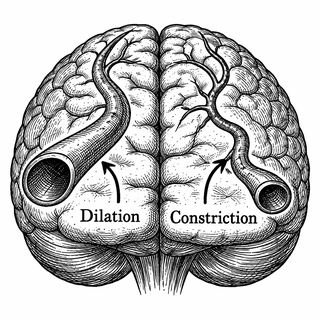
A team from the University of Toronto and Sunnybrook Research Institute decided to change that. They built an AI-powered pipeline that can track hundreds of interconnected blood vessels simultaneously, watching the whole network respond when neurons start firing. And what they found suggests your brain's circulatory system is way more like a choreographed dance troupe than a collection of independent contractors.
Teaching Computers to Watch Blood Flow
The researchers used two-photon fluorescence microscopy - essentially a super-powered microscope that can peer into living brain tissue - combined with deep learning algorithms to automatically map and measure blood vessel changes. If you've ever tried to trace a tangle of Christmas lights, multiply that frustration by about a thousand, add the requirement that everything is three-dimensional and constantly moving, and you'll understand why automation was necessary.
They tested their system in mice genetically engineered to have neurons that activate when exposed to light (a technique called optogenetics). Flash a light at the brain, neurons fire, and then you watch what happens to the surrounding blood vessels. Simple in concept, monumentally complex in execution.
The Network Throws a Party
Here's where it gets interesting. When the researchers cranked up the light stimulation, they didn't just see individual vessels dilating to let more blood through. They observed network-wide coordination, with connected vessels responding in similar ways. The "assortativity" - a fancy graph theory term for how much neighboring vessels match each other's behavior - jumped by a whopping 152% at higher stimulation levels.
Both dilations and constrictions happened across different cortical depths, with dilating vessels averaging about 16 micrometers from the nearest activated neuron, and constricting ones sitting slightly farther away at 22 micrometers. The vessels weren't just opening wider uniformly either - individual vessel radius changes varied by about 24% of their resting diameter, probably reflecting the uneven distribution of contractile cells along vessel walls.
Why Your Brain's Coordination Matters
This network-level view matters for reasons beyond satisfying scientific curiosity. When neurovascular coupling goes wrong - and it does, in conditions like Alzheimer's disease, stroke, and hypertension - understanding the full network response could reveal problems that single-vessel analysis would miss.
Current brain imaging techniques like fMRI rely entirely on blood flow changes to infer neural activity. If we don't understand how blood vessel networks coordinate their responses, we're essentially trying to reconstruct a symphony from one instrument's sheet music.
The researchers also found that the capillary network's "efficiency" - how well the system distributes blood - increased by about 4% during peak stimulation compared to baseline. That might sound small, but in a system processing the metabolic needs of billions of neurons, small efficiency gains matter enormously.
The Bottom Line
What does this mean for the future? Potentially a lot. This pipeline could help researchers study how diseases disrupt vascular coordination long before symptoms appear. It could improve our interpretation of brain imaging data. And it demonstrates that AI can handle biological complexity that would take human analysts years to untangle manually.
Your brain's blood supply isn't just a bunch of passive pipes responding to local demand. It's a sophisticated, coordinated network that adjusts as a team. The night shift in your head is running a tighter operation than anyone realized.
References
-
Rozak MW, Mester JR, Attarpour A, et al. A deep learning pipeline for mapping in situ network-level neurovascular coupling in multi-photon fluorescence microscopy. eLife. 2026;13:RP95525. DOI: 10.7554/eLife.95525 | PMCID: PMC13012726
-
Chen X, et al. From Mechanisms to Medicine: Neurovascular Coupling in the Diagnosis and Treatment of Cerebrovascular Disorders. Cells. 2024;14(1):16. DOI: 10.3390/cells14010016 | PMCID: PMC11719775
-
Liu Y, et al. Neuromodulation of Cerebral Blood Flow: A Physiological Mechanism and Methodological Review of Neurovascular Coupling. Bioengineering. 2025;12(5):442. DOI: 10.3390/bioengineering12050442 | PMCID: PMC12108752
-
Hill RA, et al. Imaging and optogenetic modulation of vascular mural cells in the live brain. Nature Protocols. 2021;16:472-496. DOI: 10.1038/s41596-020-00425-w
Disclaimer: The image accompanying this article is for illustrative purposes only and does not depict actual experimental results, data, or biological mechanisms.