
LRRK2 mutations are among the most common genetic causes of Parkinson's disease. When this protein goes wrong, dopamine neurons in the brain start dying, and the characteristic motor symptoms follow. Scientists have spent years trying to understand exactly what LRRK2 does and why its mutant forms are so toxic.
One thing everyone thought they knew: LRRK2 has an "on" state where it's active and can form filaments on microtubules (the cell's internal highway system), and an "off" state where it's autoinhibited and supposedly stays put. Blocking the active form seemed like a reasonable therapeutic strategy.
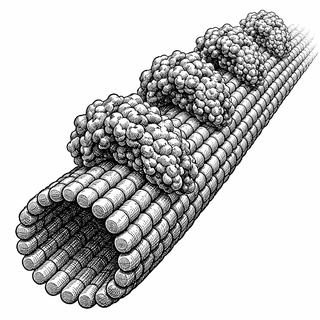
But a study in eLife just threw a wrench in that plan. Using fancy cryo-electron tomography to capture the protein in action, researchers found that LRRK2 can still decorate microtubules even when it's supposedly turned off. So much for the simple on/off model.
The Original Story: Active LRRK2 Coats Microtubules
LRRK2 is a big, complicated protein with a kinase domain (the part that does enzymatic work) and various regulatory regions. When the protein is active, the kinase domain is ready for action, and LRRK2 can assemble into orderly filaments that wrap around microtubules.
Microtubules are like the cell's railroad system, tracks along which cargo gets transported. They're especially important in neurons, which have to move materials long distances from the cell body to distant axon terminals. When LRRK2 filaments coat microtubules, they might interfere with this transport system. Too much LRRK2 decoration could gum up the works.
The autoinhibited form of LRRK2 was thought to be different. In this configuration, the N-terminal region of the protein acts like a lid, sitting over the kinase domain and preventing it from doing its thing. The assumption was that this inactive form wouldn't polymerize or cause problems. It would just float around harmlessly until it got activated.
The Plot Twist: "Off" Doesn't Mean "Quiet"
The researchers used cryo-electron tomography (cryo-ET) to watch full-length human LRRK2 interacting with microtubules. Cryo-ET is like taking 3D pictures of proteins at very low temperatures, frozen in the act of doing whatever they were doing. It lets you see molecular structures in something close to their native state.
What they saw was unexpected. Autoinhibited LRRK2, the form that's supposed to be off, was still forming filaments on microtubules. The kinase was dormant, the lid was in place, but the protein was still polymerizing and coating the cellular highways.
This wasn't just true for normal LRRK2. Parkinson's-linked mutant versions did the same thing. The disease-associated forms of the protein were still decorating microtubules in their supposedly inactive state.
Same Protein, Different Wardrobe
The autoinhibited filaments aren't identical to the active ones. They share some molecular contacts, the handshakes that stabilize protein-protein interactions. But they also have new interfaces that aren't present in active filaments.
Specifically, N-terminal repeat regions that stay disordered in active filaments become organized in the autoinhibited form, contributing to a different type of filament structure. It's like the same person wearing two different outfits. The basic identity is the same, but the appearance and details differ.
These autoinhibited filaments also behave differently. They twist along the microtubule at different angles. They're shorter and less orderly. They appear less stable than their active counterparts. But "less stable" doesn't mean "nonexistent." They're still there, still coating microtubules, still potentially causing problems.
What This Means for Parkinson's Treatment
This finding complicates the therapeutic picture. Several companies have been developing LRRK2 kinase inhibitors as potential Parkinson's treatments. The logic was straightforward: if the active kinase is the problem, turn it off.
But if the inactive form of LRRK2 can also coat microtubules and potentially disrupt cellular function, kinase inhibitors might not be enough. You'd be successfully turning off the kinase, but you might not prevent the microtubule decoration that could also be contributing to toxicity.
This doesn't mean kinase inhibitors are useless. It just means the situation is more complicated than hoped. Understanding all the ways LRRK2 can misbehave is necessary for developing treatments that actually address the full spectrum of pathology.
It also raises questions about what the autoinhibited filaments are actually doing. Are they just as harmful as active filaments? More harmful? Less harmful but still problematic? These are questions that will need more research to answer.
The Takeaway: Proteins Are Complicated
LRRK2 joins a long list of proteins that turn out to be more complicated than their initial models suggested. Biology rarely respects clean on/off switches. Even autoinhibited proteins, even supposedly dormant enzymes, can still do things that matter.
For Parkinson's research, this is both frustrating and valuable. Frustrating because it means simple solutions may not work. Valuable because understanding the full behavior of LRRK2 is ultimately necessary for cracking this puzzle.
The protein won't follow the rules we assumed it would. But now that we know that, we can adjust our strategies accordingly.
Reference: Chen S, et al. (2025). Cryo-electron tomography reveals the microtubule-bound form of inactive LRRK2. eLife. doi: 10.7554/eLife.100799 | PMID: 41171629
Disclaimer: The image accompanying this article is for illustrative purposes only and does not depict actual experimental results, data, or biological mechanisms.