
Ever been startled by a loud noise and found yourself halfway across the room before your conscious mind even filed a complaint? That wasn't a glitch. That was your brain's escape system doing exactly what millions of years of evolution designed it to do - getting your body out of danger before "you" even have time to think about it. A team of researchers just cracked open the hood on this system, and the engineering is annoyingly elegant.
One Brain Region to Rule Them All
Neuroscientists have known for a while that the brain has dedicated circuits for escape behavior. Hear something terrifying? Run. See something terrifying? Also run. But here's what nobody had pinned down: does a single brain region contain all the specialized neurons needed to go from "that sound is bad" to "LEGS, GO NOW" - regardless of which sense detected the threat?
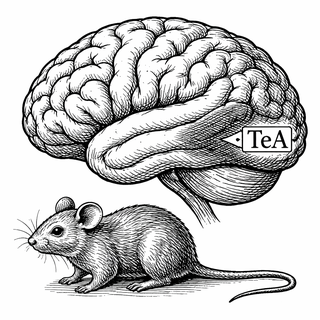
He Li and colleagues threw multiple scary stimuli at mice - visual looming threats (picture a hawk shadow expanding overhead) and loud sounds - and found that a region called the temporal association cortex (TeA) handled all of them (Li et al., 2026). This strip of neural tissue on the side of the brain, previously known mostly for processing complex sounds and linking sensory information together, turns out to be running a complete escape operation. Within a single layer of cortex (Layer 5, for the scorekeepers), they identified three functionally distinct neuron types working like a well-oiled assembly line:
- Sensory neurons - the lookouts, flagging anything alarming.
- Sensory-motor decision neurons - middle management, taking that alarm and making the call: "Yep, time to bail."
- Motor command neurons - the ones who actually yell "RUN!" to the legs.
That's the full pipeline from "something scary happened" to "we are leaving immediately," all packed into one cortical neighborhood.
The Office Hierarchy Inside Your Head
Here's where it gets properly nerdy. Those decision-making neurons are a specific subtype called intratelencephalic (IT) neurons - cells whose connections stay within the brain's upper structures. The motor command neurons are pyramidal tract (PT) neurons that fire signals straight down to the dorsal periaqueductal gray (dPAG), a midbrain structure that's basically the brain's emergency broadcast system for defensive behavior.
The really slick part? IT neurons excite PT neurons, but PT neurons don't return the favor. It's a one-way chain of command - sense it, evaluate it, execute the escape. No committee meetings, no reply-all emails. Recent work mapping IT and PT circuits across the sensorimotor cortex has shown this unidirectional wiring is a fundamental design principle, not a one-off quirk (Yao et al., 2024). But nobody had caught these two cell types performing a coordinated escape act in the same cortical layer before.
Why the dPAG Is Everyone's Favorite Emergency Switch
The dPAG has been on neuroscientists' radar for decades. Stimulate it and animals bolt. Damage it and they become suspiciously relaxed about things that should terrify them. Recent work showed that tonically active inhibitory neurons in the dPAG essentially set a "flee threshold" - a sensitivity dial that has to be overcome before the animal actually runs (Stempel et al., 2024). Other studies traced hypothalamic inputs that control how vigorously an animal sprints once it commits to fleeing (Wang et al., 2021). And earlier research established that the periaqueductal gray coordinates sensory and motor circuits across multiple levels of the nervous system simultaneously (Koutsikou et al., 2015).
What Li and colleagues add is the upstream wiring - the cortical microcircuit that decides whether to hit that panic button in the first place. Using optogenetics, chemogenetics, and old-fashioned electrode recordings, they showed that TeA's PT neurons are the critical link between cortical threat evaluation and the dPAG's escape machinery.
Why This Matters Beyond Mouse Problems
Understanding how the brain converts "I sense danger" into "I am running" isn't just a nice intellectual exercise. Anxiety disorders, PTSD, and panic disorder all involve escape circuits stuck in overdrive - firing too easily or refusing to shut off. If a specific three-neuron microcircuit in one cortical layer is making the "escape now" call, that's a potentially targetable mechanism for more precise therapies that fix the decision step rather than just dampening everything.
It's also just a satisfying piece of biological engineering. Three cell types, one layer, one clean circuit. Sense it, judge it, run from it. Your brain's been running this operation since before you were born, and it never once asked for a performance review.
References
-
Li, H., Chen, J., Zhong, W., Lian, N., Huang, Y., Yao, L., Yin, P., Xu, Z., Qin, X., Tan, J., Zeng, Y., Liu, J., & Xiao, Z. (2026). An intralayer microcircuit in the temporal association cortex underlies sensory-induced escape in mice. Nature Communications. DOI: 10.1038/s41467-026-70754-z | PubMed
-
Yao, M., Tudi, A., Jiang, T., An, X., Jia, X., Li, A., Huang, Z.J., Gong, H., Li, X., & Luo, Q. (2024). From individual to population: Circuit organization of pyramidal tract and intratelencephalic neurons in mouse sensorimotor cortex. Research, 7, 0470. DOI: 10.34133/research.0470 | PMC
-
Stempel, A.V., Evans, D.A., Pavon Arocas, O., Claudi, F., Lenzi, S.C., Kutsarova, E., Margrie, T.W., & Branco, T. (2024). Tonically active GABAergic neurons in the dorsal periaqueductal gray control instinctive escape in mice. Current Biology, 34(13), 3031-3039.e7. DOI: 10.1016/j.cub.2024.05.068 | PubMed
-
Wang, W., Schuette, P.J., La-Vu, M.Q., et al. (2021). Dorsal premammillary projection to periaqueductal gray controls escape vigor from innate and conditioned threats. eLife, 10, e69178. DOI: 10.7554/eLife.69178 | PubMed
-
Koutsikou, S., et al. (2015). The periaqueductal gray orchestrates sensory and motor circuits at multiple levels of the neuraxis. Journal of Neuroscience, 35(42), 14132-14147. DOI: 10.1523/JNEUROSCI.0261-15.2015 | PubMed
Disclaimer: The image accompanying this article is for illustrative purposes only and does not depict actual experimental results, data, or biological mechanisms.