
Your brain sits in a bath of biological scaffolding called the extracellular matrix - a squishy web of proteins and sugars that tells neurons where to go, how to connect, and when to fire. Think of it as the architectural blueprint that keeps your 86 billion neurons from just flopping around like wet spaghetti. Scientists have been trying to recreate this setup in a lab for years, because studying brain diseases in a flat petri dish is like trying to understand traffic patterns by looking at a parking lot.
Enter the Brain Sandwich
A team led by Xiaoyan Liu and colleagues at Southern University of Science and Technology just pulled off something genuinely wild: they took pig brains - the kind heading for the biological waste bin at slaughterhouses - stripped out all the cells, and turned the leftover protein scaffolding into a hydrogel. Then they layered this brain-derived goo with flexible electronic sensors to create what they're calling an "electronic brain biochip" (Liu et al., 2025).
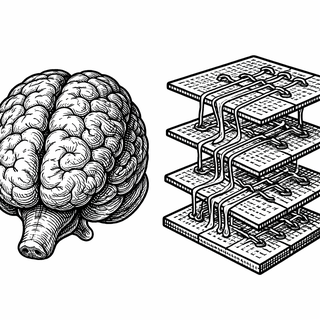
Here's the setup. Take porcine brain tissue, wash away every living cell through a process called decellularization, and you're left with the extracellular matrix - all the structural and chemical signals neurons crave, minus the actual neurons. Pour this into a gel, sandwich it between layers of flexible electrodes, seed it with neurons, and wait about three weeks. What grows is a multilayer, three-dimensional neural network where each layer can be independently monitored in real time. It's a brain layer cake with electronic frosting.
Why Pig Brains? (Besides Being Hilarious)
The choice of porcine brain tissue isn't random. Most 3D neural culture systems rely on Matrigel, a protein goop extracted from mouse tumors that costs a small fortune and varies wildly between batches. Pig brain extracellular matrix, on the other hand, is cheap, abundant (we're not running out of pork production anytime soon), and loaded with exactly the biochemical signals that mammalian neurons evolved to respond to - laminin, collagen, glycosaminoglycans, the whole crew.
Previous work established that decellularized brain matrix retains these growth-promoting molecules and supports everything from neurite extension to brain organoid formation (Simsa et al., 2021). But this team went further by showing their porcine-derived hydrogel works with both rat primary neurons and human iPSC-derived neurons, meaning the platform isn't limited to one species' cells.
The Electronics Part Is Equally Cool
Growing neurons in 3D is only half the battle. You also need to actually listen to them. Traditional rigid electrodes are about as compatible with soft brain tissue as a fork is with Jell-O - they damage cells, create inflammation, and can only sample from wherever you jammed them in.
The biochip uses flexible, multichannel electrode arrays that conform to each layer of the neural sandwich. This isn't a new idea in isolation - researchers have previously created stretchable mesh nanoelectronics that can integrate with brain organoids during development, recording single-cell activity for months without disrupting growth (Le Floch et al., 2022). The concept of "cyborg organoids," where electronics are embedded directly into growing neural tissue, has been gaining traction since Li and colleagues first demonstrated the approach (Li et al., 2019).
What's new here is the combination: brain-derived scaffolding plus flexible electronics plus independent layer monitoring. The team could apply chemical stimulation to one layer and watch the signal propagate through the entire 3D network, capturing synchronized bursting activity across all levels. That's not just neurons growing - that's neurons talking to each other across a three-dimensional architecture.
So What Does This Actually Mean?
Right now, drug companies testing neurological therapies mostly rely on two options: flat cell cultures that don't behave like real brains, or animal models that are expensive, ethically fraught, and often don't translate to humans. This biochip sits in the gap. It's a scalable, reproducible, three-dimensional brain model with built-in monitoring that could let researchers test how drugs affect neural network activity in something that actually resembles brain tissue.
The "electronic organoid" concept could prove particularly valuable for studying network-level brain diseases - epilepsy, where synchronized firing goes haywire, or neurodegenerative conditions where connectivity breaks down layer by layer. Having independent electronic access to each layer means you could track exactly where and when things go wrong.
And the sustainability angle is genuinely appealing. Turning slaughterhouse waste into high-value neuroscience tools is the kind of upcycling story that makes both environmentalists and grant committees smile.
The Caveats (Because Science)
This is still early-stage work. Three weeks of culture and a few electrode channels is a long way from replicating the brain's staggering complexity. The team demonstrated functional connectivity, but the networks are simple compared to even a tiny region of actual cortex. Scaling up - more layers, more electrodes, longer culture times - will reveal whether the platform holds up or whether the hydrogel degrades, the electrodes drift, or the neurons eventually throw in the towel.
Still, as proof-of-concept work goes, this is a strong entry. The researchers took cheap biological waste, turned it into a brain-mimicking scaffold, wired it up with flexible electronics, and got synchronized neural activity out the other end. Not bad for a Tuesday.
References
-
Liu, X., Dong, R., Hang, C., Lim, C. T., & Jiang, X. (2025). Brain Extracellular Matrix-Based Electronic Brain Biochip. ACS Nano. DOI: 10.1021/acsnano.5c21848. PMID: 41812179.
-
Le Floch, P., Li, Q., Lin, Z., et al. (2022). Stretchable Mesh Nanoelectronics for 3D Single-Cell Chronic Electrophysiology from Developing Brain Organoids. Advanced Materials, 34(11), 2106829. DOI: 10.1002/adma.202106829. PMID: 35014735.
-
Li, Q., Nan, K., Le Floch, P., et al. (2019). Cyborg Organoids: Implantation of Nanoelectronics via Organogenesis for Tissue-Wide Electrophysiology. Nano Letters, 19(8), 5781-5789. DOI: 10.1021/acs.nanolett.9b02512. PMID: 31347851.
-
Simsa, R., Rothenbücher, T., Gürbüz, H., et al. (2021). Brain organoid formation on decellularized porcine brain ECM hydrogels. PLOS ONE, 16(1), e0245685. DOI: 10.1371/journal.pone.0245685. PMID: 33507989.
-
McDonald, M., Bhargava, D., & Bhatt, D. (2022). Emerging Bioelectronics for Brain Organoid Electrophysiology. Journal of Molecular Biology, 434(3), 167165. DOI: 10.1016/j.jmb.2021.167165. PMCID: PMC8766612.
Disclaimer: The image accompanying this article is for illustrative purposes only and does not depict actual experimental results, data, or biological mechanisms.