
Pilocytic astrocytomas - the most common brain tumors in children - have been playing scientists for decades. These slow-growing masses behave perfectly well in a kid's brain but basically throw a tantrum and refuse to cooperate the moment you put them in a petri dish. It's like trying to study a panda by observing it in a parking lot. Not exactly its natural habitat.
A team at Washington University School of Medicine just solved this problem in the most creative way possible: they built tiny human brains in a dish and let the tumors move in.
Mini-Brains With Unwanted Tenants
Here's the setup. Enquan Xu, David Gutmann, and colleagues took patient-derived pilocytic astrocytoma (PA) samples and nested them inside human iPSC-cerebral organoids - essentially miniature brain-like structures grown from reprogrammed stem cells. They called these hybrid creations PANCOs, which stands for PA Nested within Cerebral Organoids. It sounds like a breakfast item, but it's actually a first-of-its-kind laboratory model that faithfully recreates how these tumors look and behave inside a real brain.
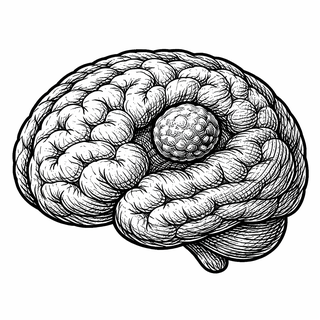
And that's a big deal. Previous attempts to grow PAs outside the body have been, frankly, disappointing. These tumors are the ultimate homebodies. They're deeply dependent on their local brain neighborhood - the neurons, the signaling molecules, the whole microscopic ecosystem. Strip that away and they just... stop being themselves. The PANCO model gives them back their neighborhood.
Neurons: The Tumor's Unwitting Accomplices
Now here's where things get weird. When the team introduced neural progenitor cells into their PANCOs, those cells preferentially matured into glutamatergic neurons - the type of nerve cell that communicates using glutamate, the brain's main excitatory chemical messenger. And those neurons didn't just sit there quietly. They actively boosted tumor cell proliferation.
Your neurons, it turns out, are accidentally cheerleading for the tumor.
This finding plugs into a rapidly exploding field called cancer neuroscience, which has been revealing that brain tumors aren't passive squatters - they're actively wired into neural circuits. Previous work has shown that high-grade gliomas form actual synaptic connections with neurons, using glutamate signaling to fuel their own growth (Venkataramani et al., 2019). But until now, nobody had shown this kind of neuron-driven growth dependency in low-grade pediatric tumors using a humanized model system.
Blocking the Signal, Shrinking the Tumor
The PANCO model also let the team test treatments in a realistic setting. First, the good news everyone expected: MEK inhibitors - drugs that target the ERK signaling pathway these tumors are known to rely on - successfully reduced proliferation. That confirms the model is behaving like a real PA, since ERK pathway dependence is a hallmark of these tumors.
But the really juicy finding? When they blocked glutamate receptors, the neuron-driven tumor growth boost disappeared. The neurons were still there, still firing, but the tumor could no longer eavesdrop on their chemical conversations.
A companion study from the same lab, published in Neuron, went further: drugs like memantine - already FDA-approved for Alzheimer's disease - reduced human pediatric brain tumor growth in mice (Anastasaki et al., 2025). The possibility of repurposing existing neurological drugs for pediatric brain cancer is, to use a technical term, extremely exciting.
Why This Matters Beyond the Lab Bench
Pilocytic astrocytomas account for roughly 15% of all pediatric brain tumors. While they're classified as "low-grade" and many kids do well after surgery, the story gets complicated fast. Tumors near the optic nerve or hypothalamus can't always be fully removed. Kids who need chemotherapy or radiation face long-term cognitive side effects. And despite decades of research, there still aren't great drug options that specifically target how these tumors actually grow inside a living brain.
The PANCO model cracks open two major doors. First, it gives researchers a realistic, human-relevant platform to screen drugs - no more relying on tumor cells that forgot how to be tumor cells the moment they left the brain. Second, it reveals a completely new therapeutic angle: targeting the conversation between neurons and tumors rather than just the tumor itself.
As David Gutmann put it: "The potential to repurpose drugs that are already in use for other neurological disorders means we may have another trick up our sleeves."
For the thousands of families dealing with pediatric brain tumors each year, another trick up the sleeve sounds pretty good.
References:
-
Xu, E., Zhang, C., Rodriguez, F. J., Dahiya, S., Anastasaki, C., & Gutmann, D. H. (2025). Nested pediatric low-grade glioma cerebral organoid avatars reveal glutamatergic neuron stromal growth dependency. Genes & Development. DOI: 10.1101/gad.353336.125 | PubMed
-
Anastasaki, C., et al. (2025). Aberrant coupling of glutamate and tyrosine kinase receptors enables neuronal control of brain-tumor growth. Neuron. DOI: 10.1016/j.neuron.2025.08.009 | PubMed
-
Venkataramani, V., et al. (2019). Glutamatergic synaptic input to glioma cells drives brain tumour progression. Nature, 573, 532-538. DOI: 10.1038/s41586-019-1564-x
-
Abdullah, K. G., et al. (2022). Establishment of patient-derived organoid models of lower-grade glioma. Neuro-Oncology, 24(4), 612-623. DOI: 10.1093/neuonc/noab273
-
Venkatesh, H. S., et al. (2019). Electrical and synaptic integration of glioma into neural circuits. Nature, 573, 539-545. DOI: 10.1038/s41586-019-1563-y
Disclaimer: The image accompanying this article is for illustrative purposes only and does not depict actual experimental results, data, or biological mechanisms.