
Welcome to the brain's version of a Friday night call center, where the prefrontal cortex (PFC) and the locus coeruleus (LC) are constantly chit-chatting about the latest cognitive dilemmas and mood swings. In our latest episode, starring the ever-mysterious endocannabinoids, we unravel how this dynamic duo is mastered by some slick, lipid-based moderators, keeping the whole operation smooth and efficient.
The Brain's Gossip Line: PFC and LC
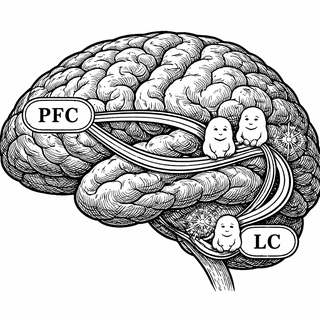
First, let me introduce you to the characters: the PFC, your brain's front office, is the decision-maker, the planner, and, let's face it, a bit of a control freak. Meanwhile, the LC is like a caffeine shot for your neurons, doling out norepinephrine to keep the whole system awake and alert. Together, they form a bidirectional circuit that's crucial for you not to fall asleep during that really long, boring meeting.
Endocannabinoids: The Brain's Pacifiers
Now, here's where the plot thickens. Endocannabinoids (eCBs) stroll into the scene like the chill, yoga-practicing peacekeepers they are. When the PFC gets a bit too bossy, sending loads of signals down to the LC, eCBs step in to say, "Whoa, let's take it down a notch, folks." By mobilizing eCBs, the brain cleverly tones down the PFC-to-LC signal relay, thus controlling the release of norepinephrine back to the PFC. It's like the brain's way of stopping a hyperactive group chat from spiraling out of control.
Why Should You Care? Because It's Your Brain's DJ!
Imagine your brain as a dance floor at a club. The endocannabinoids are the DJ, skillfully adjusting the tempo so nobody gets too hyped up or too chilled out. This modulation ensures you're not just alert, but appropriately alert, differentiating between the sound of an incoming email and, say, a fire alarm.
Real-World Impact: More Than Just Neuroscience Jazz
Assuming these findings hold up in humans, this could mean new ways to manage disorders where norepinephrine goes rogue, such as ADHD or PTSD. Imagine if we could fine-tune how the brain responds to stress or stimuli, not with heavy medications, but with the brain's own internal rhythms. Now that's an encore worth waiting for!
The Challenges: The Brain's Tough Crowd
Is everything perfect? Not exactly. The brain, much like a cat, doesn't always do what you want it to. The challenge lies in understanding how these systems work in various contexts and how they can be influenced without throwing the whole thing out of whack. It's the neuroscientific equivalent of spinning plates while riding a unicycle on a tightrope.
In conclusion, this research not only sheds light on how our brains manage to multi-task but also opens new doors (or synapses, if you will) to potential therapeutic approaches. So, next time your brain feels like it's juggling too much, remember—there might just be a tiny endocannabinoid whispering, "Chill, I've got this."
References
- Locarno, A., Nava, L., Barsotti, N., et al. (2026). Endocannabinoid modulation of a reciprocal fronto-coerulear connection in contextual discrimination. Cell Reports. DOI: 10.1016/j.celrep.2026.117141
Disclaimer: The image accompanying this article is for illustrative purposes only and does not depict actual experimental results, data, or biological mechanisms.
```