
Here's something neuroscientists have believed for decades: each neuron has a fixed job. It sees a thing, it fires a certain way, end of story. A face cell sees faces. A line cell sees lines. Everyone stays in their lane. Tidy, elegant, beautifully simple.
Turns out, that's wrong. Or at least, way too simple.
A team led by Yuelin Shi and Doris Tsao just published a study in Nature showing that the same neurons in your brain's face-processing region pull off a costume change in under 20 milliseconds - switching from one neural code to a completely different one, right in the middle of looking at a face. That's faster than a hummingbird's wingbeat. These cells aren't just multitasking. They're shapeshifting.
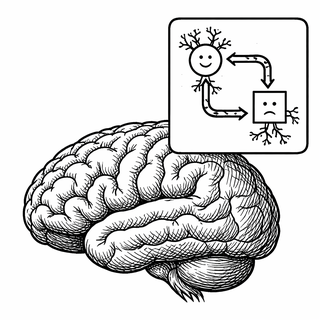
First: "Is That a Face?" Then: "Whose Face Is It?"
The team recorded from face-selective neurons in the inferotemporal cortex of macaque monkeys - a brain region that's been the go-to spot for studying how primates (including us) process faces since Tsao's lab first mapped these "face patches" back in 2006 (Tsao et al., 2006).
What they found was wild. When a face first appears, the neurons fire using a general-purpose code. Think of it like a security guard scanning a crowd: "Face? Face? Not a face. Face." The neurons are optimized for detection - figuring out whether what they're looking at is a face at all, using the same coding scheme they'd use for any object.
Then, roughly 20 milliseconds later, the entire population of neurons flips. Not gradually. Not one cell at a time. The whole group executes a rapid, coordinated switch to a completely different code - one that's face-specific and optimized for discrimination. Now the question isn't "is that a face?" but "is that Steve or Janet?" Response gradients reverse direction. New tuning dimensions pop up to handle the fine-grained differences between individual faces.
It's like watching an orchestra suddenly, seamlessly pivot from playing jazz to classical in the middle of a song - with every musician switching at exactly the same moment.
Why This Matters (and Why Neuroscientists Are Losing Their Minds)
This finding crashes straight into one of the biggest debates in visual neuroscience. In 2017, Tsao's own lab showed that face cells use a beautifully simple axis code, where each neuron's firing rate maps to a single dimension of "face space" (Chang & Tsao, 2017). Then in 2023, a Harvard team published a provocative paper arguing that the neural code for "face cells" isn't actually face-specific at all - that these neurons respond to non-face objects in ways that predict their face selectivity, suggesting a domain-general mechanism (Vinken et al., 2023).
So who's right? Plot twist: both of them, depending on when you look.
The early response window is genuinely domain-general - face cells are using the same code they'd use for coffee mugs or bananas. But the late response window? Totally face-specific. The code switch only happens for faces. Show these neurons a chair, and they just... keep doing the same thing. No costume change. No secret second act. Chairs don't get the VIP treatment.
Your Brain Is a Temporal Multiplexer (Yes, That's as Cool as It Sounds)
This isn't the first time Tsao's lab has caught neurons doing double duty on different timescales. In 2024, they showed that the same IT cortex neurons multiplex perception and memory codes - encoding what you're seeing right now and what you remember from the past using different coding axes at different time points (She et al., 2024).
The picture that's emerging is that your brain doesn't waste neural real estate by assigning one job per cell. Instead, it squeezes multiple computations out of the same neural population by time-sharing - switching between codes so quickly that different functions can operate within the same hardware, separated only by tens of milliseconds.
If your brain were a computer, this would be like the CPU running two completely different programs on the same core, switching between them in 20 milliseconds flat - except no operating system engineer on Earth has figured out how to do that this cleanly.
What's Next?
The big open question: does this happen everywhere, or is it special to face processing? The researchers found the switch was face-specific in face patches, but other brain regions handling other categories might have their own versions of this trick. If concerted code switching turns out to be a general mechanism, it would fundamentally change how we think about neural computation - from "each cell has a job" to "each cell has a schedule."
Your neurons aren't the reliable nine-to-fivers we thought they were. They're pulling double shifts, switching roles mid-task, and doing it all faster than you can snap your fingers. Honestly? Kind of relatable.
References
-
Shi Y, Bi D, Hesse JK, Lanfranchi FF, Chen S, Tsao DY. Rapid concerted switching of the neural code in the inferotemporal cortex. Nature. 2026. DOI: 10.1038/s41586-026-10267-3
-
She L, Benna MK, Shi Y, Fusi S, Tsao DY. Temporal multiplexing of perception and memory codes in IT cortex. Nature. 2024;629:861-868. DOI: 10.1038/s41586-024-07349-5. PMCID: PMC11111405
-
Vinken K, Prince JS, Konkle T, Livingstone MS. The neural code for "face cells" is not face-specific. Science Advances. 2023;9(35):eadg1736. DOI: 10.1126/sciadv.adg1736. PMCID: PMC10468123
-
Chang L, Tsao DY. The code for facial identity in the primate brain. Cell. 2017;169(6):1013-1028.e14. DOI: 10.1016/j.cell.2017.05.011
-
Tsao DY, Freiwald WA, Tootell RBH, Livingstone MS. A cortical region consisting entirely of face-selective cells. Science. 2006;311(5761):670-674. DOI: 10.1126/science.1119983
Disclaimer: The image accompanying this article is for illustrative purposes only and does not depict actual experimental results, data, or biological mechanisms.