
If you've ever walked into a meeting and instantly clocked who's allied with whom, who's on thin ice with the boss, and who's probably looking for a new job, congratulations: you're doing what primate brains evolved to do. Maintaining and updating social knowledge is one of the most cognitively demanding things we do, and a review in Neuroscience & Biobehavioral Reviews argues that this pressure shaped the evolution of communication itself.
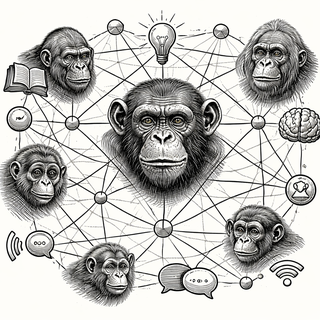
Your ability to track workplace drama? That might be the reason you can speak.
Your Brain Is Running a Social Simulation 24/7
Primates are social animals, and social living requires keeping track of a lot of information. Who's dominant? Who's friends with whom? Who can be trusted to share food? Who holds grudges? Who's sleeping with whom (relevant for different reasons depending on the species)?
This isn't just gossip for its own sake. This information enables predictions. If you know that Alpha is friendly with Beta but hostile toward Gamma, you can predict how a three-way interaction will go. If you know that Delta tends to remember slights for weeks, you'll behave differently around Delta after a conflict.
Primates who track this stuff accurately do better. They find allies, avoid conflicts, access resources, and navigate the complex web of relationships that determines who thrives and who gets pushed to the margins.
The mental machinery for doing this is what we might call social knowledge, an internal model of your social world that represents relationships, histories, and likely future behaviors.
The Problem: Social Knowledge Goes Stale
Here's the catch: social relationships aren't static. Alliances shift. Yesterday's friend is today's rival. Someone who was reliable last month has become unreliable due to stress, injury, or new competing relationships.
This means social knowledge needs constant updating. You can't just build a model once and run it forever. You have to continuously incorporate new information, revise your predictions, and adjust your behavior accordingly.
And updating is cognitively expensive. It requires attention, working memory, and the ability to override previous learning when circumstances change. When you're stressed, hungry, or tired, these resources are limited. The very situations where accurate social knowledge matters most (conflict, competition, scarcity) are also the situations where your ability to update that knowledge is compromised.
This creates a genuine dilemma. How do you maintain accurate social models when the cognitive resources for updating are scarce precisely when you need them most?
Maybe Communication Evolved to Help
The review proposes an interesting answer: complex communication may have evolved partly to facilitate social knowledge updating.
Think about what primate signals do. Vocalizations, facial expressions, and gestures often convey information about social relationships. A greeting call signals friendly intent. A threat display clarifies dominance relationships. Grooming vocalizations indicate the state of a partnership.
These signals don't just communicate immediate needs. They update the social models of everyone watching. When Alpha visibly grooms Beta, every other group member gets information about that relationship. They can update their social knowledge without having to directly interact with Alpha and Beta.
From this perspective, communication is partly a distributed social knowledge maintenance system. Instead of every individual needing to independently track every relationship through direct observation, signals share the load. Information flows through the network, and social models stay more accurate with less individual cognitive effort.
Human Language: Social Updates on Steroids
If this framework is right, human language represents a massive elaboration of these primate communication systems. We're not just signaling relationship states through grooming calls. We're explicitly describing relationships, narrating past events, predicting future behaviors, and discussing third parties in their absence.
In other words: gossip.
Gossip gets a bad reputation, but from an evolutionary perspective, it's doing exactly what social communication is supposed to do. It updates social knowledge across the network. When you hear that Dave from accounting was rude to Sarah, you update your model of Dave. You didn't have to witness the interaction. The information propagated through the communication network.
Language lets us share social knowledge at unprecedented scale and detail. We can describe complex relationship structures, communicate about people who aren't present, and even discuss hypothetical future scenarios. It's social knowledge maintenance technology.
Why This Matters for Understanding Human Minds
If social cognition and communication co-evolved in this way, it has implications for how we understand both abilities.
Social cognition disorders might be partly communication disorders. If you can't properly interpret social signals, your social knowledge doesn't update correctly, and your behavior becomes misaligned with social reality.
Conversely, communication disorders might be partly social cognition disorders. If you can't model what others know and need to know, your communication becomes ineffective.
This could help explain why social and communicative difficulties so often travel together in conditions like autism spectrum disorders. The underlying issue might be a connected system, not two separate capacities that happen to both be affected.
The Stress Connection
The review particularly emphasizes what happens under stress. Stress impairs the cognitive resources needed for updating social knowledge. This creates a vulnerability: during challenging periods, your social models become less accurate precisely when accurate models matter most.
This might explain some patterns in human behavior. Under chronic stress, people often become more rigid in their social judgments, more likely to rely on stereotypes, and less responsive to new information about individuals. Their social knowledge updating system is running on fumes.
It also suggests that social support might be more than just emotional comfort. Having communicative partners who share social information might literally maintain your social model when you can't update it yourself. They're outsourcing part of the cognitive load.
Looking at Primates to Understand Ourselves
The evolutionary perspective offers something valuable: it places human abilities in context. We didn't spring into existence with fully formed language and social cognition. These capacities evolved from primate precursors, shaped by the same pressures.
Understanding how other primates handle social complexity, how they communicate, how they update knowledge, how they cope with stress, provides a baseline for understanding what's unique about humans and what's shared across primate evolution.
It's also a reminder that the seemingly frivolous aspects of human social life, the gossip, the small talk, the constant discussion of who did what to whom, might be serving a function that goes back millions of years.
You're not wasting time talking about other people. You're running essential maintenance on the social simulation that keeps you alive in a complex social world. The apes would understand.
Reference: Bhattacharyya S, et al. (2025). Updating social knowledge under stress: Communicative complexity and the evolution of primate social cognition. Neuroscience & Biobehavioral Reviews. doi: 10.1016/j.neubiorev.2025.106125 | PMID: 41125215
Disclaimer: The image accompanying this article is for illustrative purposes only and does not depict actual experimental results, data, or biological mechanisms.