
Picture this: you're scrolling through photos and suddenly spot your friend's face in a crowd shot. Your brain didn't just see a face - it identified whose face. And the wild part? Your neurons pulled off a complete costume change in the time it takes a hummingbird to flap its wings once.
New research from Doris Tsao's lab at UC Berkeley has caught neurons doing something nobody expected: rapidly switching their entire coding strategy mid-thought. It's like discovering your calculator can suddenly become a piano, then switch back, all while you're still doing math.
The Textbook Got It Wrong
Here's what neuroscience textbooks have told us for decades: neurons have "tuning functions" - basically their personal preferences for what makes them fire. A neuron tuned to vertical lines stays tuned to vertical lines. A face-detecting neuron detects faces the same way every time. Stable. Predictable. Boring.
Turns out, that's only half the story.
Yuelin Shi, Dasheng Bi, and colleagues stuck electrodes into the inferotemporal cortex of macaque monkeys - that's the brain region responsible for recognizing objects and, crucially, faces. What they found upends a fundamental assumption about how neurons work (Shi et al., 2026).
Two Brains for the Price of One
When a face appears in view, the monkey's face-patch neurons initially fire up using what the researchers call a "general code" - optimized for answering one simple question: Is that a face? Think of it as your brain's bouncer, checking IDs at the door.
But then - and this is the bonkers part - within less than 20 milliseconds, the same neurons completely flip their coding strategy. The features that made them fire strongly now make them fire weakly, and vice versa. New dimensions of information pop online. Suddenly they're not just asking "is this a face?" but "whose face is this?"
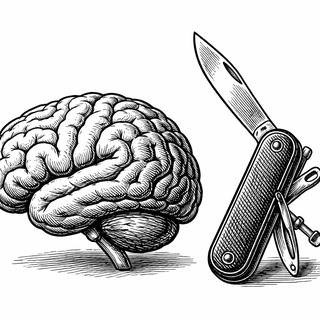
It's like watching a Swiss Army knife unfold in slow motion, except it happens faster than you can blink.
Why Your Brain Bothered Evolving This
From an engineering standpoint, this is elegant problem-solving. Face detection and face identification are fundamentally different computational problems. Detection needs to be fast and categorical - friend or foe, face or not-face. Identification requires nuance, comparing subtle differences across dozens of facial dimensions.
Previous theories suggested the brain handled this with separate neural populations: some neurons for detection, others for identification. But Tsao's team found that the same neurons do both jobs - they just rapidly switch uniforms between tasks.
This "temporal multiplexing" (fancy term for taking turns really fast) lets the brain squeeze two functions out of one neural population. It's like having employees who are morning cashiers and afternoon accountants, except the shift change happens 50 times per second.
The Bigger Picture
This finding didn't emerge from nowhere. Tsao won the 2024 Kavli Prize in Neuroscience for her pioneering work on face patches - six distinct brain regions in primates dedicated to face processing (The Kavli Prize, 2024). Her earlier work showed these patches contain neurons almost exclusively devoted to faces, and in 2017 her team demonstrated they could actually reconstruct faces by reading neural activity - effectively pulling images out of a monkey's brain.
But even Tsao didn't see this coming. The current study reveals that face-patch neurons aren't just selective for faces; they're dynamically reconfigurable, adopting entirely different computational strategies depending on what the brain needs moment-to-moment.
What This Means for Understanding the Brain
The inferotemporal cortex has long been considered the final stage of the ventral visual pathway - where raw visual signals finally become meaningful object representations (Conway, 2018). Understanding how this region encodes faces has implications beyond recognizing your relatives at Thanksgiving.
Face recognition is remarkably fast - your brain starts decoding age and gender within 60-70 milliseconds of seeing a face, with identity processing beginning around 90 milliseconds (MIT News, 2019). The new findings help explain how your brain accomplishes this multi-stage processing without needing separate hardware for each step.
More broadly, if neurons can switch their fundamental coding strategies this rapidly, it suggests the brain's representational capacity is far more flexible than we assumed. The same neural circuits might serve radically different functions depending on context and timing - a possibility that could reshape how we think about everything from perception to memory to decision-making.
The Bottom Line
Your neurons aren't the reliable, single-purpose workers we thought they were. They're more like actors who can perform multiple roles in rapid succession, switching characters faster than you can follow the plot. And somewhere in your inferotemporal cortex right now, face-patch neurons are flipping between detection and identification modes dozens of times per second, helping you navigate a world full of faces.
The brain, it turns out, loves a good plot twist.
References:
-
Shi, Y., Bi, D., Hesse, J. K., Lanfranchi, F. F., Chen, S., & Tsao, D. Y. (2026). Rapid concerted switching of the neural code in the inferotemporal cortex. Nature. https://doi.org/10.1038/s41586-026-10267-3 | PMID: 41882367
-
Conway, B. R. (2018). The organization and operation of inferior temporal cortex. Annual Review of Vision Science, 4, 381-402. PMC6404234
-
Chang, L., & Tsao, D. Y. (2017). The code for facial identity in the primate brain. Cell, 169(6), 1013-1028. https://doi.org/10.1016/j.cell.2017.05.011
-
Dobs, K., et al. (2019). How face perception unfolds over time. MIT News. https://news.mit.edu/2019/human-brain-face-recognition-0322
-
The Kavli Prize. (2024). Doris Tsao - Kavli Prize Laureate in Neuroscience. https://www.kavliprize.org/bio/doris-tsao
Disclaimer: The image accompanying this article is for illustrative purposes only and does not depict actual experimental results, data, or biological mechanisms.