
Ever wonder what actually happens when an anesthesiologist says "count backwards from ten" and you wake up mid-sentence saying "...seven" four hours later? Turns out, scientists have been wondering the same thing. And they just figured out something wild: three completely different anesthesia drugs - ones that shouldn't have anything in common - all knock you out by doing the exact same thing to your brain.
The Brain's Balancing Act (That Anesthesia Totally Ruins)
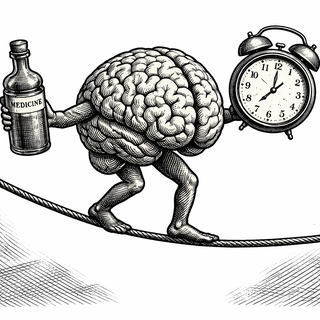
Here's the thing about your conscious brain: it's basically a tightrope walker with a caffeine addiction. Neurons need to be excitable enough to talk to each other and pass information around, but not so excitable that everything descends into chaos. Earl Miller, a neuroscientist at MIT, puts it perfectly: your nervous system operates "on a knife's edge" between being responsive and going completely haywire.
Think of it like a party. Too quiet and nothing happens - nobody's mingling, no connections are made. Too rowdy and, well, someone's definitely breaking a lamp. Your awake brain keeps things at exactly the right energy level. Anesthesia? It kicks down the door and unplugs the speakers.
Three Drugs Walk Into a Brain...
Researchers at MIT studied three popular anesthesia drugs: propofol (the "milk of amnesia" you might've gotten for a colonoscopy), ketamine (yes, that ketamine), and dexmedetomidine (the one nobody can pronounce on the first try). These drugs have about as much in common as coffee, wine, and energy drinks - they hit completely different targets in the brain.
Propofol buddies up to GABA receptors, basically telling neurons to chill out. Ketamine blocks NMDA receptors, which are usually involved in learning and memory. Dexmedetomidine messes with norepinephrine, the brain's version of a wake-up alarm.
Different molecular mechanisms. Different receptor targets. Same result: lights out.
The Plot Twist Nobody Saw Coming
Here's where it gets interesting. MIT graduate student Adam Eisen and his colleagues developed a clever method to measure something called "dynamic stability" - essentially, how quickly your brain bounces back after something grabs its attention, like a sound.
When they looked at brain recordings from animals receiving each drug, they found something remarkable: all three anesthetics produced identical destabilization patterns. The brain's ability to recover from perturbations slowed down the same way, regardless of which drug was on board.
"All three of these drugs appear to do the exact same thing," Miller reported. "In fact, you could look at the destabilization measure we use, and you can't tell which drug is being applied."
It's like discovering that coffee, tea, and energy drinks all wake you up by flipping the same hidden switch - even though they contain completely different ingredients.
Why Your Brain Gets Slow and Sleepy
The researchers noticed something else: when the brain becomes destabilized, neural activity shifts dramatically toward low frequencies. Those neurons that normally fire 7-10 times per second during wakefulness? Under anesthesia, they're down to about once per second. Your brain essentially enters a "down state" where it can still technically respond to stimuli - it just takes forever to process anything and get back to baseline.
This explains why anesthesia isn't just sleep. Sleep has cycles, stages, dreams. Anesthesia is more like someone turned the processing speed dial way down and then yanked out the dial entirely.
The Practical Payoff
Beyond satisfying scientific curiosity about why you can't remember that procedure, this research has real clinical implications. The team is developing a monitoring device that could measure brain stability in real-time during surgery, automatically adjusting drug doses to keep patients at just the right level of unconsciousness.
This matters because going too deep under anesthesia carries risks - especially for older adults and people with conditions like dementia. A "universal biomarker" of anesthetic depth, independent of which specific drug is used, could make surgery safer for millions of vulnerable patients.
As Miller noted, if you can limit unnecessary exposure to anesthesia, "you can reduce risks across the board."
The Bottom Line
Three drugs. Three completely different mechanisms. One shared outcome: your brain loses its ability to maintain the delicate balance required for consciousness. It's a beautiful example of how complex systems can arrive at the same destination via wildly different routes - and how understanding that destination might matter more than memorizing every path.
Next time you go under, you can rest assured (literally) that science is getting closer to understanding exactly what's happening while you're taking the world's most chemically-induced nap.
References
-
Eisen AJ, Bardon AG, Ballesteros JJ, et al. Similar destabilization of neural dynamics under different general anesthetics. Cell Reports. 2026. DOI: 10.1016/j.celrep.2026.117048
-
MIT News. Three anesthesia drugs all have the same effect in the brain, MIT researchers find. March 17, 2026. Available at: https://news.mit.edu/2026/three-anesthesia-drugs-all-have-same-effect-brain-0317
-
Purdon PL, Sampson A, Pavone KJ, Brown EN. Clinical electroencephalography for anesthesiologists: Part I: Background and basic signatures. Anesthesiology. 2015;123(4):937-960. PMCID: PMC4573341
-
Mashour GA, Hudetz AG. Neural correlates of unconsciousness in large-scale brain networks. Trends in Neurosciences. 2018;41(3):150-160. PMCID: PMC5826863
-
Brown EN, Lydic R, Schiff ND. General anesthesia, sleep, and coma. New England Journal of Medicine. 2010;363(27):2638-2650. PMCID: PMC3162622
Disclaimer: The image accompanying this article is for illustrative purposes only and does not depict actual experimental results, data, or biological mechanisms.