
Turns out your brain has a midlife crisis too, except it's been quietly planning this since before you were born.
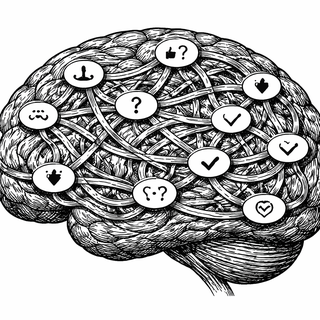
Scientists have finally mapped how the brain's internal communication network - that tangled mess of neurons gossiping with each other - changes from the womb all the way to your eighties. And the findings? Let's just say your brain's best years might already be in the rearview mirror.
What's a Connectome, Anyway?
Think of your brain as the world's most chaotic group chat. Different regions are constantly pinging each other, coordinating everything from moving your fingers to contemplating the meaning of life. The "functional connectome" is basically the map of who's talking to whom and how intensely.
A massive new study pulled together brain scan data from over 33,000 people across 132 research sites worldwide. Ages ranged from 32 weeks after conception (yes, they scanned fetuses) to 80 years old. The result? The most detailed timeline we've ever had of how your brain's social network evolves.
The Peak Performance Window
Here's where it gets interesting. Your brain's connectivity strength - the intensity of those region-to-region conversations - peaks in your late thirties. Meanwhile, the variety of those connections maxes out a bit earlier, around your late twenties to early thirties.
So if you're in your mid-thirties feeling like you're at the top of your game, congratulations - your brain hardware agrees. If you're older, well, your neurons had a good run.
But before you spiral into existential dread, there's nuance here. Different brain systems hit their stride at different times, like runners in a relay race handing off batons at various checkpoints.
The Sensorimotor Express vs. The Association Slow Train
Your sensorimotor regions - the parts handling basic stuff like touch and movement - mature early and stabilize quickly. These are the reliable employees who show up to work on time every day.
The higher-order association regions, though? These late bloomers handle the fancy cognitive stuff: abstract thinking, social cognition, executive control. They keep developing well into adulthood, which explains why teenagers make questionable decisions. Their brain's management team is still getting trained.
The tradeoff: those late-maturing regions are also the first to show wear and tear as you age. The parts of your brain that took longest to set up are apparently the flimsiest.
Why This Matters Beyond Academic Curiosity
This isn't just neuroscientists nerding out over pretty brain maps. Having a detailed "normal" baseline for brain development opens doors for spotting when things go sideways.
Autism spectrum disorder, major depression, Alzheimer's - these conditions show distinct patterns when compared against the typical connectivity trajectory. The researchers found substantial individual differences in brain networks among patients with these conditions, variations that wouldn't be visible without knowing what "normal" looks like at every age.
Think of it like growth charts at the pediatrician's office, but for your brain's wiring. If doctors know where you should be on the connectivity curve, they can catch early warning signs when you start deviating.
The Gradient of Growing Up
Perhaps the coolest finding: brain development follows a predictable spatial pattern. It rolls out from the sensorimotor cortices (basic functions) toward what scientists call "transmodal" regions (complex thinking). It's like your brain is building a house - foundation first, fancy interior design last.
This sensorimotor-to-association gradient also governs how the brain declines. The regions that developed last tend to be the most vulnerable to aging. Your brain is basically dismantling the additions before it touches the original structure.
What Now?
The atlas these researchers created will serve as a reference for years of future studies. It's the kind of foundational work that doesn't grab headlines but quietly makes everything else possible.
For the rest of us, it's a reminder that your brain is less a static organ and more a constantly shifting landscape - one that peaks, plateaus, and gradually reorganizes whether you want it to or not.
At least now we know the timeline.
References
-
Bethlehem, R.A.I. & Margulies, D.S. (2026). Charting the human brain's lifelong functional organization. Nature. DOI: 10.1038/d41586-026-00637-2 | PMID: 41882080
-
Sun, L., Zhao, T., Liang, X. et al. (2025). Human lifespan changes in the brain's functional connectome. Nature Neuroscience, 28, 891-901. DOI: 10.1038/s41593-025-01907-4 | PMID: 40181189
-
Bethlehem, R.A.I., Seidlitz, J. et al. (2022). Brain charts for the human lifespan. Nature, 604, 525-533. DOI: 10.1038/s41586-022-04554-y | PMID: 35388223
-
Margulies, D.S. et al. (2016). Situating the default-mode network along a principal gradient of macroscale cortical organization. Proceedings of the National Academy of Sciences, 113(44), 12574-12579. DOI: 10.1073/pnas.1608282113
Disclaimer: The image accompanying this article is for illustrative purposes only and does not depict actual experimental results, data, or biological mechanisms.