
So, here's a plot twist you didn't see coming: Your brain's aging process, or senescence, might be playing a significant role in autism spectrum disorder (ASD). That’s right, the brain is like a Netflix series with unexpected plotlines. Today, we're diving into a study that looks at how aging brain cells could be throwing their own rogue party, impacting ASD development. Grab a drink; it's going to get interesting!
The Mystery Unveiled: Aging Cells and ASD
Autism spectrum disorder is like the brain's own spin-off series, featuring a diverse cast of symptoms and challenges. While the cause of ASD remains a mystery worthy of its own true-crime series, recent research has been poking around in the genetic soup of brains with ASD. This study, led by Wei Zhang and his team, took a closer look at how senescence—essentially the cells' way of saying, "I'm too old for this"—might be influencing ASD in mice exposed to maternal immune activation (MIA). Researchers have a knack for finding drama in the microcosm of cellular life, don't they?
Senescence: The Brain's Overlooked Drama Queen
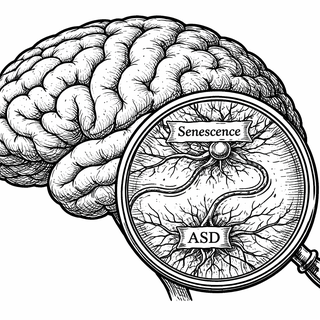
Picture this: Neurons are tiny gossip networks, always communicating and keeping things running smoothly. But when senescence kicks in, certain brain cells start acting like they've been watching too many soap operas. They latch onto the APP-CD74 pathway and recruit IGFBP7 and CDKN1A as their partners in crime, stirring up trouble in the neighborhood—kind of like a love triangle, but less romantic and more, well, pathological.
MIA and the ASD Connection
Now, you might wonder, "What in the world is maternal immune activation?" Well, imagine your mom becoming a superhero in the immune system world while you're still a developing fetus. Sounds cool, except when that superhero action leads to changes in how your brain develops. MIA is like those plot devices that set off a chain of events leading to ASD-like symptoms in offspring. Who knew prenatal life was such a soap opera?
What's Truly Groundbreaking? A Potential Plot Resolution!
Here's where things get juicy: The study found that blocking those senescence-associated troublemakers—IGFBP7 and CDKN1A—could actually prevent ASD-like behaviors in the mice. It's like casting the perfect actor to resolve a twisted plotline. Imagine if these findings can be replicated and expanded in humans! It could lead to interventions that might just change the game for ASD treatment.
Real-World Impact and Challenges
Sure, all of this sounds like scientific magic, but there are real-world implications here. If the findings hold up, we could be looking at new ways to treat or prevent ASD, bringing a glimmer of hope to many families. However, like any good mystery, there are challenges. The complexity of human genetics, ethical considerations, and the need for extensive clinical trials make this an ongoing saga. But hey, every good show knows how to keep you on the edge of your seat, right?
Wrapping It Up with a Bow
So there you have it: A snapshot of how your brain's aging cells might be causing more drama than you thought possible. While this study gives us a tantalizing new piece of the puzzle, there's still much to explore. In the meantime, remember that your brain's neurons are just trying to keep their act together, one synaptic text message at a time.
References
- Zhang, W., Chen, K., Ke, Y., Yan, D., Lin, Z., Chen, L., Gao, Z., Shen, Y., Wan, H., Yang, X., Hu, C., Chen, R., Ma, X., & Zhang, S. (2026). Spatial and single-cell transcriptomics reveals senescence-associated changes in MIA-induced ASD male mouse brain. Cell Reports. https://doi.org/10.1016/j.celrep.2026.117191
Disclaimer: The image accompanying this article is for illustrative purposes only and does not depict actual experimental results, data, or biological mechanisms.
```