
A massive 79-author roadmap just laid out how we can stop feeding AI like a competitive eater and start building computers that think more like, well, you.
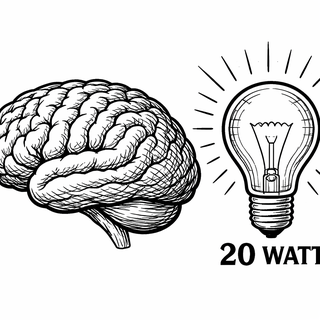
Here's a fun party fact: your brain handles everything from recognizing your ex across a crowded bar to solving calculus problems, all on roughly 20 watts. That's the same juice as a couple of LED bulbs. Meanwhile, training a single large AI model can guzzle enough electricity to power a small town for a year. Modern AI chips draw 700 to 1,200 watts per processor, and global data center electricity consumption is projected to hit 945 terawatt-hours by 2030 - double what it is today (IEA, 2025).
Something's clearly wrong with this picture. And a massive new roadmap paper in ACS Nano, featuring 79 authors from institutions worldwide, thinks the fix has been sitting between your ears all along.
The Problem: Your Computer Has a Traffic Jam
Traditional computers follow what's called the von Neumann architecture - a design from the 1940s where the processor and memory live in separate neighborhoods and spend most of their time shuttling data back and forth like an overworked courier service. This "von Neumann bottleneck" means the bulk of energy in AI systems isn't spent on actual thinking - it's spent on moving information around (Ivanov et al., 2022).
Your brain doesn't do this. Neurons process and store information in the same spot. They fire only when they have something worth saying (unlike your group chat). And they work in parallel - billions of operations happening simultaneously rather than single-file. It's the difference between a highway and a one-lane country road.
Building Brains From Scratch
The Wang et al. roadmap breaks bioinspired computing hardware into three big challenges: the devices themselves (artificial synapses and neurons), the architectures (how you wire them together), and actual working prototypes.
On the device side, researchers are building tiny components that behave like biological synapses - the junctions where neurons pass signals to each other. Memristors, for example, are resistors with memory. Their resistance changes based on what's happened to them before, which is eerily similar to how your synapses strengthen or weaken through experience. That's basically learning, at the hardware level (Jin et al., 2025).
Then there are artificial neurons. A team at USC recently built neurons using diffusive memristors that physically replicate the electrochemical behavior of real brain cells - substituting silver ions for the sodium and potassium your neurons use. Unlike conventional neural networks that simulate brain activity mathematically, these things actually embody it. And they shrink the footprint from tens of transistors down to one (Yang et al., 2025).
Not Just Theory: Chips That Already Exist
This isn't all bench-top dreaming. Intel's Loihi 2 chip simulates a million neurons on-chip with on-device learning. IBM's NorthPole ran image recognition tasks 22 times faster than GPUs while using 25 times less energy. And research labs worldwide are building photonic neuromorphic chips - that's brain-inspired computing using light instead of electricity, which is about as sci-fi as it sounds (Ivanov et al., 2022).
The roadmap also highlights retinomorphic devices - hardware that mimics how your retina processes visual information before it even reaches the brain. Instead of capturing a full image and then analyzing it (the camera approach), these sensors process on the spot, sending only the important bits upstream. Your eyeballs have been doing edge computing since before edge computing was cool.
Why This Matters (Beyond Cool Science)
The AI industry's electricity appetite is on track to match medium-sized countries. U.S. data centers alone consumed 183 terawatt-hours in 2024 and are projected to hit 426 TWh by 2030. If we want AI that can run on a drone, a wearable medical device, or a remote sensor rather than a warehouse-sized server farm, we need hardware that sips power instead of chugging it.
What makes this roadmap different from a typical review paper is its sheer breadth - 79 experts across materials science, neuroscience, computer science, and mathematics collectively mapping the path from individual devices to complete computing systems. It's less "here's a cool thing we built" and more "here's how the whole field gets from A to Z."
The brain took evolution a few hundred million years to optimize. With the right roadmap, we might not need quite that long.
References:
-
Wang, S., Li, Z., Pei, M., et al. (2026). Technology Roadmap of Bioinspired Computing Hardware. ACS Nano, 20(10), 8102-8163. DOI: 10.1021/acsnano.5c17087. PMID: 41771048
-
Ivanov, D., Chezhegov, A., Kiselev, M., Grunin, A., & Larionov, D. (2022). Neuromorphic artificial intelligence systems. Frontiers in Neuroscience, 16, 959626. DOI: 10.3389/fnins.2022.959626. PMCID: PMC9516108
-
Jin, B., Wang, Z., Wang, T., & Meng, J. (2025). Memristor-Based Artificial Neural Networks for Hardware Neuromorphic Computing. Research, 8, 0758. DOI: 10.34133/research.0758. PMCID: PMC12231232
-
Yang, J. et al. (2025). Artificial neurons replicate biological function for improved computer chips. Nature Electronics. DOI: 10.1038/s41928-025-01318-0
Disclaimer: The image accompanying this article is for illustrative purposes only and does not depict actual experimental results, data, or biological mechanisms.