
You know how some people insist their foods can't touch on the plate? Turns out your visual cortex is the same way - except about information.
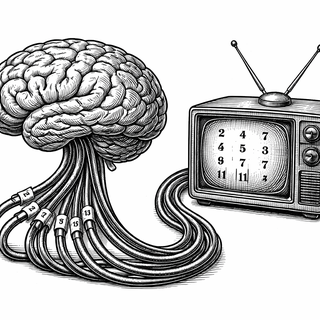
Scientists just discovered that when your brain processes what you see, it keeps different types of visual information in completely separate channels. No mixing. No blending. Like a TV subscription service with 60 distinct channels, except each channel is dedicated to a specific visual feature, and they all broadcast independently to multiple brain regions at once.
The Great Brain Cable Network
Here's what researchers at the University of California, Santa Barbara found when they peeked into mouse brains (as one does): the primary visual cortex (V1) and the higher visual areas (HVAs) that it connects to don't scramble their signals together like a fruit smoothie. Instead, they maintain what scientists call "discrete channels" - separate streams of information that stay remarkably unmixed.
The team, led by Yiyi Yu and Spencer LaVere Smith, used large field-of-view two-photon calcium imaging to watch roughly 18,000 neurons across five different visual areas simultaneously. That's over a million pairs of neurons they could analyze. The imaging technique essentially lets researchers watch neurons light up in real-time as they process visual information - think of it as a very expensive, very precise mood ring for brain cells.
Noise Correlations: The Gossip Network of Neurons
The secret sauce here is something called "noise correlations." When neurons fire, they don't do it in perfect isolation. They gossip. Neurons that are functionally connected tend to have correlated activity even when they're supposedly just making random noise. It's like how you can tell which coworkers are friends by watching who laughs at whose bad jokes.
The researchers found that neurons belonging to the same "tuning class" - meaning they respond to similar visual features like specific orientations or movement directions - have much higher noise correlations with each other than with neurons from different classes. This held true whether the neurons were microns apart in the same brain region or millimeters apart in completely different visual areas.
Using a data-driven clustering approach, they identified approximately 60 distinct tuning classes. Sixty! Your visual system is running a 60-channel operation where each channel maintains its integrity from the initial processing center all the way to the specialized higher visual areas. The study published in eLife describes these channels as being "broadcast" across cortical areas - same content, multiple destinations, no signal degradation.
Why Your Brain Bothers With All This Separation
This broadcasting system makes a lot of sense from an engineering perspective. Earlier in the visual pathway, information actually does get mixed. Signals from the retina to the lateral geniculate nucleus (LGN) stay largely unmixed, but then the LGN-to-V1 connection deliberately combines dark-sensing and light-sensing information to create orientation tuning. That mixing is useful - it's how you can detect edges.
But once that mixing is done, the V1-HVA network apparently decided enough is enough. By keeping channels separate, the brain may be preserving the specialized processing it worked so hard to create. Think of it like a factory: you mix ingredients to make products, but then you keep different products on separate conveyor belts so they don't contaminate each other.
The MICrONS Consortium's recent mapping project, which traced over half a billion connections in mouse visual cortex, supports this picture of organized, structured connectivity rather than chaotic wiring.
What This Means for Understanding Your Own Wetware
This research offers what scientists call "effective constraints to network models" - basically, it gives theorists actual rules to work with when building computational models of how the visual cortex functions. If you're trying to simulate a brain, knowing that it maintains 60 separate information channels that refuse to intermingle is enormously helpful.
It also suggests that our visual system isn't just a passive receiver. It actively maintains the structure of information as it flows through multiple processing stages. Your brain isn't just watching the world; it's running an organized broadcast network with strict editorial policies about keeping content separated.
So next time someone calls you "compartmentalized," tell them you're just neurologically consistent.
References
-
Yu Y, Stirman JN, Dorsett CR, Smith SL. Visual information is broadcast among cortical areas in discrete channels. eLife. 2025;13:RP97848. DOI: 10.7554/eLife.97848 | PMID: 41874539
-
Cohen MR, Kohn A. Measuring and interpreting neuronal correlations. Nature Neuroscience. 2011;14(7):811-819. DOI: 10.1038/nn.2842
-
MICrONS Consortium. Scientists map the half-billion connections that allow mice to see. Princeton University News. April 9, 2025. https://www.princeton.edu/news/2025/04/09/first-time-scientists-map-half-billion-connections-allow-mice-see
-
Huang C, Ruff DA, Pyle R, Rosenbaum R, Cohen MR, Doiron B. Five key factors determining pairwise correlations in visual cortex. Journal of Neurophysiology. 2019;121(1):191-204. PMC4725109
Disclaimer: The image accompanying this article is for illustrative purposes only and does not depict actual experimental results, data, or biological mechanisms.