
Optogenetics is the golden child of modern neuroscience. You can control specific neurons with light, turning them on and off like little biological switches. It's transformed our understanding of how brain circuits work. There's just one problem: it requires genetically modifying neurons to make them light-sensitive, which means it's not coming to a clinic near you anytime soon.
A study in Cell Reports tackled this gap. The researchers figured out how to achieve similar circuit selectivity using regular drugs, no gene therapy needed. Just clever pharmacology that exploits the natural differences between neurons.
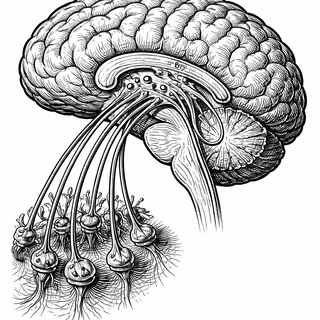
The Locus Coeruleus Is Tiny but Shouts to the Whole Brain
Deep in your brainstem sits a small cluster of neurons called the locus coeruleus, or LC if you're feeling informal. It's tiny, containing only about 50,000 neurons in humans. But those neurons punch way above their weight class.
The LC produces norepinephrine and sprays it across most of the brain. It's involved in arousal, attention, stress responses, and yes, pain processing. Different neurons within the LC project to different brain regions and seem to do different things. Some target the prefrontal cortex. Some go to the hippocampus. Some reach other structures entirely.
The researchers were particularly interested in the neurons that project to the prefrontal cortex and influence pain. Could they find a way to selectively shut down just that population, leaving the rest of the LC alone?
If they could, it would be a proof of concept for something really valuable: targeting specific circuits with drugs rather than genetic tools.
The Receptor Fingerprint Idea
Here's the insight that made this work possible. Different populations of neurons express different combinations of receptors on their surfaces. Even neurons that look similar and live in the same nucleus can have different receptor profiles.
If you can figure out which receptors are enriched in your target population, you might be able to find a drug combination that preferentially affects those neurons. The key word is combination. Any single drug might affect too many neuron types. But the right cocktail, hitting multiple receptors that happen to overlap in your target population, might achieve selectivity.
It's like finding someone in a crowd. You probably can't identify them by just saying "tall" or just "brown hair." But "tall with brown hair and glasses and a red jacket?" That starts to narrow things down.
Screening for the Right Combination
The researchers combined several sophisticated techniques. They used retrograde tracing to label exactly which LC neurons projected to the prefrontal cortex. They used calcium imaging to watch those neurons fire in real time. And they systematically tested drugs targeting different receptors that LC neurons are known to express.
Machine learning helped decode the calcium signals and identify patterns. The question they kept asking: which drugs or drug combinations preferentially suppress activity in the prefrontal-projecting neurons compared to other LC populations?
This is a lot of work. You're essentially searching through a high-dimensional space of possible drug combinations, looking for a needle that preferentially quiets one population. But modern tools make this kind of search feasible.
The Winning Cocktail
They found it. A combination targeting muscarinic receptors, opioid receptors, and serotonin receptors selectively inhibited the prefrontal-projecting LC neurons.
No single drug in the combination achieved the same selectivity. But together, they added up to something that preferentially hit the target population. Each receptor was somewhat enriched in the prefrontal-projecting neurons, and hitting all three at once created enough selectivity to matter.
When they tested this cocktail in live animals, it produced pain relief. Not just any pain relief, synergistic pain relief that was greater than what any single drug in the combination achieved alone. This is exactly what you'd predict if the cocktail was selectively quieting a circuit that promotes pain processing.
Why This Matters for Real Medicine
The gap between neuroscience discoveries and medical treatments is frustrating. We keep learning amazing things about how specific circuits cause specific symptoms, but turning that knowledge into therapies is hard. Optogenetics taught us incredible things about circuit function, but you can't shine lasers into patients' brains after genetically modifying their neurons. Not ethically, anyway.
Drugs, on the other hand, we can definitely give to people. The problem is that most drugs affect too many things at once. A drug that hits opioid receptors will hit opioid receptors everywhere, not just in the circuit you care about. That's why opioid painkillers have side effects like constipation and respiratory depression and addiction.
But if you can find drug combinations that achieve circuit selectivity through the natural receptor differences between neuron populations, you might be able to get more precise effects with fewer off-target problems. The LC cocktail the researchers found is a proof of concept.
A Blueprint, Not Just a Discovery
The really exciting thing about this study isn't just the specific cocktail they found. It's the framework. The approach is generalizable.
Any brain circuit where the target neurons have a distinct receptor signature could potentially be targeted this way. You map the receptor expression, you screen drug combinations, you find the cocktail that achieves selectivity. It's laborious, but it's systematic.
This creates a bridge between the genetic tool discoveries that help us understand the brain and the pharmacological interventions that can actually help patients. Instead of being stuck with "we figured out how this circuit works, too bad we can't do anything about it," we have a path toward "here's a drug combination that specifically targets that circuit."
The Limits and the Future
This isn't a magic solution. Finding the right receptor combination requires extensive screening. Not every circuit will have a usable receptor signature. Drug interactions can be unpredictable. And what works in mice won't necessarily work in humans.
But the concept is sound. Neurons are different from each other in ways that can be exploited pharmacologically. Multiple drugs that each do a little bit can add up to something more selective than any single drug. And with modern screening and analysis tools, finding those combinations is becoming practical.
Circuit-selective pharmacology. It's not as flashy as optogenetics, but it might actually show up in a pharmacy someday.
Reference: Kuo CC, McCall JG. (2025). Circuit-selective pharmacological targeting of prefrontal cortex-projecting locus coeruleus neurons drives antinociception. Cell Reports. doi: 10.1016/j.celrep.2025.116294 | PMID: 40971298
Disclaimer: The image accompanying this article is for illustrative purposes only and does not depict actual experimental results, data, or biological mechanisms.