
There's a weird problem in neuroscience that doesn't get talked about enough: brains evolved inside bodies. You can record from neurons all day, but those neurons evolved to control a physical thing swimming through water, walking on land, or reaching for food. A team of researchers decided to take this insight and run with it, building both a detailed virtual zebrafish AND a physical swimming robot to see if they could crack some neural mysteries. Their results in Science Robotics show this wasn't just an elaborate excuse to build a fish robot (though that's a pretty good excuse on its own).
Say Hello to SimZFish
The researchers created simZFish, a neuromechanical simulation of larval zebrafish. These tiny fish perform something called the optomotor response, which is basically their way of staying in one place while the world moves around them. If you've ever tried to stand still on a train while looking out the window and felt yourself compensating for the motion, you've done something similar.
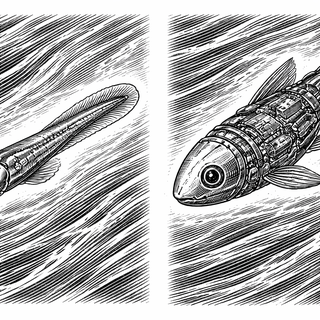
Now, this wasn't some crude fish-shaped animation swimming around a blue background. The simulation includes realistic body mechanics, actual water physics with proper hydrodynamics, visual environments that mimic what a real fish sees, and neural network architectures derived from experimental data on real zebrafish brains. When they ran the simulation, it behaved like real zebrafish actually behave.
But here's the real power of simulation: you can break things in ways that would be impossible in a living animal. Want to see what happens if you swap out the fish's lens for one with different properties? Done. Curious about rewiring the retina? Go for it. Interested in changing the body's physical mechanics? Just update the parameters.
Breaking the Rules to Learn the Rules
The team systematically manipulated their simulation in ways that would be either impossible or extremely difficult in living fish. Swap the lens, change the retinal connectivity, alter the body mechanics, and watch what happens.
This is where things got interesting. By watching how these changes affected behavior, they could figure out why certain features of the neural circuit exist. For example, they discovered why the lower posterior visual field is so important for optimal optomotor responses. This wasn't obvious from studying the neural circuit in isolation. The answer only emerged when you looked at how the body, the environment, and the brain work together as an integrated system.
It's like trying to understand a car's steering system. You could study the steering wheel all day, but you won't really understand it until you see how it connects to the wheels, the road, and the physics of turning at speed.
"We Bet These Neurons Exist" (They Did)
SimZFish made specific predictions about neuronal response types that hadn't been observed before. The model said: based on how this system should work, there should be neurons with these particular response properties in these locations.
The researchers then went hunting in real zebrafish brains using two-photon calcium imaging, which lets you watch individual neurons light up in living fish. And they found them. The neurons the simulation predicted were actually there, doing what the model said they should do.
This is the dream of computational neuroscience: building models that don't just explain data you already have, but that predict things you haven't seen yet. When those predictions pan out, you know you're actually understanding something rather than just curve-fitting.
Building a Robot to Prove It Works
Virtual fish are great, but the real world is messy in ways simulations can't fully capture. So the team built ZBot, a physical swimming robot implementing the same sensorimotor circuits they'd been studying.
They put ZBot in an actual river with complex, unpredictable fluid dynamics. No neat parameters. No controlled conditions. Just real water doing real water things.
ZBot maintained its position using optic flow as a navigational cue. The neural circuits identified through simulation weren't just mathematical abstractions that only work on a computer. They worked in physical reality, dealing with all the chaos and noise that entails.
Why Build Fish Robots?
There's something almost playfully excessive about this research approach. A virtual fish AND a real robot AND experiments on actual fish? But the excess is the point. Each approach validates and extends the others.
The simulation lets you explore things you can't do in living animals. The living animals confirm that your simulation isn't just fantasy. The robot proves that the principles work in the physical world, not just in controlled lab conditions.
Sometimes the best way to understand how biology works is to build it yourself. Not because you'll build it better than evolution did, but because the process of building forces you to specify everything explicitly. You can't wave your hands when you're writing code or wiring up a robot.
These researchers wanted to understand how zebrafish brains control swimming behavior. So they built fish brains in computers, put them in virtual bodies, predicted what neurons should exist, found those neurons in real fish, and then built a robot to prove the whole thing works outside the lab. That's one way to do neuroscience.
Reference: Liu X, et al. (2025). Artificial embodied circuits uncover neural architectures of vertebrate visuomotor behaviors. Science Robotics. doi: 10.1126/scirobotics.adv4408 | PMID: 41091910
Disclaimer: The image accompanying this article is for illustrative purposes only and does not depict actual experimental results, data, or biological mechanisms.