
Neuroscientists have been spoiled by the motor cortex. Want to know how excitable that part of the brain is right now? Easy: zap it with transcranial magnetic stimulation (TMS), watch the thumb twitch, measure the twitch size. The bigger the twitch for a given stimulation intensity, the more excitable the cortex. It's elegant, it's clean, and it has enabled decades of productive research.
There's just one problem, as a review in Neuroscience & Biobehavioral Reviews points out: what about all the interesting brain regions that don't control muscles? The prefrontal cortex where you do your planning? The parietal cortex where you pay attention? No twitches to measure. The field has had to get creative.
The Motor Cortex: Everybody's Favorite Lab Partner
Let's appreciate why motor cortex excitability research has been so successful. The motor cortex has a direct output: it makes muscles move. This gives you a clean, objective, easily quantifiable readout. Stimulate the brain, measure the muscle response. No subjective reports needed. No complicated analysis pipelines. Just a twitch and a number.
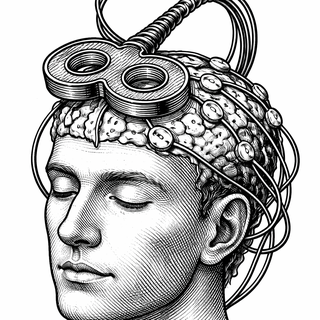
This has allowed researchers to study how excitability changes with all sorts of interesting factors. Learning a new motor skill? Excitability shifts. Taking a drug? Excitability changes. Sleeping versus awake? Different excitability. Healthy versus various disease states? Different patterns.
The accumulated knowledge about motor cortex excitability has been genuinely useful, informing everything from stroke rehabilitation to understanding how skills are acquired. But it's also created a bit of a blind spot. We know a lot about motor excitability because it's easy to measure. We know much less about excitability in regions that actually do most of the interesting cognitive work.
The Cognitive Regions Have No Easy Readout
The prefrontal cortex is arguably the most interesting part of the human brain. It handles planning, decision-making, working memory, impulse control, and all the executive functions that make complex thought possible. It would be incredibly valuable to measure its excitability with the same precision we use for the motor cortex.
But stimulate the prefrontal cortex with TMS and what happens? No twitch. No muscle response. Nothing you can easily measure with an electrode over a muscle. The output of the prefrontal cortex is... thinking. And "how much did that person just think?" is not a quantity you can easily record.
The same problem applies to parietal cortex, temporal regions, and essentially every brain area that doesn't have a direct line to the muscles. These regions are doing the heavy lifting of cognition, but they don't give us convenient readouts.
The Creative Workarounds
The review surveys what the field has come up with to work around this limitation. None of these approaches are as clean as measuring a thumb twitch, but they're what we've got.
TMS-EEG combinations involve stimulating the brain with TMS while simultaneously recording the brain's electrical response with electroencephalography. No muscles needed because you're measuring the brain's response directly. The challenge is that EEG data is noisy and interpretation is tricky. What exactly does a bigger EEG response mean? It's not as straightforward as "bigger twitch equals more excitable."
TMS-fMRI combinations pair stimulation with functional brain imaging. Zap the brain, watch what lights up on the scanner. You can see how the stimulated region responds and which connected areas get activated. The downside: fMRI is expensive, the experiments are technically demanding, and the temporal resolution isn't great. You're measuring blood flow changes that happen over seconds, not the millisecond-scale neural responses you really want.
Behavioral indices involve measuring how TMS affects task performance. If stimulating a region disrupts memory, that tells you something about its function and state. This approach is indirect, though. You're inferring excitability from performance changes, which requires a lot of assumptions about the relationship between the two.
Each approach has strengths and limitations. The emerging consensus is that combining multiple methods probably gives the best picture, even if no single approach is as clean as the motor cortex gold standard.
Why Excitability Matters Beyond Academic Curiosity
Excitability isn't just a technical parameter that neuroscientists like to measure. It reflects something fundamental about brain state: how readily a region will respond to input. Think of it like the sensitivity setting on a microphone. Turn it up and you pick up whispers. Turn it down and you miss loud conversations.
Brain excitability isn't fixed. It changes moment to moment based on attention, arousal, and cognitive demands. It changes day to day based on sleep, stress, and other factors. It changes longer-term with learning, aging, and disease.
Mapping these excitability changes across cognitive systems could answer questions we currently can't touch. Why do some patients respond to brain stimulation treatments while others don't? Why does learning come easily on some days and feel impossible on others? Why do certain mental states favor certain cognitive functions?
The motor cortex taught us that excitability matters. Now the challenge is developing tools to measure it everywhere else. The brain regions that do the thinking are harder to interrogate, but they're where the interesting questions live.
Reference: Bhattacharyya S, et al. (2025). Approaches to map cortical excitability beyond the primary motor cortex. Neuroscience & Biobehavioral Reviews. doi: 10.1016/j.neubiorev.2025.105812 | PMID: 40812727
Disclaimer: The image accompanying this article is for illustrative purposes only and does not depict actual experimental results, data, or biological mechanisms.