
Think sleep apnea is just an airway problem? Snoring, gasping, repeat? Well, grab your CPAP machine and settle in, because a new review in Sleep Medicine Reviews wants to blow that simple story wide open. It turns out sleep apnea isn't just your throat being uncooperative. Your heart, brain, metabolism, and immune system all have their hands in this mess.
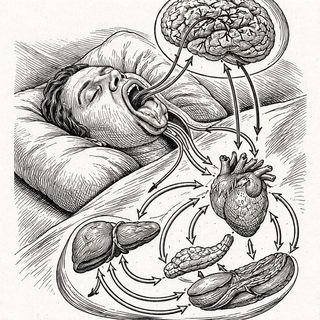
The old model was appealingly simple: the airway collapses, breathing stops, you wake up a little, the airway opens, repeat all night. But reality, as usual, is more complicated and more interesting.
The Metabolic Feedback Loop From Hell
Here's something that should have been obvious but wasn't fully appreciated until recently: obesity doesn't just contribute to sleep apnea through mechanical squishing of the airway. Yes, extra tissue around the neck can physically compress things. But that's only part of the story.
Obesity also triggers metabolic inflammation. Fat tissue isn't just passive storage; it's an active endocrine organ pumping out inflammatory signals. These signals affect the muscles that control the airway, the brain centers that regulate breathing, and the neural reflexes that should be waking you up when oxygen gets low.
But wait, it gets worse. Sleep apnea itself promotes insulin resistance, disrupts glucose metabolism, and makes it harder to lose weight. So obesity causes apnea, which worsens the metabolic dysfunction, which promotes more obesity, which worsens apnea.
The authors diplomatically call this a "bidirectional relationship." Let's be more blunt: it's a vicious cycle where your body is essentially sabotaging itself while you sleep. Each problem makes the other problem worse.
Your Heart Is Also Having a Bad Night
The connection between sleep apnea and cardiovascular disease has been recognized for a while, but the mechanisms are becoming clearer. Every time you stop breathing, your oxygen levels drop. Your heart has to work harder to push oxygen-depleted blood around. Blood pressure spikes. Stress hormones surge.
Do this hundreds of times per night, every night, for years, and your cardiovascular system takes a beating. Hypertension, arrhythmias, increased risk of heart attack and stroke. The heart wasn't designed for this kind of repeated stress testing.
Modern imaging is revealing just how much damage is happening. MRI can now detect subtle signs of cardiac ischemia (not enough blood supply to the heart muscle) in sleep apnea patients who have no symptoms. The heart is struggling in ways that don't show up until imaging catches it.
Your Brain Didn't Sign Up for This Either
Sleep apnea doesn't just leave you tired. Brain scans are revealing structural and functional changes that accumulate over time. White matter abnormalities. Reduced gray matter in regions involved in memory and executive function. Disrupted connectivity between brain networks.
The mechanisms are multiple: repeated oxygen drops, fragmented sleep architecture, inflammatory cascades reaching the brain, chronic activation of stress systems. Neurotransmitter systems get thrown off. The neural networks that should be consolidating memories and clearing metabolic waste during sleep can't do their jobs properly.
This helps explain why untreated sleep apnea is associated with cognitive decline and increased dementia risk. The brain needs sleep to function properly, and apnea sabotages sleep at a fundamental level.
Why Complexity Science Matters Here
The review brings in concepts from complexity science, which might sound like academic overreach but actually makes sense here. The old model treated sleep apnea as a simple mechanical problem with a simple mechanical solution (CPAP to keep the airway open). That helps, but it doesn't address the whole picture.
Sleep-wake regulation isn't a simple on/off switch. It's an emergent property arising from billions of neurons engaging in collective behavior. Think of it less like a light switch and more like weather patterns. Multiple systems interact, feedback loops amplify or dampen effects, and small changes in one component can cascade through the whole system.
This perspective explains why targeting one thing at a time often produces disappointing results. You might fix the airway obstruction but still have metabolic dysfunction. You might address the sleep fragmentation but not the cardiovascular damage. Systems problems need systems solutions.
What This Means for Treatment
The takeaway for clinicians and patients is that sleep apnea management probably needs to expand beyond the airway. Addressing metabolic health matters. Managing cardiovascular risk factors matters. Treating depression and cognitive symptoms matters. Sleep apnea isn't just one problem; it's a syndrome that touches multiple organ systems.
The good news is that treatment options are expanding. Newer pharmacological approaches are joining the traditional armamentarium of CPAP, dental devices, and surgery. Combination approaches that address multiple mechanisms simultaneously may be more effective than any single intervention.
For the hundreds of millions of people worldwide whose bodies have apparently decided that breathing while sleeping is optional, understanding the full scope of the problem is the first step toward better solutions. Sleep apnea isn't just a throat problem. It's a whole-body problem that deserves whole-body thinking.
Reference: Beache GM, et al. (2025). Sleep apnea at the frontier- an integrated multidisciplinary functional framework. Sleep Medicine Reviews. doi: 10.1016/j.smrv.2025.102190 | PMID: 41274210
Disclaimer: The image accompanying this article is for illustrative purposes only and does not depict actual experimental results, data, or biological mechanisms.