
Tracking how animals move has been a challenge since the beginning of behavioral neuroscience. The old-school solution was simple but terrible: glue markers to the animal. Little dots on the paws, the back, the head. Then track those dots with cameras. Works fine until the markers fall off, or slide around on fur, or the mouse decides to groom them off, or the glue irritates the skin. And of course, having things glued to you affects how you move, which is exactly what you're trying to measure in the first place.
AI-based markerless tracking changed everything. Train a neural network on video of mice, and it learns to identify body parts without needing physical markers at all. No glue. No falling-off dots. The animal moves naturally while the computer figures out where everything is.
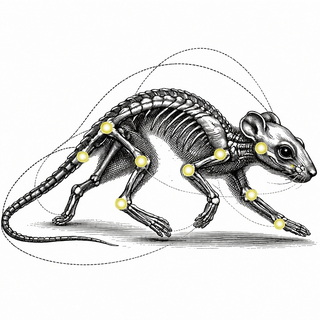
But here's a question nobody had really answered: how accurate are these AI trackers, actually? A study in Science Advances finally provided ground truth by developing injectable fluorescent nanoparticles. Yes, they made mice glow. Just a little bit. Just enough to know where everything really is.
The Problem With Not Knowing Your Error
AI tracking tools like DeepLabCut and SLEAP have been adopted widely across neuroscience. Labs use them routinely to quantify behavior in all sorts of experiments. But these tools have never been properly benchmarked against genuine ground truth in common lab animals.
How far off is the algorithm when it says the left paw is at position X? A millimeter? Half a millimeter? Three millimeters? Nobody knew for certain because there was no reliable reference to check against.
For some applications, this doesn't matter much. If you just want to know roughly where the mouse is and whether it's moving or still, approximate positions are fine. But for other applications, that uncertainty is a serious problem. Detailed biomechanics requires precision. Tight correlations between neural activity and behavior require knowing exactly when and where movements happen. If your movement measurements have unknown error, that error becomes noise in your brain-behavior correlations.
You end up in a frustrating situation where you don't know if weak correlations reflect genuine biology or just measurement imprecision.
When Glue Won't Cut It
The obvious solution would be to use physical markers as ground truth. Attach something to the mouse with precisely known position, compare the AI predictions to that position, calculate the error.
But we're back to the original problem. Physical markers are invasive. They alter behavior. They fall off. They slide around on the surface of the fur. A marker on a mouse's back might be sitting on fur that shifts around while the underlying body stays still. You think you're measuring the body, but you're really measuring fur movement plus body movement, and good luck separating those.
What researchers needed was some way to mark specific points on (or in) the animal that would stay put, move with actual tissue rather than sliding on fur, and be easily visible to cameras without interfering with behavior.
The Elegant Solution: Glow From Within
The researchers developed customized quantum dots that can be injected under the skin. These are fluorescent nanoparticles, tiny enough to stay where you put them, bright enough to be visible through fur when you illuminate them with the right wavelength of light.
Once injected, these particles create stable reference points that don't fall off (because they're inside) and don't slide around (because they're anchored in tissue). When the mouse moves its leg, the quantum dots in that leg move with the actual underlying structure. No surface artifacts. No fur slippage.
Because they're fluorescent, cameras with appropriate filters can pick them out with high specificity. Regular video sees the mouse. The fluorescent channel sees tiny glowing points precisely marking body positions. It's like giving the mouse internal GPS beacons that only the computer can see.
The researchers describe this as achieving motion-capture-quality data from freely moving animals. That's a significant claim. Motion capture in movies and video games involves actors covered in reflective markers. This technique gets equivalent precision from animals behaving naturally, with no external equipment strapped to them.
Finally, Real Numbers
With ground truth from the fluorescent markers, researchers could finally do what the field has been waiting for: properly benchmark the AI trackers.
The results were informative. Current markerless tracking algorithms performed pretty well for some things and not so well for others. Some body parts were tracked more reliably than others. Some movements were estimated accurately; others had larger errors. The benchmark provided actual numbers instead of assumptions, which is how science is supposed to work.
This matters because now researchers can make informed decisions. If you need sub-millimeter precision for your analysis, you know whether the AI tracker can deliver that or whether you need the fluorescent markers as ground truth. If approximate tracking is sufficient for your question, you can use the AI tools with confidence about what level of error to expect.
Why Precision Matters for Brain-Behavior Science
The goal of much behavioral neuroscience is linking neural activity to behavior. You record from neurons while an animal does something, then look for correlations. Which neurons fire when the paw moves? How does cortical activity relate to running speed? What predicts a turn versus a straight path?
All of these analyses depend on accurate behavior measurement. If your movement data has significant error, that error becomes noise in your correlations. Real signals get buried. You might conclude that neural activity isn't reliably related to behavior when actually the problem is that your behavior measurements aren't reliable.
Sub-millimeter precision opens possibilities that approximate tracking doesn't allow. You can look at fine motor adjustments during skilled movements. You can detect subtle postural changes. You can time behavior precisely enough to correlate with fast neural dynamics.
The injectable markers also solve a chronic problem with longitudinal studies. Glued markers fall off between sessions, creating inconsistencies. Internal fluorescent markers stay put for weeks or months, providing stable reference points across the entire experiment.
The Gently Glowing Future
There's something almost science-fiction about injecting animals with quantum dots that make them detectable to specialized cameras. But the application is practical and the benefit is clear: better data with less invasiveness.
Sometimes the solution to a longstanding methodological problem is pleasingly direct. You need ground truth? Put something in the animal that gives you ground truth. Make it stay put. Make it visible. Make it not interfere with behavior.
The mice glow now. Just a little bit. Just enough to finally know where they really are.
Reference: Ulutas EZ, et al. (2025). High-resolution in vivo kinematic tracking with customized injectable fluorescent nanoparticles. Science Advances. doi: 10.1126/sciadv.adu9136 | PMID: 41032617
Disclaimer: The image accompanying this article is for illustrative purposes only and does not depict actual experimental results, data, or biological mechanisms.