
Sepsis is one of those medical conditions that sounds almost too simple when described but is devastatingly complex when it actually happens. Bacteria get into the bloodstream. The immune system freaks out. Things go south fast. But here's the weird part: what actually kills people isn't the bacteria directly. It's the body's own response, including a mysterious metabolic shutdown where body temperature drops, blood pressure crashes, and organs start failing.
A study in Cell Reports just identified the brain circuit that drives this deadly response. And the kicker? The circuit can be turned off, at least in mice.
The Shutdown No One Asked For
When severe infection spreads through the body, some patients don't run fevers. They do the opposite. Their body temperature drops, their metabolism slows way down, and their cardiovascular system starts to fail. This hypometabolic state is associated with really bad outcomes. If you're the patient going cold rather than hot, your prognosis is worse.
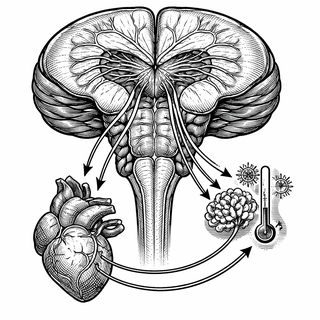
This response doesn't make intuitive sense. You'd think the body would ramp up its defenses when fighting infection. Instead, some patients' systems seem to give up and shut down. Why would evolution produce this?
One theory is that the hypometabolic response is a kind of energy conservation strategy that backfires in severe cases. Slow everything down to save resources for fighting the infection. But when the infection is overwhelming, this shutdown becomes part of the problem rather than the solution.
The question the researchers wanted to answer: which brain circuits control this shutdown?
Finding the Neurons That Light Up During Sepsis
The team used clever genetic tools to figure out which neurons become active during systemic inflammation. They gave mice lipopolysaccharide (LPS), a bacterial component that triggers strong immune responses without actual bacterial infection, or put them through a more severe sepsis model that better mimics clinical disease.
Then they looked at which brain regions showed increased activity. Using activity-dependent genetic labeling, they could mark neurons that fired during the inflammatory response and then study them in detail.
A specific population lit up: glutamatergic neurons (neurons that use the excitatory neurotransmitter glutamate) in a region called the ventrolateral periaqueductal gray, or vlPAG for short.
The periaqueductal gray is a brain region that's been studied for its role in pain modulation and defensive behaviors. When an animal perceives a threat, this region helps orchestrate the response. But a metabolic role during sepsis? That was new.
Proving These Neurons Actually Control the Shutdown
Finding neurons that are active during sepsis is interesting, but correlation isn't causation. To prove these neurons were actually driving the hypometabolic response, the researchers did gain-of-function and loss-of-function experiments.
For gain-of-function, they used optogenetics to artificially activate the vlPAG neurons even without any inflammation. Just turn on these specific cells with light. The result: the mice developed hypothermia and cardiovascular depression. Without any infection, without any immune activation, just stimulating these neurons was sufficient to trigger the shutdown.
For loss-of-function, they inhibited the neurons during actual sepsis. The result: the hypometabolic crash was prevented. The mice still had inflammation, still had immune activation, but without the vlPAG neurons driving the shutdown, they didn't develop the deadly metabolic and cardiovascular collapse.
This is the kind of clean causal evidence that gets neuroscientists excited. The circuit both causes the response when activated and prevents it when silenced.
Why Would the Brain Do This to Us?
This finding raises an interesting question about the brain's role in immune responses. We tend to think of immunity as something the immune system handles on its own. White blood cells, antibodies, cytokines. But the brain is deeply involved in coordinating the body's response to infection.
Sickness behavior, that constellation of fatigue, loss of appetite, social withdrawal, and fever that happens when you're ill, is orchestrated by the brain in response to signals from the immune system. The brain decides that you should feel terrible and want to sleep because that's actually adaptive when you're fighting an infection.
The hypometabolic shutdown might be an extreme version of this. A kind of "hunker down and conserve resources" program that the brain initiates when it detects overwhelming systemic inflammation. In mild cases, this might be helpful. In severe sepsis, it becomes deadly.
The vlPAG seems to be the control switch for this program. And now we know exactly which neurons are responsible.
Therapeutic Possibilities
Here's where this gets medically interesting. Sepsis kills hundreds of thousands of people every year. Current treatments focus on fighting the infection with antibiotics and supporting organ function with intensive care. But if the brain circuit driving the deadly shutdown can be identified and modulated, there might be a completely different therapeutic angle.
What if you could block the vlPAG neurons in a septic patient? In mice, this prevented the cardiovascular collapse even though the inflammation was still present. The body still knew it was fighting an infection, but it didn't initiate the deadly shutdown program.
Obviously, going from "this works in mice" to "this helps patients in the ICU" is a long road. You'd need to figure out how to safely modulate this circuit in humans, whether drugs could target these specific neurons, and whether blocking the response might have unintended consequences. Maybe the hypometabolic response provides some protection in certain scenarios.
But at least now there's a target. Instead of just trying to fight the infection and hope the patient survives the body's own response, there might be a way to prevent the worst of that response from happening in the first place.
The Brain and the Body
This study is a good reminder that the brain isn't just sitting in your skull running consciousness. It's constantly regulating the rest of the body, including responses to infection and inflammation. The line between "neurological" and "immunological" is blurrier than the medical specialties would suggest.
Understanding how the brain orchestrates responses to systemic threats opens new possibilities for intervention. If the brain decides to shut down the body's metabolism during sepsis, maybe we can convince it not to.
Reference: Bhattacharyya S, et al. (2025). An excitatory circuit in the ventrolateral periaqueductal gray drives hypometabolic state during acute systemic inflammation. Cell Reports. doi: 10.1016/j.celrep.2025.116394 | PMID: 41045458
Disclaimer: The image accompanying this article is for illustrative purposes only and does not depict actual experimental results, data, or biological mechanisms.