
Ever wonder how your brain manages to hear the difference between your friend whispering a secret and a truck barreling down the street? It all comes down to some incredibly precise wiring between your ear and your brain, and a study in eLife just uncovered one of the molecular matchmakers making it all happen. Turns out a protein called RTN4RL2 works like biological velcro, helping the right cells stick together during development.
The World's Most Important Handshake
Let's set the scene. Deep in your inner ear, you have these specialized cells called inner hair cells (IHCs). Their job is to convert sound vibrations into electrical signals. But having the signal isn't enough. You need to deliver it somewhere useful, which means connecting to spiral ganglion neurons (SGNs) that run the message up to your brain.
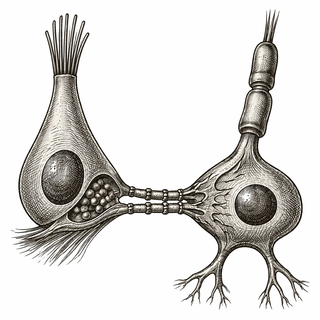
Here's the tricky part: this connection has to be absurdly precise. We're talking about synapses that need to fire with split-second timing, reliably, thousands of times per second. Get the wiring wrong, and suddenly you can't tell if someone said "bat" or "cat," or worse, you're missing entire frequencies altogether.
So how does a developing embryo figure out which cells should connect to which? How do hair cells and neurons find each other in the crowded cellular neighborhood of the inner ear and form exactly the right partnerships? This is the kind of problem that keeps developmental biologists up at night.
Enter RTN4RL2: The Cellular Dating App
The researchers in this study focused on a protein called RTN4RL2, also known as Nogo receptor (which, let's be honest, sounds like a rejected Star Wars character). This protein belongs to a family of synaptic adhesion molecules, which is a fancy way of saying it helps glue the right cells together.
RTN4RL2 shows up at developing cochlear synapses, which immediately makes it suspicious. It's like finding someone loitering at the scene of every handshake in town. The researchers wanted to know: is this protein actually doing something useful, or is it just hanging around looking important?
To find out, they did what scientists do best. They broke it. Using genetic manipulation, they created animals lacking functional RTN4RL2 and then watched what happened to the developing ear.
What Happens When You Remove the Velcro
Without RTN4RL2, the development of connections between inner hair cells and spiral ganglion neurons went off-script. The interplay between the presynaptic side (the hair cells sending signals) and the postsynaptic side (the neurons receiving signals) was altered.
Think of it like trying to build furniture without some of the connecting hardware. The pieces are all there, but they don't come together quite right. Some connections formed, but the overall organization and possibly the function of these synapses was compromised.
Now, here's where the story gets appropriately humble. Removing RTN4RL2 didn't completely prevent synapse formation. The ear didn't just fail to wire up entirely. This tells us something important: RTN4RL2 is part of the team, but it's not the whole team. Other adhesion molecules and guidance cues are clearly also participating in this molecular construction project.
Why Your Ear Needs Such Ridiculous Precision
Let's take a moment to appreciate just how demanding hearing is as a sensory system. Your cochlear synapses need to be fast, reliable, and incredibly consistent. When a sound hits your ear, the hair cells need to signal their partner neurons within microseconds. And they need to do this accurately for decades without getting sloppy.
Compare this to, say, a synapse in your gut that's helping regulate digestion. That synapse can afford to be a little casual. But the synapses in your ear? They're performing at the level of a professional orchestra, except the concert never ends and there's no intermission.
This is why understanding the molecular machinery that builds these connections matters so much. If something goes wrong during development, or if these synapses start to degrade later in life, the result is hearing loss. And hearing loss isn't just about missing sounds. It's linked to social isolation, cognitive decline, and reduced quality of life.
The Bigger Picture: Building Better Hearing Treatments
So we've got this protein that helps wire the ear correctly. Cool. But why should anyone outside a research lab care?
Here's why: a lot of hearing disorders trace back to problems at the synapse. Hidden hearing loss, where people struggle to hear in noisy environments despite having "normal" hearing tests, often involves damaged or dysfunctional synapses rather than dead hair cells. Age-related hearing loss also involves synaptic deterioration.
If we understand exactly which proteins are required to build and maintain these synapses, we might eventually figure out how to repair them. Maybe that means gene therapy to boost RTN4RL2 expression. Maybe it means drugs that mimic its function. The point is, you can't fix what you don't understand, and this study is one more piece of the understanding puzzle.
The Bottom Line
Your ability to hear your favorite song, recognize your mother's voice, or notice when someone's sneaking up behind you all depends on molecular velcro that develops before you're even born. RTN4RL2 is one of those sticky proteins, helping hair cells and neurons find each other and form the precisely organized connections that make hearing possible.
Is it the only protein involved? Definitely not. But it's now officially on the list of molecules that matter, and that's how science inches forward: one sticky protein at a time.
Reference: Bhattacharyya S, et al. (2025). Probing the role of synaptic adhesion molecule RTN4RL2 in setting up cochlear connectivity. eLife. doi: 10.7554/eLife.103481 | PMID: 41114721
Disclaimer: The image accompanying this article is for illustrative purposes only and does not depict actual experimental results, data, or biological mechanisms.