
Here's something that sounds made up but isn't: new neurons in your adult brain catch rides on blood vessels to get where they're going. And not just in a "using the vessel as a road" kind of way. A study in eLife shows that the actual blood flow, the liquid moving through those vessels, actively helps push neurons along their journey. Your circulatory system is apparently running a tiny Uber service for brain cells.
Wait, Adults Make New Neurons?
Before we get into the blood vessel taxi system, let's address the elephant in the room. Yes, adults make new neurons. Not everywhere, and not a ton of them, but it happens in specific brain regions. This was controversial for a long time because the old dogma said "you get the neurons you're born with and that's it." Turns out the old dogma was wrong.
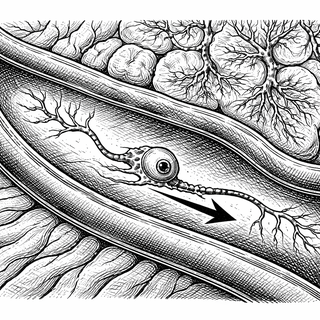
One place where adult neurogenesis definitely happens is the olfactory system, which handles your sense of smell. New neurons are born in an area called the subventricular zone, then they have to travel all the way to the olfactory bulb, which is the brain structure that actually processes smell information. That's a trip of several millimeters, which doesn't sound impressive until you remember how small a neuron is. For a single cell, that's basically a cross-country road trip.
And here's the thing: these migrating neurons don't just wander randomly through brain tissue hoping to bump into their destination. They travel along blood vessels, using them as highways.
But Here's Where It Gets Interesting
Scientists already knew that migrating neurons stick to blood vessels. What they didn't know was whether the blood inside those vessels mattered. Is the vessel just a structural scaffold, like a road that happens to have water running through it? Or does the blood flow actually do something?
The researchers decided to find out. They tracked newly born neurons in the adult brain and looked at how they interacted with blood vessels. What they found was pretty remarkable.
New neurons don't just follow vessels. They preferentially accumulate near blood vessels with abundant flow. More blood moving through? More neurons hanging out nearby. It's like they're gravitating toward the busy highways rather than the quiet back roads.
Then came the real test. What happens if you reduce blood flow? If the vessels are just passive scaffolds, it shouldn't matter much. But if blood flow actively contributes to migration, slowing it down should slow the neurons down too.
That's exactly what happened. Inhibiting blood flow caused neuronal migration to slow. The neurons were still there, they were still on the vessels, but they weren't moving as quickly. Take away the flow, and the neurons lose some of their mojo.
How Does Liquid Moving Through Tubes Affect Cells Outside Those Tubes?
This is where things get a bit mysterious. Blood is flowing inside the vessel. Neurons are migrating outside the vessel. How does the internal flow affect the external migration?
There are a few possibilities. Mechanical forces could play a role. Blood flow creates pressure and shear stress on the vessel walls, which might somehow transmit to the surrounding tissue and the cells migrating along it. Think of it like walking along a road while trucks are passing. You feel the wind, even though you're not in the truck.
Chemical signaling is another option. Blood flow could be delivering molecules that promote migration, or the flow itself could affect what the vessel wall cells release. Blood vessels aren't just passive pipes. They're lined with active cells that respond to flow and can secrete all sorts of signaling molecules.
The study provides evidence that flow-dependent mechanisms are at work, though the exact details are still being sorted out. Either way, the bottom line is clear: blood flow isn't just bringing oxygen and nutrients to the brain. It's actively participating in how new neurons find their way.
Your Cardio Workouts Might Be Helping Your Brain in Ways You Didn't Expect
Here's where this gets practically interesting. If blood flow promotes neuronal migration, then cardiovascular health might directly affect adult neurogenesis. Not just by keeping the brain alive (obviously important), but by specifically helping new neurons complete their journey from birthplace to destination.
Impaired blood flow, whether from aging, vascular disease, or just sitting on the couch too much, could mean that even if your brain is making new neurons, they're not getting where they need to go as efficiently. The assembly line is running, but the delivery trucks are slow.
This creates a surprising link between your heart and your brain's ability to replenish itself. Going for a run might not just be good for your cardiovascular system. It might be speeding up the migration of baby neurons in your olfactory bulb.
The Bigger Picture
Neuroscience is increasingly recognizing that the brain doesn't exist in isolation. It's deeply intertwined with the rest of the body's systems. Blood vessels aren't just infrastructure for fuel delivery. They're active participants in brain function and development.
This particular finding adds another piece to that puzzle. The cardiovascular and nervous systems are coupled in ways we're only beginning to understand. Blood flow doesn't just keep neurons alive. It helps new ones find their way home.
So next time someone asks why you're going for a jog, you can tell them you're optimizing neuronal migration. They'll probably look at you funny, but you'll know you're right.
Reference: Bhattacharyya S, et al. (2025). Neuronal migration depends on blood flow in the adult mammalian brain. eLife. doi: 10.7554/eLife.99502 | PMID: 41146614
Disclaimer: The image accompanying this article is for illustrative purposes only and does not depict actual experimental results, data, or biological mechanisms.