
Ever bitten into something questionable and felt your entire digestive system go "nope, we're closed"? That's not just your imagination being dramatic. Your nervous system has a direct line to your gut, and when it detects bad food, it can slam the brakes on digestion faster than you can spit out that suspicious leftovers. A study in eLife now shows exactly how this works, at least in tiny roundworms. And honestly, it's pretty elegant.
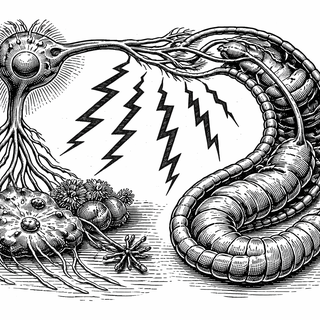
The star of this show is C. elegans, a microscopic worm that neuroscientists love because it has exactly 302 neurons, all of which have been mapped. That's right, we know every single connection in this creature's brain. It's like having the complete wiring diagram for a very simple robot that eats bacteria.
The Universal Food Quality Problem
Here's a question that every animal faces, from worms to humans: is this thing I'm about to swallow actually food, or am I about to have a very bad day?
You'd think this would be simple. Food good, not-food bad, move on. But reality is messier. Some bacteria are nutritious. Some are poisonous. Some are fine in small amounts but problematic if you keep eating. And once you've swallowed something harmful, the damage is done. Evolution, being the efficient problem-solver it is, came up with a better approach: detect the bad stuff early and shut down the eating operation before too much gets in.
But how do you actually coordinate that? Your sensory neurons are in one place (sensing), your digestive system is somewhere else (processing), and they need to communicate in real time. The researchers behind this study wanted to figure out exactly how that conversation happens.
The Worm's Early Warning System
Using C. elegans as their model, the research team identified specific neurons that act as food quality detectors. These aren't just passive sensors waiting for information to drift by. They're actively monitoring what's coming in and making rapid judgments about whether the worm should keep eating or stop immediately.
When these neurons detect something problematic, they don't politely suggest that maybe digestion should slow down. They trigger a systemic response that shuts down the whole digestive operation. It's less "maybe reconsider" and more "EMERGENCY STOP, EVERYONE OUT."
This happens fast. We're talking about a neural circuit that can detect adverse food conditions and halt digestion before the worm has time to make things worse by continuing to eat. In an organism this small, with this few neurons, every connection has to earn its keep. The fact that this shutdown circuit exists means it's been worth maintaining across millions of years of evolution.
A New Way of Talking (Neuron to Gut Edition)
The study mapped out the specific circuit: sensory neurons detect food quality, send signals to intermediary neurons, which then communicate directly with the digestive system. The researchers identified the molecular players involved in each step of this relay.
This is interesting because it's different from the gut-brain communication we usually hear about. You've probably read about the gut-brain axis, where your digestive system sends signals up to your brain, influencing mood, behavior, and all sorts of things. This is the opposite direction: brain detecting something and telling gut to shut up.
Think of it as a top-down override. Your sensory neurons are like security guards at the door. They spot something suspicious, and instead of just filing a report, they have a direct line to kitchen operations. "Stop serving, we've got a problem." The molecular specificity of this pathway suggests it evolved precisely for this purpose.
Why Worms Matter for Human Biology
Now you might be wondering why we should care about worm digestion. Fair question. But here's the thing: the basic principles of neural circuitry are surprisingly conserved across species. Worms and humans shared a common ancestor hundreds of millions of years ago, and a lot of the fundamental wiring has been maintained because it works.
The ability to rapidly suppress eating in response to detecting bad food is universal across animals. Every creature that eats faces the same problem, and they've all evolved solutions. The specific neurons are different in a mouse versus a worm versus a human, but the logic of the circuit, detect, signal, and respond, often follows similar patterns.
So when researchers identify a clean, clear mechanism in C. elegans, it raises the question: is something similar happening in more complex nervous systems? We don't know yet, but this kind of work provides a roadmap for where to look.
The Takeaway for Your Next Questionable Meal
Your body has defense mechanisms you don't even notice until they kick in. That instant gut reaction to food that's gone off isn't random queasiness. It's your nervous system doing exactly what it evolved to do: detect a threat and shut down the pipeline before more damage gets done.
The fact that we can see this same basic logic operating in a 302-neuron worm suggests it's a pretty ancient solution to a very old problem. Eating is risky. Bad food has always existed. And nervous systems, even tiny ones, have been running food quality control since before anything had a spine.
Next time your gut tells you to stop eating something, consider thanking your sensory neurons. They're running the same basic security protocol that's been keeping animals alive for a very, very long time.
Reference: Bhattacharyya S, et al. (2025). Neuronal detection triggers systemic digestive shutdown in response to adverse food sources. eLife. doi: 10.7554/eLife.105042 | PMID: 41042602
Disclaimer: The image accompanying this article is for illustrative purposes only and does not depict actual experimental results, data, or biological mechanisms.