
Your brain is supposed to match. Not perfectly, of course, but connected regions tend to have similar characteristics: thickness, folding patterns, general organization. It's like how different rooms in a well-designed house share an architectural style. You can tell they belong together.
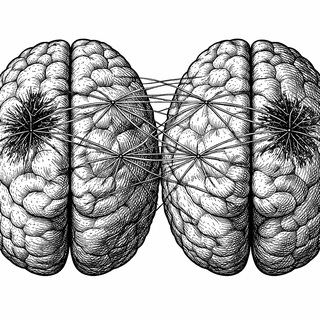
A study in Nature Communications finds that in schizophrenia, this structural harmony is disrupted. Brain regions that should look similar to each other... don't. And the areas most affected are precisely the ones that were still under construction during adolescence, which happens to be exactly when schizophrenia typically emerges. That's probably not a coincidence.
A New Way to Look at Brain Differences
Most brain imaging studies in schizophrenia ask questions like "is this region too big?" or "is that region too small?" These are perfectly reasonable questions, but they treat each brain area as an independent entity.
The researchers in this study took a different approach. Using MRI data from 352 people with schizophrenia spectrum disorders and 195 healthy controls, they built individual networks of something called "Morphometric INverse Divergence" (or MIND, because scientists love acronyms).
What this measures is how similar each brain region looks compared to every other region in the same brain. Rather than asking "is this region abnormal in size?", they asked "do the relationships between regions follow normal patterns?"
Think of it like assessing a house. You could measure each room individually: is the bedroom the right size? Is the kitchen proportional? But you could also ask whether the whole house looks like it was designed by the same architect. Do the rooms go together? Does the style make sense as a unified whole?
This study was asking whether schizophrenia brains show reduced "architectural coherence" rather than just individual room problems.
Where Things Fall Out of Alignment
Compared to healthy controls, individuals with schizophrenia showed reduced structural similarity primarily in specific brain regions: the temporal lobe, cingulate cortex, and insula. These aren't random areas. They're all higher-order association regions involved in complex cognition, including things like integrating information across senses, processing social signals, and regulating emotions.
In other words, the brain regions responsible for the really sophisticated mental operations were the ones that didn't match up properly with their connected neighbors. The basic sensory and motor areas looked more normal. It was the integration hubs that showed the mismatch.
And here's where it gets clinically interesting: the reductions in similarity actually tracked with how people were doing. Individuals with worse clinical outcomes, more cognitive impairment, and more severe symptoms showed more pronounced mismatches. The brain's "coherence" predicted real-world functioning.
The Adolescent Brain That Never Finished Assembling
Here's the piece that ties the story together. The affected regions share something in common beyond their cognitive roles: they all mature late in development. These are the brain areas that continue developing through adolescence and into early adulthood.
And when does schizophrenia typically emerge? Late adolescence to early adulthood.
This pattern suggests that the reduced structural similarity might reflect atypical brain maturation rather than degeneration. It's not that something was working fine and then broke. It's that something never finished building properly in the first place.
During normal adolescent development, these late-maturing regions are supposed to become increasingly similar to their connected partners. The architecture is supposed to cohere. In schizophrenia, this coherence process may be disrupted, leaving the brain with regions that look like they were designed by different architects.
The Biological Details Under the Mismatch
The researchers didn't stop at describing the pattern. They also mapped 46 different neurobiological features onto these networks to understand what might be driving the differences.
The regions showing reduced similarity in schizophrenia had several distinctive characteristics: high concentrations of certain neurotransmitters, elevated astrocyte markers, decreased metabolic activity, and altered microstructure.
This suggests the mismatch isn't just an architectural quirk. These areas are biologically different in multiple ways. They're metabolically distinct, chemically distinct, and structurally distinct from what you'd expect. The lack of similarity reflects deep biological differences, not just surface appearance.
Why This Matters for Understanding Schizophrenia
Schizophrenia has been notoriously difficult to characterize biologically. Brain imaging studies often find small effects scattered across many regions, with no clear unifying pattern. This study offers a different framework: maybe the problem isn't that individual regions are wrong, but that regions don't relate to each other properly.
This "network coherence" perspective might explain why schizophrenia affects complex cognition more than basic functions. If integration across brain areas requires those areas to have compatible architecture, then reduced architectural similarity would specifically impair integrative processing.
It also suggests that schizophrenia might be best understood as a developmental coordination problem. The late-maturing regions never properly joined the team. They're there, they're working, but they're not properly matched to their neighbors.
For a disorder that has resisted simple explanations for over a century, this coherence-based framework offers a genuinely new angle on an old puzzle.
Reference: Sotiras A, et al. (2025). Reduced brain structural similarity is associated with maturation, neurobiological features, and clinical status in schizophrenia. Nature Communications. doi: 10.1038/s41467-025-63792-6 | PMID: 41034229
Disclaimer: The image accompanying this article is for illustrative purposes only and does not depict actual experimental results, data, or biological mechanisms.