
Your visual system didn't spring into existence fully formed. It developed in stages, following a carefully choreographed sequence that evolution has been perfecting for hundreds of millions of years. First, your brain practiced with spontaneous activity, neurons firing in patterns that laid down the basic wiring. Then, after your eyes opened, actual visual experience arrived to refine those circuits based on the real world.
This sequence matters more than you might think. A study in eLife shows what happens when visual experience arrives before the brain is ready for it. The answer isn't "things develop faster." It's "things develop wrong."
The Brain's Two-Stage Building Plan
Before your eyes ever opened (and in primates, even before birth), your visual cortex was already buzzing with activity. Not visual activity, since there wasn't any visual input yet, but spontaneous waves of neural firing that spread across the developing retina and cortex. These waves weren't random noise. They were practice runs, establishing the basic architecture of visual circuits before any real data arrived.
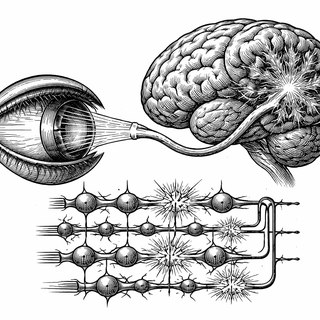
Think of it like building a house. Before you move in, contractors install the electrical wiring, plumbing, and framing. They don't need to know exactly where you'll put your furniture to get the basic infrastructure in place. Similarly, spontaneous activity in the developing brain sets up the fundamental connectivity patterns that visual experience will later refine.
Once the eyes open, a different kind of activity takes over. Now visual input is streaming in, edges and contrasts and movements and colors. The brain uses this information to fine-tune what spontaneous activity built. Connections that match real visual patterns get strengthened. Connections that don't match get pruned.
This two-stage process produces the remarkably precise visual system that lets you read these words. But it only works if the stages happen in the right order.
What Happens When the Schedule Gets Disrupted
The researchers in this study asked a pointed question: what if visual experience arrives during the spontaneous-activity stage? What if the brain is still running practice mode when the real game starts?
They exposed developing visual cortex to patterned visual input earlier than normal. Not just light, but actual structured visual patterns, the kind of input the brain normally receives only after eye opening.
This created a developmental mismatch. Visual input was arriving when the circuit was still configured for spontaneous activity. The brain wasn't ready for this information, but it was receiving it anyway.
The results weren't subtle. Premature visual experience drove aberrant development of response properties in primary visual cortex. The neurons that should have developed normal responses to visual features instead developed abnormal ones.
Faster Isn't Better
Here's what makes this finding interesting and a little counterintuitive. You might expect that early visual experience would simply accelerate development. The brain gets visual input sooner, so it develops visual abilities sooner. Earlier is better, right?
Wrong. Premature visual experience didn't accelerate normal development. It drove development in a different direction entirely. Cortical neurons developed response properties that were qualitatively different from what normal development produces.
Some properties that should have emerged were disrupted. The neurons didn't learn to respond properly to edges at certain orientations, or to objects moving in certain directions. Other properties developed abnormally, in ways that wouldn't have happened under normal developmental timing.
It's as if the brain was trying to learn the wrong lessons because the teaching materials arrived at the wrong time. The same visual input that would have been instructive later was actually misleading earlier.
Why the Sequence Is the Sequence
This raises an obvious question: why does the brain have this two-stage system in the first place? Why not just start learning from visual experience as soon as possible?
The answer seems to be that spontaneous activity accomplishes things that experience-driven activity cannot. The early waves of activity establish large-scale organizational features, like the basic mapping of visual space onto cortical tissue. These features need to be in place before experience-dependent refinement can work properly.
If visual input arrives before these foundations are laid, the experience-dependent learning processes don't have the right substrate to work with. It's like trying to wire a house for electricity before the walls are up. Technically you can run cables, but they won't end up where they should be because the structure isn't ready.
Evolution settled on this staged approach because it works. Spontaneous activity first, then experience. The timing isn't arbitrary. It reflects what each stage needs from the previous one.
What This Means for Understanding Visual Disorders
This research has implications for understanding visual problems that arise from abnormal early experience. Conditions like congenital cataracts, which block normal visual input, have long been known to affect visual development. But the timing of both the deprivation and the restoration of vision matters in ways that this research helps explain.
If visual input is missing during the experience-dependent phase, circuits that should have been refined don't get refined. If visual input arrives during the spontaneous phase (imagine a situation where the retina is somehow stimulated before natural eye opening), you get the kind of aberrant development this study documented.
Clinicians treating children with early visual problems have long observed that outcomes depend heavily on timing. This research provides a mechanistic framework for understanding why. The brain isn't just a general-purpose learning machine that improves with any input. It's a staged developmental system that expects specific inputs at specific times.
The Broader Lesson About Development
The visual system is one of the best-studied developmental systems in neuroscience, but the principles probably apply more broadly. Other sensory systems, motor systems, and cognitive circuits likely have their own staged developmental processes, their own sequences that need to unfold in order.
This matters for thinking about interventions, educational programs, and enrichment activities for developing brains. More stimulation isn't always better. Earlier isn't always better. What matters is whether the input matches what the developmental stage can actually use.
Your brain developed following a precise temporal script. The schedule wasn't arbitrary. And when that schedule gets disrupted, the brain doesn't just catch up later. It builds something different. Sometimes timing really is everything.
Reference: Bhattacharyya S, et al. (2025). Premature vision drives aberrant development of response properties in primary visual cortex. eLife. doi: 10.7554/eLife.106513 | PMID: 41059702
Disclaimer: The image accompanying this article is for illustrative purposes only and does not depict actual experimental results, data, or biological mechanisms.