
Your brain contains roughly 86 billion neurons, each one gossiping with thousands of others through tiny junctions called synapses. If you've ever wondered how neuroscientists map this preposterously complex social network, the answer has historically been: very slowly, and with a great deal of swearing.
Traditional connectomics - the study of neural wiring diagrams - involves painstakingly slicing brain tissue thinner than a human hair, imaging each slice under an electron microscope, and then somehow stitching it all back together digitally. It's a bit like reconstructing the London Underground map by photographing one tile at a time. The complete fruit fly brain connectome, mapping just 140,000 neurons, required 21 million microscope images and a small army of scientists working for years.
Surely there must be a better way.
Enter Connectome-seq: Barcodes for Synapses
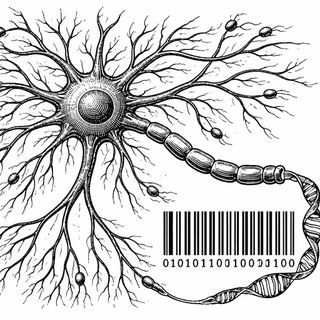
A team led by researchers at the University of Illinois Urbana-Champaign has developed what can only be described as an elegantly sneaky solution. Their method, Connectome-seq, essentially gives each neuron a unique RNA barcode and then exploits the cell's own synaptic machinery to deliver matching barcodes to connected neurons. Think of it as molecular Tinder, but instead of swiping right, neurons are exchanging business cards at every synaptic handshake.
The technical wizardry involves adeno-associated viruses (AAVs) - harmless viral vectors beloved by neuroscientists for their ability to slip genetic cargo into brain cells without causing a fuss. These AAVs deliver engineered proteins that shuttle barcoded RNA molecules across synapses. When you later sequence the contents of individual synaptic junctions, you can read which barcode pairs ended up together, revealing precisely which neurons are physically connected.
It's rather like solving a puzzle by reading the serial numbers on interlocking pieces rather than staring at the picture until your eyes water.
What They Actually Found
The team tested their approach on the mouse pontocerebellar circuit - the neural highway connecting the pons (a relay station at the base of the brain) to the cerebellum (your balance and coordination headquarters). This pathway has been studied for decades, which makes it ideal for validation: if Connectome-seq produces nonsense, someone would notice.
Instead, it produced over 1,000 mapped neurons and some genuine surprises. The researchers identified connectivity patterns between cell types that nobody had previously documented in the adult brain. More intriguingly, by simultaneously capturing gene expression data alongside connectivity information, they spotted molecular signatures that seem to predict which neurons will connect with which - hints at the underlying rules governing brain wiring.
Why This Matters Beyond the Laboratory
Here's the thing about neural circuits: when they go wrong, so does everything else. Parkinson's disease, autism, dystonia, various ataxias - all involve disrupted connectivity in specific brain networks. But diagnosing and understanding these conditions currently relies on relatively blunt tools. We're essentially trying to debug software by looking at the computer case.
Connectome-seq offers something genuinely new: the ability to compare wiring diagrams between healthy and diseased brains at single-synapse resolution, while retaining information about cell types and gene expression. You could map how connectivity changes as Alzheimer's progresses, or identify the precise circuit alterations underlying a particular movement disorder. The method scales reasonably well - certainly better than slicing a brain into 70-nanometer sections and photographing each one.
Of course, we're still mapping mouse brains. The human brain contains roughly 100 trillion synapses, and even the most optimistic barcode enthusiast would admit that presents certain logistical challenges. But the principle is sound, and the technology will inevitably improve.
The Quiet Revolution in Brain Cartography
For decades, neuroscientists have operated with what amounts to a medieval map of the brain - "here be dragons" territory for much of the detailed circuitry. The past few years have seen remarkable progress: the complete Drosophila connectome, increasingly sophisticated human imaging, and now high-throughput molecular methods like Connectome-seq.
We're not quite at the point where your neurologist can pull up a detailed wiring diagram of your brain and spot the faulty connection. But we're considerably closer than we were, and the path forward is becoming clearer.
One barcode at a time.
References
-
Chen D, Isakova A, Wan Z, Wagner MJ, Wu Y, Zhao BS. Connectome-seq: high-throughput mapping of neuronal connectivity at single-synapse resolution via barcode sequencing. Nature Methods. 2026. DOI: 10.1038/s41592-026-03026-9. PMCID: PMC12478398
-
Dorkenwald S, et al. Neuronal wiring diagram of an adult brain. Nature. 2024. Available at: MIT McGovern Institute
-
Human Connectome Project. Structure-function relationships in the brain. ScienceDaily. November 2025. Available at: ScienceDaily
-
Murthy M, Seung S, White J, Rubin G. Wiley Prize in Biomedical Sciences for connectome mapping. Princeton University. February 2026. Available at: Princeton News
-
Stanford Wu Tsai Neurosciences Institute. Q&A: High-throughput brain mapping - a barcode for every synapse. Available at: Stanford Neuroscience
Disclaimer: The image accompanying this article is for illustrative purposes only and does not depict actual experimental results, data, or biological mechanisms.