
Back in 1906, there was a scientific showdown about how the nervous system is organized. Santiago Ramon y Cajal argued that neurons are separate cells that communicate through synapses, tiny gaps where one cell signals to another. Camillo Golgi thought the whole nervous system might be one continuous network, with cells directly connected to each other. They shared the Nobel Prize that year, but Cajal's view won in the court of scientific opinion. The neuron doctrine became textbook gospel.
A review in Biological Reviews suggests we might want to give Golgi a little more credit. Neurons can indeed directly share cytoplasm through non-synaptic connections, and this forgotten aspect of neural biology might actually matter for understanding how the brain works and why it sometimes breaks.
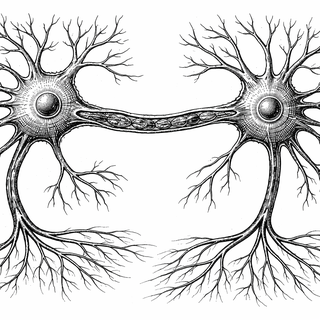
The Secret Tunnels Nobody Talks About
There are at least three ways neurons can form direct physical connections with each other, and none of them involve synapses.
First, there are intercellular bridges. These form when cells divide but don't fully separate, like conjoined twins who never got the surgery. The daughter cells end up sharing a bit of cytoplasm through a permanent connection. This happens during neural development and in certain stem cell populations.
Second, there are tunneling nanotubes. These are thin membrane tubes that cells actively build to connect with their neighbors. One cell reaches out, makes contact with another, and establishes a channel through which material can flow. It's not an accident or a leftover from cell division. Cells do this deliberately.
Third, cells can just fuse together. Two separate cells become one, merging their membranes and sharing their contents. This sounds dramatic, and it is, but it happens in various biological contexts.
Through any of these connections, cells can exchange stuff. Not just small signaling molecules, but big things. Organelles. Proteins. Mitochondria, those little power plants that generate cellular energy. It's like discovering your apartment has a hole in the wall connected to your neighbor's place, and you've been sharing appliances without knowing it.
This Isn't Just Weird Lab Stuff
You might be thinking this sounds like something that only happens in artificial conditions, Petri dish artifacts that don't reflect real biology. The review addresses this concern directly: these connections show up in organisms with ancient nervous systems and in developing mammalian brains.
Ctenophores, commonly known as comb jellies, have some of the most evolutionarily ancient nervous systems on Earth. They represent what nervous systems looked like hundreds of millions of years ago. And they have these cytoplasmic connections. If this were just a lab artifact, you wouldn't expect to find it in organisms that diverged from our lineage before synapses even became standardized.
The connections also appear during mouse brain development. This suggests they're part of the normal toolkit that developing brains use to build themselves, not just a curiosity.
The Good and Bad of Sharing
If neurons can share beneficial things with each other, they can also share harmful things. This has implications for understanding how neurodegenerative diseases spread through the brain.
Conditions like Alzheimer's and Parkinson's involve pathological proteins that aggregate and damage cells. A big question in the field has been how these protein aggregates spread from cell to cell. Synaptic transmission has been one proposed route, but cytoplasmic connections offer another. If neurons are directly connected, toxic proteins could potentially move between cells without needing to be released and taken up through normal secretion and absorption pathways.
On the flip side, there's a rosier possibility. Healthy neurons might be able to rescue struggling neighbors by lending them functional organelles. If your mitochondria are failing, maybe a healthy neighbor can send you some backup power plants through a tunneling nanotube. Brain cells might be running tiny charitable operations, sharing resources to keep the network functioning.
This bidirectional possibility, sharing both good and bad, makes cytoplasmic connections a potentially important factor in both brain resilience and brain disease.
Why Did We Miss This?
The neuron doctrine has been so successful and so central to how we think about the brain that alternative modes of connection were easy to overlook. Synapses are undeniably important. They're where most of the action happens for fast neural signaling. The elegant system of neurotransmitter release, receptor binding, and electrical changes is beautiful and well-characterized.
But the focus on synapses may have created a blind spot. If you're only looking for synaptic connections, you might miss other ways cells are communicating. The technologies traditionally used to study neural circuits emphasize synaptic wiring. Cytoplasmic connections might have been there all along, just below the radar.
The review argues that neuroscience needs to incorporate these non-synaptic connections into its models. They're not replacing synapses in importance, but they might be adding a dimension we haven't fully appreciated.
What Does This Mean for Understanding the Brain?
If cytoplasmic connections are widespread and functionally important, we might need to revise some of our assumptions about how information and resources flow through neural networks.
Synaptic transmission is about signals. One neuron fires, releases neurotransmitter, the next neuron responds. It's discrete, fast, and directional. Cytoplasmic connections are about material exchange. Proteins, organelles, even genetic material moving between cells. It's slower, bidirectional, and involves sharing actual cellular components rather than just signals.
A brain that combines both modes of communication is more complicated than one that only uses synapses. But it might also be more flexible, more resilient, and capable of coordination strategies that pure synaptic signaling can't achieve.
Golgi's Quiet Vindication
Camillo Golgi lost the scientific argument in his own time. His idea of a continuous nervous system seemed to contradict the evidence for discrete neurons. But in a way, he was seeing something real. Neurons aren't as isolated as the neuron doctrine suggests. They can connect directly, share their contents, and function more like a network with physical links rather than a collection of independent units communicating only through synaptic gaps.
He didn't get the details right, and synapses are definitely a major mode of communication. But the intuition that the nervous system might be more continuous than Cajal's model suggested? Maybe that deserves a second look.
Somewhere in the history of science, Golgi might be enjoying a quiet smile.
Reference: Rakotobe M, Zurzolo C. (2025). Beyond synapses: cytoplasmic connections in brain function and evolution. Biological Reviews. doi: 10.1111/brv.70034 | PMID: 40515735
Disclaimer: The image accompanying this article is for illustrative purposes only and does not depict actual experimental results, data, or biological mechanisms.