
When scientists named a protein "Death Receptor 6," they weren't being subtle. It sounds like the villain in a low-budget sci-fi movie, and for years, researchers believed it lived up to its ominous name. Previous studies suggested DR6 was a key player in axon degeneration - the slow, agonizing breakdown of nerve fibers that happens after injury and in diseases like ALS. Block DR6, the thinking went, and you might save neurons from their own self-destruct sequence.
Turns out, DR6 might just be the most over-hyped protein in neuroscience.
The Setup: A Villain's Origin Story Gets Fact-Checked
Here's the backstory. When a nerve gets injured, something called Wallerian degeneration kicks in. Named after Augustus Waller, who first described it in 1850 (yes, we've been puzzling over this for that long), it's essentially the nervous system's cleanup crew. The damaged part of the axon breaks down while Schwann cells - the support staff of peripheral nerves - transform into repair mode, clearing debris and setting the stage for regeneration.
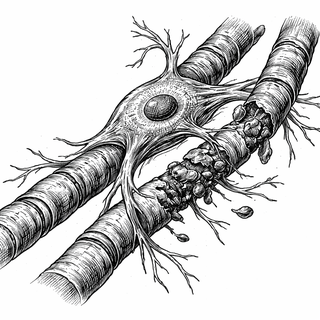
A 2017 study reported that DR6 was essential for this breakdown process. Mice without DR6 supposedly kept their axons intact for weeks after injury. This was exciting news. Maybe we'd found an off-switch for nerve death!
The Twist Nobody Saw Coming
Enter Bogdan Beirowski and colleagues, who decided to double-check these findings. Using not one but two different DR6 knockout mouse lines (because if you're going to debunk something, you do it properly), they ran the whole experiment again.
The result? Nothing. Nada. Zero difference.
Axons in DR6-deficient mice degenerated at exactly the same rate as normal mice. The Schwann cells did their usual injury response dance - activating c-Jun (a master switch for nerve repair), remodeling myelin, the whole routine - completely unaffected by DR6's absence. Even when they grew neurons in a dish and removed DR6, those axons still fell apart on schedule.
DR6, it seems, was innocent all along.
Why This Actually Matters
You might think, "Great, scientists got something wrong and then corrected it. That's just science doing its thing." And you'd be right, but there's more to this story.
SARM1 - now there's a protein that actually runs the axon death program. When injury depletes NAD+ (your cells' energy currency), SARM1 activates and essentially drains the remaining metabolic reserves, triggering a cascade that ends in fragmented axons. This is the real executioner, and pharmaceutical companies are actively developing SARM1 inhibitors as potential treatments for nerve injuries and neurodegenerative diseases.
Meanwhile, Schwann cells remain the unsung heroes of nerve repair. These remarkable cells can completely reprogram themselves after injury, transforming from myelin-producing factories into elongated repair cells that clear debris, secrete growth factors, and literally build highways (called Bands of Büngner) for regenerating axons to follow. The transcription factor c-Jun orchestrates this transformation, and when it fails - particularly in aging - nerve regeneration suffers.
The Bigger Picture
This study is a reminder that science is messy. Results get published, other labs try to replicate them, and sometimes the original findings don't hold up. It's not a bug in the system - it's a feature. The 2009 paper that first implicated DR6 in axon death through its interaction with amyloid precursor protein (APP) was actually retracted from Nature, though related work continued.
The good news? We now know not to waste resources chasing DR6 as a therapeutic target for preventing Wallerian degeneration. Any benefits from blocking DR6 in disease models probably come through entirely different mechanisms - perhaps affecting cell body survival or synaptic function rather than axon breakdown itself.
For the millions of people dealing with peripheral nerve injuries each year, the path forward is clearer: focus on the real players. That means understanding SARM1, supporting Schwann cell function, and finding ways to keep c-Jun active in aging nerves. Sometimes learning what doesn't work is just as valuable as discovering what does.
References:
-
Beirowski, B., Huang, H., & Babetto, E. (2025). Death receptor 6 does not regulate axon degeneration and Schwann cell injury responses during Wallerian degeneration. eLife, 14:e108389. DOI: 10.7554/eLife.108389
-
Gamage, K.K., et al. (2017). Death Receptor 6 promotes Wallerian degeneration in peripheral axons. Current Biology, 27(6):890-896. PMCID: PMC5360522
-
Figley, M.D., & DiAntonio, A. (2020). The SARM1 axon degeneration pathway: Control of the NAD+ metabolome regulates axon survival in health and disease. Current Opinion in Neurobiology, 63:59-66. PMCID: PMC7483800
-
Arthur-Farraj, P.J., et al. (2012). c-Jun reprograms Schwann cells of injured nerves to generate a repair cell essential for regeneration. Neuron, 75(4):633-647. PMCID: PMC3657176
-
Tao, J., et al. (2025). Enhancing peripheral nerve regeneration in aging: the role of Schwann cells, c-Jun, and emerging therapeutic strategies. GeroScience. DOI: 10.1007/s11357-025-01882-5
Disclaimer: The image accompanying this article is for illustrative purposes only and does not depict actual experimental results, data, or biological mechanisms.