
For decades, the standard mental model of cancer was pretty straightforward: cells go rogue, divide uncontrollably, form a tumor, and try to spread. Fight the cells, beat the cancer. Simple narrative, clear enemy, focused treatment approach. But a review in Advanced Science makes a compelling case that we've been missing a major character in this story: the nervous system. Tumors don't just grow in isolation. They actively recruit nerves, form synaptic connections, and basically set up their own private communication network.
Welcome to cancer neuroscience, where your nerves might be working for the other team.
Nerves Were Supposed to Be Innocent Bystanders
The traditional view was that nerves were just passing through. They ran through tissues doing their normal nerve things, occasionally getting squashed or irritated by growing tumors, but not really participating in the cancer process itself. Background scenery, not active players.
That view is looking increasingly naive. Recent discoveries show that nerves actively shape cancer at every stage of the disease: initiation, progression, metastasis, and even treatment resistance. They're not innocent bystanders; they're collaborators.
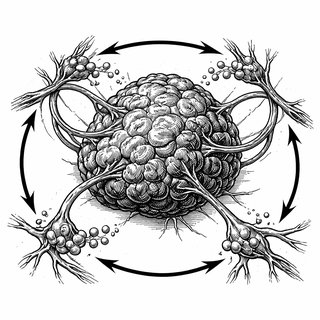
The relationship operates through multiple mechanisms. Some tumors form direct synaptic connections with nerves, essentially plugging themselves into the nervous system like plugging a device into a power grid. Others communicate through chemical signaling, sending and receiving neurotransmitters and growth factors. Some cancer cells get so cozy with the nervous system that they actually acquire neuron-like properties and form functional synapses.
The tumor is basically building its own telephone network, and it's using it to coordinate with the rest of your body.
The Dirty Details of Neural-Cancer Collaboration
Tumors recruit nerves into their microenvironment, and those nerves then release growth factors and neurotransmitters that promote cancer cell survival. Neural signals influence cancer cell metabolism, helping tumors thrive. They affect stemness, the ability of cancer cells to self-renew and resist treatment. They even help tumors evade immune attack.
The tumor microenvironment, that complex ecosystem of blood vessels, immune cells, and stromal cells surrounding a tumor, includes neural elements as active participants. The nerves aren't just scenery; they're players.
Think of it like a city where you thought the telephone lines were just infrastructure, only to discover they're actively helping the criminals coordinate their activities.
New Ways to Fight Back
Understanding these neural-cancer interactions opens up therapeutic opportunities that weren't obvious before.
Cutting nerve supply to tumors (denervation) can slow tumor growth in some cancers. If the tumor is using nerves for communication and support, cutting those lines might cripple it.
Drugs targeting neurotransmitter receptors might complement conventional cancer therapies. Some of these drugs already exist for other purposes, so repurposing them could be faster than developing new compounds from scratch.
Here's an interesting one: beta-blockers, those common heart medications that block certain neural signals, have shown promise in some cancers. The reason might be that they disrupt neural signaling pathways that tumors exploit for survival. Your grandfather's blood pressure medication might have anti-cancer properties nobody expected.
A Young Field With Serious Potential
Cancer neuroscience is still in its early days. The field is growing rapidly, but there's a lot we don't know. Which tumors are most dependent on neural input? What are the key signaling pathways? How can we target them without causing unacceptable side effects?
But the potential is significant. Integrating neuroscience perspectives into oncology could yield insights that pure molecular approaches miss. Cancer has been studied intensively as a genetic disease and an immune disease, but the neural angle is relatively new. Fresh perspectives sometimes see things that established approaches overlook.
Your nervous system might be a secret battleground where cancer fights for survival. Time to start fighting back on that front too.
Reference: Bhattacharyya S, et al. (2025). Cancer Neuroscience: Decoding Neural Circuitry in Tumor Evolution for Targeted Therapy. Advanced Science. doi: 10.1002/advs.202506813 | PMID: 40926561
Disclaimer: The image accompanying this article is for illustrative purposes only and does not depict actual experimental results, data, or biological mechanisms.