
Picture this scene in a neuroscience lab: a researcher hunched over a mouse, carefully poking its paw with increasingly stiff filaments, trying to determine exactly how sensitive the animal is to touch. Now picture doing this hundreds of times. Per day. For months.
This is the glamorous reality of pain research.
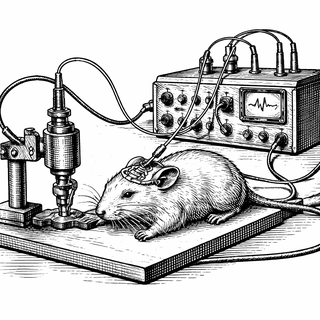
A study in eLife presents a solution that sounds almost too obvious: what if we let a robot do the poking? Introducing ARM, a device that delivers mechanical stimuli automatically while recording what the brain is doing. It's more consistent than humans, never gets tired, and nobody ends up with carpal tunnel.
The Problem With Human Paw-Pokers
Let's talk about von Frey filaments, the standard tool for testing mechanical sensitivity in rodents. They're basically calibrated plastic hairs of different stiffnesses. You poke the animal's paw, starting with the softest filament, and gradually increase until you get a response. Flinch or withdrawal tells you the sensitivity threshold.
Simple in principle. Nightmarish in practice.
First, it takes forever. Each animal needs many trials at many force levels. Studies involve dozens of animals. You're spending entire days just... poking paws.
Second, humans are terrible at being consistent. How hard you press, the angle of approach, how long you hold the filament, whether you've had coffee yet, all of this introduces variability. One researcher might get systematically different results than another, even with identical animals.
Third, and this is the part nobody talks about in grant applications, this work destroys your hands. Repetitive strain injuries are an occupational hazard of pain research. The irony writes itself.
Enter ARM: The Robot That Pokes So You Don't Have To
The researchers built a device they call ARM, which stands for Automated Reproducible Mechanostimulation (scientists love their acronyms). It delivers mechanical stimuli remotely, with precise force control, while the animal is awake and behaving normally.
No more hunching. No more variable poke angles. No more wondering if your postdoc and your grad student are secretly using different techniques.
The device integrates with brain recording equipment, so you can deliver a precisely calibrated stimulus and immediately see what the brain is doing in response. This is the kind of thing that was technically possible before but practically painful enough that people avoided it.
Why Reproducibility Matters (Especially in Pain Research)
Here's the dirty secret of behavioral neuroscience: replication is harder than it should be. You'd think poking a mouse paw would give pretty consistent results, but labs routinely struggle to reproduce each other's findings.
Some of this is genuinely biological. Mice are individuals; they have different sensitivities. But a lot of it is technical. The human element introduces noise that obscures the signal.
ARM attacks this problem directly. When the machine delivers a 2.5 gram stimulus at a 90-degree angle for exactly 500 milliseconds, it does that every single time. When your grad student tries to do the same thing, well, they do their best. But their best varies with fatigue, distraction, and whether they've been at the bench for one hour or eight.
More consistent stimulation means cleaner data. Cleaner data means smaller sample sizes for the same statistical power. Smaller sample sizes mean faster experiments with fewer animals. This is the kind of virtuous cycle that makes methodology papers worth reading.
New Science Becomes Possible
Beyond just doing the old experiments better, automation enables new experiments entirely. When stimulation is cheap and easy, you can do a lot more of it.
Want to map how sensitivity changes across the entire paw surface? That used to mean days of manual testing. Now you program a grid and let the robot work.
Want to deliver hundreds of stimuli while recording from specific brain regions to build detailed neural response profiles? Impractical with manual methods, straightforward with ARM.
Want to track how sensitivity changes over the course of hours as an animal develops or recovers from injury? You'd burn out your research staff. The robot just keeps going.
This is how tools reshape science. It's not just that automation is faster (though it is). It's that the entire landscape of what's worth attempting changes when the cost of data collection drops.
The Awake, Behaving Mouse Advantage
One detail worth emphasizing: ARM works with awake, behaving animals. A lot of sensory neuroscience happens in anesthetized preparations, which is convenient for the researcher but not exactly representative of normal brain function.
Anesthesia fundamentally alters how the nervous system processes information. Recording from an anesthetized mouse tells you something, but it doesn't tell you what the brain does when the animal is actually experiencing the world.
Getting automated stimulation to work in behaving animals is harder. The mouse moves. The paw isn't always in the same place. You need feedback systems to track and target accurately. But the payoff is data that reflects actual sensory processing, not an unconscious approximation.
The Bigger Picture: Automation Is Coming for Behavioral Neuroscience
ARM is one example of a broader trend. As behavioral experiments get more sophisticated, the human bottleneck becomes increasingly limiting. Animals can be tested around the clock. Computers don't need sleep. Robots don't develop opinions about whether an animal "really" responded to a stimulus.
We're likely to see more of this: automated behavioral testing, robotic sample handling, AI-assisted analysis. Not because scientists are lazy (okay, maybe a little) but because the questions worth answering require more data than humans can practically collect.
For pain research specifically, this matters a lot. Pain is subjective in humans and hard to assess in animals. Every bit of noise in your measurement makes it harder to detect real effects. Standardized, automated testing gets you cleaner data and, hopefully, better insights into how pain works and how to treat it.
The Bottom Line
Someone built a robot to poke mouse paws, and it's genuinely useful. More consistent than manual testing, less fatiguing for researchers, and enabling experiments that weren't practical before.
It's not going to cure chronic pain by itself. But better tools lead to better data, which leads to better understanding. And somewhere in that understanding is the path to treatments that actually work.
Plus, nobody's getting repetitive strain injuries anymore. That alone seems like a win.
Reference: Bhattacharyya S, et al. (2025). Remote automated delivery of mechanical stimuli coupled to brain recordings in behaving mice. eLife. doi: 10.7554/eLife.99614 | PMID: 41104746
Disclaimer: The image accompanying this article is for illustrative purposes only and does not depict actual experimental results, data, or biological mechanisms.