
Detecting neurotransmitters is one of those problems that sounds simple until you actually try it. "Just measure the serotonin," you might say. Sure, except serotonin exists at absurdly low concentrations, looks chemically similar to dozens of other molecules in the brain, and tends to hide among a crowd of lookalikes that all want to mess with your sensor. Traditional detection methods force you to make an unpleasant choice: be really sensitive (catch even tiny amounts) or be really specific (only catch what you're actually looking for). Pick one, because you usually can't have both.
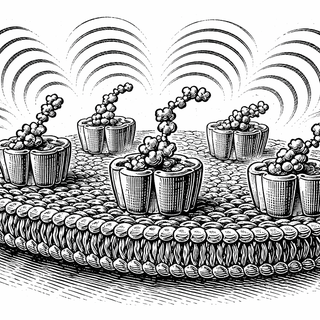
A new biosensor described in Advanced Materials says "why not both?" by combining exotic physics with some clever biological mimicry. The result is a detector that can spot serotonin at trace levels while ignoring everything else. Sometimes the best engineering is just copying what evolution already figured out.
The Needle in a Very Distracting Haystack
Let's appreciate how hard this problem actually is. Serotonin in brain tissue exists at concentrations measured in nanomoles. We're talking about finding specific molecules among billions of other molecules, all sloshing around in a soup of similar chemicals.
Traditional optical detection methods often can't tell what they're really measuring. You shine light at a sample, something absorbs it, you call it serotonin. Except maybe it was dopamine. Or norepinephrine. Or some random metabolite that happened to be in the way. The signals overlap, the specificity is poor, and you end up publishing results that might be measuring what you think you're measuring or might be measuring noise.
This matters because serotonin is involved in everything from mood regulation to gut function to blood clotting. Getting accurate measurements isn't just academic. It has clinical implications. And most current methods are varying degrees of imprecise.
Enter the Star Trek Technology
The new sensor combines two technologies that sound like they belong in a science fiction movie. First, terahertz spectroscopy. This uses radiation from that weird gap in the electromagnetic spectrum between microwaves and infrared light. Terahertz waves are useful because they interact with molecules in unique ways that provide information about structure and dynamics. They're also notoriously difficult to work with, which is why most people don't use them.
Second, nanodiscs. These are tiny lipid structures, basically miniature cell membranes that can be loaded with proteins. Think of them as little life rafts for receptor proteins that would normally need to be embedded in an actual cell membrane to function.
Here's the clever part that makes this work. The researchers didn't just build a generic sensor and hope it would detect serotonin. They engineered their nanodiscs to contain GPCR receptors, the same class of proteins that neurons naturally use to detect serotonin. Your brain cells have been doing serotonin detection for hundreds of millions of years. Why reinvent the wheel?
Teaching Physics to Speak Biology
The device works like this: serotonin floating in solution encounters the nanodisc surface. It binds to the GPCR receptor embedded in the nanodisc because that's what serotonin is supposed to do with those receptors. This binding event changes the local molecular environment. Water molecules rearrange. The receptor changes shape slightly. The whole nanoscale neighborhood shifts.
These changes alter how terahertz radiation interacts with the surface. The sensor is essentially watching the physics of light scattering and seeing it shift when serotonin shows up and does its thing.
What makes this dual-selective is that you need both the right molecule (one that binds the receptor) AND the right frequency signature (one that shows up in the terahertz range). Random interfering chemicals might bind weakly or not at all. They might scatter terahertz waves differently. Either way, they get filtered out.
Belt and suspenders. Biological specificity plus physical selectivity.
Watching Molecular Handshakes in Real Time
The combination of these technologies achieved dramatically better sensitivity and specificity than either would alone. But what's really interesting is the kind of information this sensor can provide.
This isn't just "is serotonin present yes or no." The sensor can detect the molecular handshake between serotonin and its receptor as it happens. It can pick up changes in the water molecules surrounding the binding site. It can track the dynamics of binding and release.
In other words, it doesn't just tell you that serotonin is there. It tells you what serotonin is doing right now. For researchers trying to understand how neurotransmitter signaling actually works in real biological systems, that's a different category of information than just measuring concentrations.
The Long Road from Lab Bench to Clinic
Let's be realistic about where this technology is. It's still in early development. The sensor works in controlled laboratory conditions, which is great for proof of concept but a long way from being shoved into someone's brain or deployed in a clinical setting.
The potential applications span biomedical diagnostics (imagine detecting serotonin imbalances from a simple test) and neuroscience research (watching neurotransmitter dynamics in near-biological conditions rather than inferring them from downstream effects). Being able to directly observe how serotonin interacts with receptors opens windows into signaling that we've previously only glimpsed indirectly through behavioral or pharmacological experiments.
There are also limitations. Terahertz equipment isn't exactly portable or cheap. Making the nanodiscs with embedded receptors requires some sophisticated biochemistry. And the jump from detecting purified serotonin in buffer to detecting it in actual brain tissue introduces a host of new challenges.
Sometimes the Best Sensor Is Already in Your Head
What makes this work elegant is how it leverages biology to solve a biology problem. Instead of trying to engineer a sensor from scratch that somehow recognizes serotonin among all the other molecules floating around, the researchers used the receptor proteins that evolution spent millions of years perfecting.
Neurons know how to detect serotonin. That's literally what these receptors do for a living. The sensor just borrowed that capability and combined it with physics that can see what the receptor is experiencing.
It's a reminder that some of the best engineering insights come from copying what already works. The brain figured out serotonin detection a long time ago. We just finally built a machine that listens to how it's done.
Reference: Kim T, et al. (2025). Dual-Selective Terahertz-Nanodisc Metasurfaces for Exploring Neurotransmitter Dynamics beyond Spectral Limitations. Advanced Materials. doi: 10.1002/adma.202504858 | PMID: 40556580
Disclaimer: The image accompanying this article is for illustrative purposes only and does not depict actual experimental results, data, or biological mechanisms.