
The retina is basically a tiny computer at the back of your eyeball, processing light into signals that your brain can understand. All of that processed information leaves through retinal ganglion cells, which are like the USB cables connecting your eye-computer to your brain-computer. Every single thing you see passes through these cells. And now, for the first time, researchers can control them one at a time in a living primate eye. A study in eLife reports achieving single-cell optogenetic stimulation in the primate fovea, which is a sentence that sounds like science fiction but is now actual science.
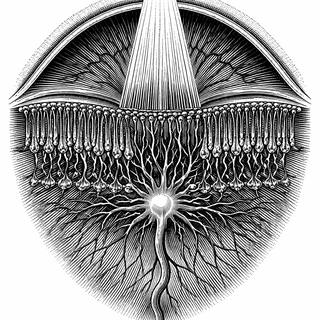
The Eye's Only Output Channel
Let's talk about why retinal ganglion cells matter so much. Your retina does a surprising amount of visual processing before information even reaches your brain. Photoreceptors detect light, but then there are layers of other neurons that start making sense of it all. Edge detection, motion sensing, contrast enhancement, all happening right there in your eyeball.
But here's the catch: all of that processing has to leave the eye through one type of cell. Retinal ganglion cells are the only neurons that send signals from the retina to the brain. Everything your visual cortex knows about the world comes through these cells. They're the bottleneck, the checkpoint, the final common pathway.
This means if you want to understand how vision works at a fundamental level, you need to understand what retinal ganglion cells are telling the brain. And if you want to someday build artificial vision systems for blind people, you need to know how to talk to these cells in the language the brain expects.
The Problem With Living Eyes
Studying retinal ganglion cells in a dish is relatively straightforward. Take out the retina, keep it alive in solution, poke the cells with electrodes, see what happens. But that approach has limitations. The retina is disconnected from everything it normally interacts with. You can't see how the signals affect actual perception. You're studying a component, not a working system.
Studying retinal ganglion cells in living eyes is much harder. The eye is a wet, moving, optically imperfect ball of tissue. The animal blinks and looks around. There are layers of other tissue between you and the cells you care about. And if you want to study the fovea specifically, the high-resolution center of vision where your best visual acuity comes from, you're talking about a tiny region with tightly packed cells.
Previous techniques could stimulate or record from general areas of the retina, but getting down to individual cells in the living fovea? That was the white whale.
Optogenetics Meets Adaptive Optics
The researchers pulled this off by combining two powerful technologies. First, optogenetics, where you genetically engineer cells to express light-sensitive proteins so you can control them with specific wavelengths of light. Point a laser at the cell, it activates. Turn off the laser, it stops. It's like installing a light switch in a neuron.
Second, adaptive optics, the same technology astronomers use to correct for atmospheric distortion when looking at stars. Except here, it's correcting for optical aberrations in the eye. The primate eye isn't a perfect lens. There are imperfections that blur your targeting. Adaptive optics measures these distortions in real time and adjusts the laser beam to compensate.
Put them together and you can hit individual retinal ganglion cells with precision, even in a living eye that's moving around. The researchers did this in the fovea of macaque monkeys, which have visual systems very similar to humans.
What Can You Do With a Cell-by-Cell Remote Control?
Once you can stimulate individual cells, you can start asking questions that were previously impossible. What does activating this specific cell type do to visual processing? If you activate multiple cells in specific patterns, what does the brain interpret that as? Can you create artificial percepts by driving retinal ganglion cells directly?
The study opens the door to linking cellular physiology to perception in ways that weren't feasible before. Instead of inferring what individual cells contribute to vision from population recordings, you can directly test it. Activate cell X, see what the animal perceives (or measure what the brain does in response). It's causation, not just correlation.
The Road to Retinal Prostheses
There's a practical angle here too. Millions of people are blind due to conditions that destroy photoreceptors while leaving retinal ganglion cells intact. The cells that detect light are gone, but the output channel to the brain is still there. In principle, you could restore some vision by directly stimulating those remaining cells.
Current retinal prostheses exist, but they're crude by comparison. They stimulate populations of cells with electrical fields, creating blurry, low-resolution percepts. For better artificial vision, you'd want to stimulate the right cell types in the right patterns at the right times.
That requires understanding exactly how different types of retinal ganglion cells contribute to vision. The fovea alone has multiple cell types with distinct functions. To create high-resolution artificial vision, you need to speak their language precisely. This study provides tools to figure out what that language actually is.
Why Primates Matter Here
Doing this work in primates isn't just about convenience. The primate fovea is special. Most mammals don't have one. Mice, the workhorses of neuroscience, have retinas with completely different architecture. If you want to develop techniques relevant to human vision restoration, you need to work in primates with human-like visual systems.
The macaque fovea is about as close to human as you can get in a research animal. The cell types, the density, the organization, it's all very similar. What works here has a realistic chance of translating to human applications down the line.
The Bigger Picture
This study represents the kind of slow, methodical progress that eventually transforms fields. It's not announcing a cure for blindness. But it's providing tools that will help us understand vision at a level of precision we couldn't reach before.
And somewhere in the future, a person who lost their sight might see again because scientists figured out how to remote-control individual cells in a monkey's eye. That's how this work goes: weird, specific, technical achievements that eventually add up to something that matters.
Reference: Bhattacharyya S, et al. (2025). Optogenetic stimulation of single ganglion cells in the living primate fovea. eLife. doi: 10.7554/eLife.105041 | PMID: 41041715
Disclaimer: The image accompanying this article is for illustrative purposes only and does not depict actual experimental results, data, or biological mechanisms.