Your DNA is basically a 3-billion-letter instruction manual. And like any document that long, it's going to have typos. Most are harmless. But sometimes a single wrong letter - one measly A where there should be a G - can rewire an entire brain during development.
That's essentially what happens in Snijders Blok-Campeau syndrome, a rare neurodevelopmental disorder so uncommon that only about 150 people worldwide have been diagnosed. It's caused by mutations in the CHD3 gene, which is basically the brain's interior decorator during development - it rearranges chromatin (the packaging around DNA) to make sure the right genes get switched on at the right time. When CHD3 is broken, the whole decorating plan falls apart. Kids with the condition face intellectual disability, speech difficulties, motor problems, and often autism-like behaviors.
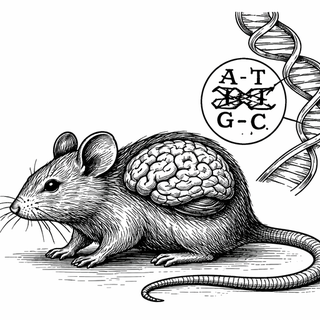
Here's the thing. A team of researchers just showed they can fix it. In mice, at least. And the way they did it is wild.
The World's Most Precise Spell-Checker
Traditional CRISPR gene editing works like scissors - it cuts both strands of your DNA and hopes your cell's repair crew patches things up correctly. It's effective, but about as delicate as performing surgery with garden shears. Base editing is the next-gen upgrade. Instead of cutting, it chemically converts one DNA letter directly into another. No double-strand breaks. No crossed fingers.
The tool in question is called TeABE - a TadA-embedded adenine base editor - and it does exactly one thing really well: it converts an A-T base pair back to a G-C pair. That's it. One letter. The biological equivalent of fixing a single typo in a novel without tearing out the page.
Yang and colleagues at Shanghai Jiao Tong University first created a mouse model carrying the exact same CHD3 mutation (p.R1025W) commonly found in kids with Snijders Blok-Campeau syndrome. These mice had the full package - social communication deficits, cognitive problems, and motor coordination issues (Yang et al., 2026).
Delivery: The Hard Part Nobody Talks About
Getting a gene editor into the brain is like trying to deliver a pizza through a locked door with no doorbell. The blood-brain barrier exists specifically to keep foreign stuff out, which is great for avoiding brain infections and terrible for delivering therapeutics.
The solution? A dual AAV (adeno-associated virus) system using PHP.eB capsids - engineered viral shells that have learned the secret handshake to cross the blood-brain barrier. Because the base editor is too large to fit into a single AAV (those things have the cargo capacity of a carry-on bag), the team split it across two viral vectors that reassemble inside brain cells through a process called intein-mediated protein splicing.
They injected it into the tail vein. The tail vein! A systemic injection that somehow reached neurons across the cortex and hippocampus. Brain-wide delivery from a shot in the tail.
The Results Are Genuinely Impressive
The numbers tell the story. About 80% Cas9 reconstitution efficiency at higher doses. Roughly 10-15% on-target editing at the intended site, with over 80% of edits hitting exclusively the therapeutic target. Bystander editing stayed around 2-3%, and off-target effects clocked in below 1% (Bender, 2026).
More importantly, CHD3 protein levels bounced back to near-normal in treated brain regions. And the mice? They were learning better, socializing more, and showing dramatically improved physical coordination compared to their untreated counterparts. The behavioral rescue was real and measurable.
From Mice to Monkeys (and Maybe Humans?)
Look. Mouse results are mouse results. We've all seen the "cured in mice" headlines that go nowhere. But this team went a step further - they demonstrated intrathecal delivery of the dual AAV system in nonhuman primates and showed widespread neuronal transduction and efficient TeABE reconstitution. That's a meaningful bridge toward clinical translation.
The broader picture is exciting too. Base editing approaches are gaining momentum across neurology. Recent work has used CRISPR activation to rescue SCN2A haploinsufficiency in mice (Bhattacharyya et al., 2025), and interneuron-specific gene replacement has shown promise for Dravet syndrome (Mora-Jimenez et al., 2025). A review of CRISPR-based strategies for monogenic neurodevelopmental disorders suggests we're entering an era where single-letter fixes could become standard therapeutic tools (Sánchez-Rivera & Jacks, 2025).
Why This Matters Beyond Rare Disease
Snijders Blok-Campeau syndrome affects maybe 150 people. So why should the rest of us care? Because CHD3 is part of the NuRD chromatin remodeling complex - and mutations in related CHD genes (CHD1, CHD2, CHD4, CHD7, CHD8) cause a whole constellation of neurodevelopmental conditions. If you can fix one, the playbook works for others.
This research is proof of concept that postnatal, systemic, single-nucleotide correction in the brain is possible. Not theoretical. Not someday. Possible now, in living animals, with measurable behavioral improvement.
The era of editing the brain's source code - one letter at a time - just got a lot more real.
References
-
Yang, K., Li, W.K., Geng, Y.X. et al. In vivo base editing of Chd3 rescues behavioural abnormalities in mice. Nature 651, 785-795 (2026). DOI: 10.1038/s41586-026-10113-6 | PMID: 41708849
-
Bender, K.J. Gene editing treats a mouse model of a neurodevelopmental disorder. Nature 651, 590-591 (2026). DOI: 10.1038/d41586-026-00291-8 | PMID: 41708820
-
Bhattacharyya, B.J. et al. CRISPR activation for SCN2A-related neurodevelopmental disorders. Nature 646 (2025). DOI: 10.1038/s41586-025-09522-w
-
Mora-Jimenez, L. et al. Interneuron-specific dual-AAV SCN1A gene replacement corrects epileptic phenotypes in mouse models of Dravet syndrome. Science Translational Medicine (2025). DOI: 10.1126/scitranslmed.adn5603 | PMID: 40106582
-
Snijders Blok, L. et al. CHD3 helicase domain mutations cause a neurodevelopmental syndrome with macrocephaly and impaired speech and language. Nature Communications 9, 4680 (2018). DOI: 10.1038/s41467-018-06014-6
Disclaimer: The image accompanying this article is for illustrative purposes only and does not depict actual experimental results, data, or biological mechanisms.