
Here's a problem that's been quietly driving neuroscientists crazy for years: we've been using monkey brains to understand human brains since forever, but which parts of the monkey brain actually match up with which parts of ours? It's like trying to compare two maps of the same city, except one was drawn by a cartographer with very different ideas about what counts as downtown. A study in PNAS finally got everyone to agree on a solution, and the method was almost stupidly simple: show everyone the same pictures and see who reacts the same way.
The Monkey-Human Brain Matching Problem (It's Harder Than It Sounds)
You'd think comparing brains between closely related primates would be straightforward. We share a lot of evolutionary history with macaques, and their brains have many of the same basic structures. But the higher you go in the brain's processing hierarchy, the trickier things get. Lower areas like primary visual cortex? Pretty easy to match. But the fancy parts that recognize faces, objects, and scenes? Those have been a battleground.
The problem is that scientists kept finding different answers depending on how they looked. Use anatomical landmarks? You get one answer. Use functional tests looking for specific responses? You get another answer, but only for whatever you happened to test. Looking for neurons that respond to faces? Great, you found some in both species. But are those the same face-processing regions, or did you just find face-responsive neurons that happen to be in completely different places?
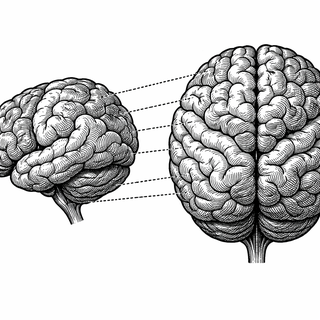
It's like two cities both having a neighborhood called "Chinatown" and assuming they must be the same just because they share a name.
The "Just Show Them Stuff and See" Approach
The researchers took a beautifully simple approach that somehow nobody had tried quite this way before. They assembled 700 natural scene photographs (think: landscapes, animals, objects, the kind of stuff you'd scroll past on Instagram) and showed them to both macaque monkeys and human participants.
For the monkeys, they recorded neural activity directly using electrodes. For the humans, they used fMRI brain scanning. Different measurement techniques, yes, but both capturing how brain regions respond to the same images. No assumptions about what features the brain should care about. No carefully curated stimuli designed to activate specific pathways. Just 700 random pictures of nature and a straightforward question: which regions respond similarly?
Think of it like a personality test, but for brain areas. Instead of asking "are you an introvert?" you just observe how everyone reacts to the same party and cluster people by their behavior.
The Face Processing Showdown Gets a Verdict
The face processing system has been ground zero for monkey-human comparison debates. Monkeys have these regions called "face patches" that respond strongly to faces, and humans have the famous fusiform face area (FFA) that does the same thing. But which monkey region matches which human region? Different research groups had different answers, and the arguments got heated enough that you'd think they were debating sports teams.
The new approach cut through the noise. By comparing response patterns to 700 images rather than just face vs. non-face responses, researchers could match regions based on their full "personality" rather than one narrow trait. The verdict: monkey area ML corresponds to human FFA, while monkey area AL matches more anterior temporal cortex in humans. This aligns with what anatomy suggested but contradicts studies that used narrower stimulus sets.
Sometimes the right answer was there all along; you just had to ask the question differently.
Why This Matters Beyond Academic Squabbling
"Great," you might think, "scientists finally agree on which brain blobs match up. Why should anyone care?" Fair question. Here's why.
An enormous amount of what we know about human brain function comes from primate research. Monkey studies use invasive recordings that would never be approved in humans, giving us detailed neural data we can't get any other way. But that data is only useful if we can accurately translate findings from monkey to human brains.
If the translation key is wrong, we've been misinterpreting a lot of research. Getting this right means decades of primate neuroscience can be properly connected to human brain function.
A Template for the Future
As neuroscience moves toward larger-scale recordings in primates, this approach offers a scalable method for systematic cross-species comparison. Natural images probe many neural properties simultaneously, making them ideal for unbiased mapping. No need to test one feature at a time and hope you picked the right ones.
It turns out the scientific equivalent of "let's just show everyone the same slideshow and see who vibes similarly" is actually a pretty solid research strategy. Sometimes the best methods are the obvious ones that just needed someone to actually do them.
Reference: Vinken K, et al. (2025). Mapping macaque to human cortex with natural scene responses. PNAS. doi: 10.1073/pnas.2512619122 | PMID: 41026824
Disclaimer: The image accompanying this article is for illustrative purposes only and does not depict actual experimental results, data, or biological mechanisms.