
When neuroscientists stick electrodes on your scalp and record brainwaves, they're supposed to be measuring brain activity. That's kind of the whole point. But here's an awkward finding from a new study in eLife: some of what we thought were age-related changes in brain dynamics are actually coming from the heart.
This is the kind of discovery that makes researchers go back and quietly re-examine a lot of their previous conclusions.
The 1/f Thing: A Quick Primer
One of the reliable features of brain recordings is something called 1/f dynamics. (The "f" stands for frequency.) Basically, when you look at the power spectrum of brain activity, low frequencies have more power than high frequencies. It's not random noise; it follows a specific mathematical pattern where power decreases proportionally as frequency increases.
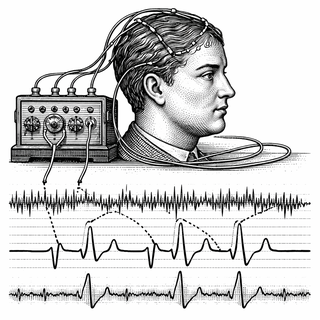
This 1/f pattern is thought to reflect something fundamental about how the brain is organized. It shows up across species and brain states, and it's been linked to everything from cognitive flexibility to neural network dynamics to aging itself.
And here's the thing that's caught researchers' attention: 1/f dynamics change as people get older. The slope of that power-frequency relationship shifts with age, and lots of papers have interpreted this as evidence for how the brain ages, how neural networks become less efficient, or how cognitive decline creeps in.
Makes sense, right? You're recording from the brain, you see changes with age, so those must be brain changes. Except there's a problem.
Your Heart Is Louder Than You Think
The heart generates a lot of electrical activity. Every time it beats, there's an electrical pulse that propagates throughout your body. And mechanical activity too, as blood gets pumped around and vessels pulse.
When you put electrodes on the scalp to record brain activity, you're putting sensitive electrical sensors on a surface that's relatively close to the brain, sure, but it's also sitting on top of a body that has a heart pumping away not too far below.
Cardiac activity makes its way into scalp recordings. Every time the heart beats, there's a little contamination in what's supposed to be a pure brain signal. For many analyses, this doesn't matter much because the heart signal is stereotyped and can be filtered out. But for 1/f analyses, which are looking at how power distributes across frequencies, cardiac contributions can actually shift the measured dynamics.
And here's where it gets interesting: cardiac function changes with age. Heart rate variability decreases. The amplitude and timing of cardiac signals shift. All of this is well-documented cardiovascular aging that has nothing to do with the brain.
Separating Brain From Heart (It's Harder Than It Sounds)
The researchers in this study set out to disentangle cardiac contributions from neural contributions to 1/f dynamics. By carefully accounting for cardiac activity in their analyses, they could ask: when you remove the heart's influence, do the age-related changes in 1/f still look the same?
The answer was illuminating. Some of the changes that had been attributed to brain aging were actually cardiac artifacts. The heart was changing with age, those changes were contaminating the recordings, and researchers were interpreting cardiac aging as neural aging.
This doesn't mean all 1/f age effects are cardiac artifacts. The brain genuinely does change with age, and some of those changes probably do show up in 1/f dynamics. But the picture is messier than previously assumed. Without properly controlling for cardiac contributions, you can't be sure whether you're seeing brain aging, heart aging, or some combination of both.
Why This Matters Beyond Methodology Papers
This might seem like a technical quibble that only matters to methods nerds. But it actually has broader implications.
First, any study using 1/f dynamics as a biomarker of brain aging or cognitive health needs to consider cardiac confounds. If you're trying to develop a neural marker that predicts who will develop dementia, you really want that marker to be measuring the brain, not the heart. Otherwise, you might just be picking up cardiovascular differences.
Second, this is a reminder that scalp recordings are inherently messy. The brain is just one of many sources of electrical activity that electrodes can pick up. Muscle activity, eye movements, environmental noise, and apparently cardiac signals all contaminate the data. Good neuroscience requires carefully accounting for these non-neural contributions.
Third, it suggests we might need to revisit some previous findings. If age-related 1/f changes have been partially attributed to the wrong organ, some conclusions about how the brain ages might need updating. That's uncomfortable, but it's how science is supposed to work: you find a confound, you correct for it, and you move forward with better methods.
The brain is complicated enough without accidentally including heart signals in the analysis. This study is a reminder to check what you're actually measuring before drawing conclusions about what it means.
Reference: Bhattacharyya S, et al. (2025). Age-related changes in 'cortical' 1/f dynamics are linked to cardiac activity. eLife. doi: 10.7554/eLife.104037 | PMID: 41037316
Disclaimer: The image accompanying this article is for illustrative purposes only and does not depict actual experimental results, data, or biological mechanisms.