
Your brain has a serious security system. There's a tough little membrane called the pia mater wrapping around it like neurological cling wrap, and beneath that lies a densely packed network of blood vessels that really, really don't appreciate being poked. So when scientists try to insert electrodes for brain-machine interfaces, they're basically trying to thread a needle through a wet sponge full of tiny water balloons. Things tend to get messy.
But here's the kicker: researchers at Stanford just figured out that if you make your probes skinny enough, you can avoid the whole blood-vessel-explosion problem entirely.
The Brain's Delicate Plumbing Problem
Every time surgeons implant an electrode into someone's brain, they rupture capillaries. It's been treated as unavoidable, like getting wet when you go swimming. The insertion damages blood vessels, cells, and the surrounding tissue matrix, which triggers inflammation, disrupts the blood-brain barrier, and kicks off a cascade of problems that can cause the electrode to fail over time.
This isn't just an inconvenience. For people with paralysis hoping to control a robotic arm with their thoughts, or patients with severe depression awaiting deep brain stimulation, electrode failure means losing their lifeline. The foreign body response creates scar tissue, pushes neurons away from recording sites, and gradually degrades signal quality until the device becomes useless.
Going Small (Really, Really Small)
The Stanford team, led by researchers from the Melosh and Wu labs, did something that sounds almost too simple: they systematically tested probes of different sizes, from 7.5 micrometers to 100 micrometers in diameter, while watching what happened under a two-photon microscope. In real time. In living brains.
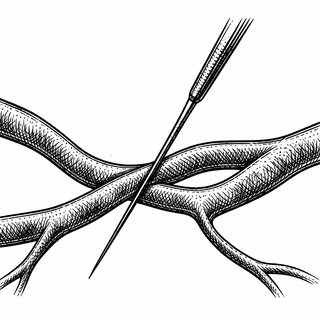
What they found was a bit like discovering that you've been using a sledgehammer when you could have been using a scalpel. Probes smaller than 25 micrometers - that's about a quarter the width of a human hair - could slip between blood vessels without rupturing them at all. The vessels just moved out of the way.
Larger probes? Not so lucky. The blood vessels would get caught on the probe surface, stretch like bubble gum, and eventually tear. The researchers describe it as "capture" - the vessel adheres to the probe and gets dragged along until something gives.
The Three-Zone Theory
The team proposes a elegant model to explain why size matters so much. Think of it as three zones around your probe:
Zone one is the sweet spot. At really small diameters, vessels can dodge the probe entirely, like pedestrians stepping aside for someone on a skateboard.
Zone two is the danger zone. Mid-sized probes create this awkward situation where vessels are too big to slide away but get caught on the surface. Stretching, tearing, bleeding.
Zone three is brute force territory. Very large probes just shove everything aside, but the damage is already done by that point.
What About the Other Stuff?
Here's a surprising finding: once the probe gets past the pia mater (that tough outer membrane), the force needed to push it deeper stays constant. It doesn't keep building up as you go further. And tip shape? Doesn't matter much after penetration. Flat tips, angled tips, electrochemically sharpened tips - the insertion force stays roughly the same once you're through the gate.
The team also tested Neuropixels probes, those incredible high-density silicon electrodes that have revolutionized neuroscience by letting researchers record from hundreds of neurons simultaneously. Same principles apply: geometry at the micro-scale is what counts.
Why This Actually Matters
Brain-computer interfaces are having a moment. Neuralink implanted their first human patient in 2024. About 25 clinical trials are currently underway. We're entering what researchers call "the translation era" - when experimental tech starts becoming real medicine.
But the failure rates have been brutal. Electrodes that work beautifully for weeks can go silent after months, victims of the inflammatory scarring response. If we can reduce the initial trauma by simply using thinner probes and smarter geometries, we might extend device lifetimes dramatically.
The study also opens doors for ultra-flexible probes that are more brain-friendly but notoriously difficult to insert. Knowing exactly how much force you need, and what diameter avoids vascular catastrophe, gives engineers a clearer design target.
Your brain might be well-defended, but it turns out the secret to getting past those defenses isn't force - it's finesse.
References
-
Obaid A, et al. (2025). Ultrasensitive measurement of brain penetration mechanics and blood vessel rupture with microscale probes. Proceedings of the National Academy of Sciences. DOI: 10.1073/pnas.2529147123
-
Steinmetz NA, et al. (2021). Neuropixels 2.0: A miniaturized high-density probe for stable, long-term brain recordings. Science. PMCID: PMC8244810
-
Kozai TDY, et al. (2015). Brain Tissue Responses to Neural Implants Impact Signal Sensitivity and Intervention Strategies. ACS Chemical Neuroscience. PMCID: PMC4304489
-
Weltman A, Yoo J, Bhardwaj A. (2024). Engineering strategies towards overcoming bleeding and glial scar formation around neural probes. Journal of Neural Engineering. PMCID: PMC8975777
-
Chen K, et al. (2024). Uniaxial extending neural probes for bleeding-absent implantation. npj Flexible Electronics. DOI: 10.1038/s41528-024-00323-1
Disclaimer: The image accompanying this article is for illustrative purposes only and does not depict actual experimental results, data, or biological mechanisms.