
There's a 19-subunit molecular machine inside your cells that's been quietly controlling gene expression for your entire life, and unless you're deep into molecular biology, you've probably never heard of it. The Integrator complex isn't going to win any popularity contests. It doesn't have the brand recognition of DNA or the catchiness of CRISPR. But after 20 years of research, scientists are realizing this thing is kind of a big deal. A review in Trends in Molecular Medicine celebrates the complex's 20th anniversary by laying out everything we've learned, and it turns out this unsung hero has been running quite an operation.
So What Does This Beast Actually Do?
The Integrator complex hangs out with RNA polymerase II, the enzyme responsible for transcribing your genes into RNA. But Integrator isn't just tagging along for the ride. It's more like a control room operator managing traffic on a highway.
One of its main tricks is cleaving nascent RNA transcripts. In plain English: when a gene starts getting copied but the copy isn't going anywhere useful, Integrator steps in and cuts it off. Think of it as the quality control manager at a publishing house, rejecting manuscripts that aren't working out before they waste everyone's time.
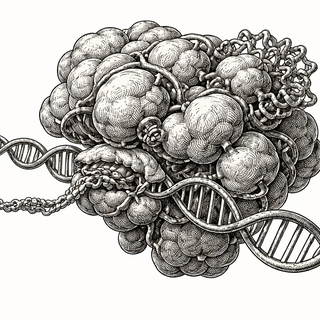
But that's just the beginning. Integrator also regulates when transcription starts in the first place, decides when paused polymerases should get going again, and oversees the whole elongation process. It processes enhancer RNAs (short regulatory RNAs that help control gene expression) and even pitches in during DNA damage responses to help maintain genome stability.
Basically, if gene expression is a symphony, Integrator is somehow playing conductor, stage manager, sound engineer, and bouncer all at once. With 19 subunits to work with, it can afford to multitask.
Taking the Machine Apart
For years, scientists knew Integrator did important stuff but didn't really understand how. Recent structural biology studies have started to change that. Researchers have been able to see exactly how the complex interacts with RNA polymerase II, specifically with its C-terminal domain (CTD), which is essentially the regulatory tail of the enzyme.
This matters because structure explains function. When you can see precisely how the parts fit together, you can finally understand what happens when specific parts break. It's like the difference between knowing your car "has engine problems" versus knowing exactly which component failed and why.
The structural work has revealed how different subunits take on different responsibilities. Some are involved in the cutting action. Others handle the regulatory decisions. Some serve as scaffolds holding everything together. It's a proper division of labor, and mutations in different subunits cause different problems depending on which job gets disrupted.
Why Your Brain Cares About This Obscure Machinery
Here's where it gets clinically interesting. Dysfunction in Integrator subunits has been linked to neurodevelopmental disorders. Why the brain specifically? Because brain development is basically the most demanding gene expression challenge your body ever undertakes.
Building a brain requires turning millions of genes on and off at exactly the right times, in exactly the right cells, at exactly the right levels. There's no margin for error. If your transcriptional control machinery has even subtle defects, the brain is going to notice first because it's pushing the system the hardest.
When Integrator isn't working properly, the cascading effects on gene expression can lead to developmental problems that show up as neurological disorders. The connection has become clearer as researchers have identified patients with mutations in specific Integrator subunits who present with neurodevelopmental phenotypes.
Cancer connections have also emerged, which makes sense when you think about it. Cancer is fundamentally a disease of gene expression gone haywire, and Integrator sits right at the control panel. When the editor goes rogue, as they say, the manuscript goes off the rails.
Twenty Years of Progress on a Humble Machine
The review celebrates how far the field has come since Integrator was discovered two decades ago. It started as a biochemical curiosity: scientists purifying RNA polymerase complexes kept finding these extra proteins and wondered what they were doing there. Now we know Integrator is essential for development, implicated in disease, and central to gene expression control in ways nobody anticipated.
This is the kind of story that happens a lot in molecular biology. Something obscure turns out to be important. Something that seemed like a footnote becomes a chapter. The cells in your body have been using this 19-subunit machine all along, and we're only now starting to appreciate what it does. Sometimes the most unassuming machinery is running the most important operations.
Reference: Tayari MM, Shiekhattar R. (2025). Integrator 20th anniversary: a molecular machine indispensable in development and disease. Trends in Molecular Medicine. doi: 10.1016/j.molmed.2025.09.003 | PMID: 41073164
Disclaimer: The image accompanying this article is for illustrative purposes only and does not depict actual experimental results, data, or biological mechanisms.