
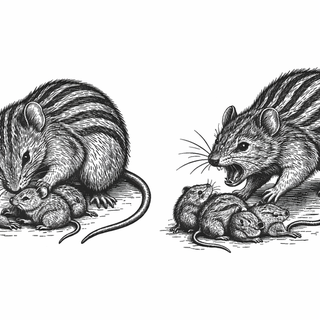
Picture this: a mouse father grooming his pups, keeping them warm, the very model of rodent domesticity. Now imagine flipping a genetic switch and watching that same father become aggressive toward his own offspring. This isn't science fiction - it's exactly what Princeton researchers discovered when they investigated why some male African striped mice make excellent fathers while others... really, really don't.
When Social Pressure Gets Under Your Skin (And Into Your Brain)
The story starts with an unlikely character: a gene called Agouti. Before this study, Agouti was known for fairly mundane things - coat color, metabolism, the sorts of genes that make for solid but unremarkable science fair projects. Nobody expected it to moonlight as the brain's paternal behavior dimmer switch.
But that's precisely what a team led by researchers at Princeton University found. Using African striped mice (Rhabdomys pumilio) - one of the rare rodent species where dads actually stick around - they discovered that Agouti expression in a brain region called the medial preoptic area (MPOA) essentially controls whether males nurture or attack their young (Rogers et al., 2026).
Here's where it gets interesting. The researchers didn't find a simple "good dad/bad dad" binary. Instead, the environment pulls the strings. Male mice raised in isolation developed into attentive fathers. But males housed in crowded, competitive conditions? Their Agouti levels shot up, their MPOA activity dropped, and their parenting skills went out the window - sometimes replaced by outright aggression.
Your Brain's Parenting Headquarters
The MPOA has long been recognized as the brain's "parenting hub." Lesion studies dating back decades showed that damage here disrupts maternal behavior. More recent work identified specific galanin-expressing neurons that, when activated, suppress aggression and promote nurturing behaviors (Wu et al., 2014; PMID: 24828191). The region is packed with receptors for oxytocin, estrogen, and prolactin - the usual suspects when hormones and caregiving intersect.
What this study adds is a mechanism for how the outside world reaches those neurons. Crowded conditions increase Agouti expression, which then suppresses MPOA activity. The gene essentially translates "lots of competition for resources" into "maybe don't invest too heavily in these particular pups."
When researchers artificially boosted Agouti levels in previously caring males using gene therapy, those fathers became disinterested - spending roughly 50% less time with pups - and some turned aggressive. The switch flipped.
Why This Matters Beyond Mice
Active fathering is genuinely rare among mammals. Only about 5-10% of mammalian species show any paternal care at all - compare that to roughly 80% of birds (Woodroffe & Vincent, 1994; CARTA research). For most male mammals, evolutionary math favors finding additional mates over helping raise existing offspring. The costs of caring (missed mating opportunities, energy expenditure) usually outweigh the benefits.
African striped mice are special because they buck this trend. They're socially flexible - capable of either solitary or group living depending on conditions - and males naturally vary in how much they invest in pups. That variability made them perfect for teasing apart what drives parental behavior at the molecular level.
The implications extend to understanding how environmental stress shapes behavior more broadly. The researchers explicitly cautioned against jumping to human conclusions - we have both the MPOA and the Agouti gene, but whether the same mechanism operates in people remains unknown. Still, the principle that social competition can reach into the brain and dial down nurturing circuitry raises intriguing questions about how context shapes even our most fundamental social behaviors.
The Takeaway
This research reveals something both unsettling and oddly reassuring: parenting behavior isn't fixed. It's a negotiation between genes and environment, mediated by ancient neural circuits. A single gene, responding to social conditions, can transform a nurturing father into something quite different.
For African striped mice at least, being a good dad isn't entirely a choice. It's partly a calculation their brains make based on the world around them.
References
-
Rogers, F. D. et al. (2026). Agouti integrates environmental cues to regulate paternal behaviour. Nature. https://doi.org/10.1038/s41586-026-10123-4
-
Wu, Z. et al. (2014). Galanin neurons in the medial preoptic area govern parental behaviour. Nature. PMID: 24828191
-
Pillay, N. (2018). African striped mice. Current Biology, 28(15), R888-R889. https://www.sciencedirect.com/science/article/pii/S0960982218301635
-
Kohl, J. (2020). Medial preoptic circuits governing instinctive social behaviors. PMC. https://pmc.ncbi.nlm.nih.gov/articles/PMC11269931/
-
Schradin, C. & Pillay, N. (2003). The striped mouse from the succulent karoo: a territorial group-living solitary forager. Journal of Comparative Psychology. PMID: 15008671
Disclaimer: The image accompanying this article is for illustrative purposes only and does not depict actual experimental results, data, or biological mechanisms.