
Your brain runs on a delicate balance of "go" and "stop" signals. Too much excitation and things get chaotic (seizures, anyone?). Too much inhibition and nothing happens at all. A study in eLife just discovered that a protein famous for one job has been moonlighting at a completely different gig, and it turns out that side hustle is pretty important for keeping your brain balanced.
The Brain's Volume Knob Problem
Picture your brain as a massive concert where billions of neurons are all playing different instruments. Excitatory neurons are like the musicians trying to make noise. Inhibitory neurons are like the sound engineers saying "hey, turn that down a bit." The concert only sounds good when these two forces are balanced.
GABAergic synapses are the main "turn it down" system in your brain. These inhibitory connections release GABA, a neurotransmitter that essentially tells neurons to chill out. Without properly functioning inhibitory synapses, your brain's volume knob gets stuck on loud, and that's bad news.
So how do these inhibitory synapses get built and maintained? That's been a bit of a mystery, and this study just found a surprising piece of the puzzle.
Plot Twist: The Membrane-Bender Has Another Job
Enter endophilin A1, a protein that scientists have studied for years. Its claim to fame? Bending membranes. When cells need to pull things inside through endocytosis (basically cellular eating), endophilin A1 helps curve the membrane to form little vesicles. It's good at this job. It's famous for this job.
But the researchers discovered something unexpected. Endophilin A1 isn't just hanging around on the "sending" side of synapses doing its membrane-bending thing. It's also present on the "receiving" side of inhibitory synapses, and it's doing something completely different there.
When the scientists removed endophilin A1, the postsynaptic machinery at GABAergic synapses fell apart. The organization of all the proteins that need to be in the right place to receive inhibitory signals got scrambled. Inhibitory synapses still formed, but they formed wrong.
It's like discovering that the person you thought was just really good at folding laundry is also secretly running the entire household's scheduling system.
When the Balance Tips
Here's where things get clinically relevant. With endophilin A1 out of the picture and inhibitory synapses malfunctioning, the balance between excitation and inhibition shifts. The "turn it down" signals don't work as well, so the "make noise" signals win more often.
This kind of imbalance shows up in a bunch of neurological conditions. Epilepsy, autism spectrum disorders, schizophrenia, anxiety disorders: many of these involve disrupted excitation-inhibition balance. Finding a new protein that helps maintain this balance opens up new questions about what might go wrong in these conditions.
If endophilin A1 or proteins that interact with it are mutated or dysfunctional, you might get synapses that look okay but don't work quite right. The architecture is subtly off, and that subtle problem could cascade into bigger circuit-level dysfunction.
A Protein's Resume Gets Longer
What makes this finding particularly interesting is the career expansion for endophilin A1. Proteins often turn out to have multiple jobs (scientists call these "moonlighting functions"), but discovering a new one in a well-studied protein always raises eyebrows.
For decades, researchers knew endophilin A1 as a membrane-bending specialist involved in endocytosis. Textbooks described it that way. Grants were written about it that way. And now it turns out there's this whole other function in organizing inhibitory synapses that was hiding in plain sight.
This discovery also hints that we should probably take another look at other "well-understood" proteins. If endophilin A1 was secretly running inhibitory synapse organization this whole time, what other proteins are pulling double duty that we don't know about?
What This Means Going Forward
The practical implications here connect to understanding and potentially treating disorders involving excitation-inhibition imbalance. If endophilin A1 is important for inhibitory synapse organization, it becomes a potential target for interventions. Or at least something to look at when trying to understand why someone's inhibitory synapses aren't working properly.
The finding also adds nuance to how we think about synapse development and maintenance. It's not enough for the right proteins to be present. They need to be organized correctly, and that organization requires its own dedicated machinery. Endophilin A1 appears to be part of that machinery for inhibitory synapses.
Your brain's ability to balance excitement and calm depends on countless molecular details like this. One protein doing a job nobody knew about, keeping things organized so your neurons can have a reasonable conversation instead of a screaming match.
Reference: Bhattacharyya S, et al. (2025). Endophilin A1 facilitates organization of the GABAergic postsynaptic machinery. eLife. doi: 10.7554/eLife.104036 | PMID: 41036704
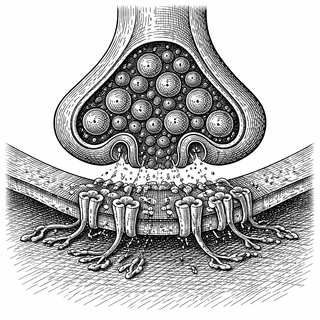
Disclaimer: The image accompanying this article is for illustrative purposes only and does not depict actual experimental results, data, or biological mechanisms.