
You're sitting in therapy, talking through some issue that's been bothering you. Maybe it's a relationship pattern you keep falling into, or anxiety that won't let go. And then something clicks. You suddenly see the situation differently. The insight feels meaningful, maybe even transformative. But what actually happened in your brain at that moment? A new framework in Perspectives on Psychological Science proposes an answer borrowed from the strangest place: spatial navigation research.
That's right. Your emotional breakthroughs might work like GPS recalculating after you take a wrong turn.
The Mystery of the "Aha" Moment
Therapists have witnessed these breakthrough moments for over a century. Clients suddenly see their problems in a new light. Patterns become visible. Solutions that seemed impossible become obvious. Freud called it insight. Carl Rogers called it something else. Every therapeutic tradition has its own vocabulary for this phenomenon.
But the specific brain processes underlying these moments have remained mysterious. We know insight happens. We know it matters. We don't really know how it works at a neural level.
Enter the cognitive map theory.
Your Brain Is a Cartographer
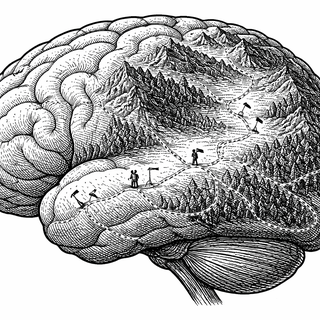
Here's the connection, and stay with me because it's actually pretty elegant. The hippocampus and related brain structures create "cognitive maps," neural representations that encode relationships between locations. This is how you know where your kitchen is relative to your bedroom without having to physically walk there. Your brain has an internal map, and you can mentally navigate it.
But researchers have discovered that similar mechanisms appear to encode abstract conceptual spaces, not just physical ones. Your brain maps relationships between ideas, memories, and emotional states using the same neural machinery it uses for finding the coffee shop.
Think about how you navigate abstract concepts. Some ideas feel "close" to each other. Others feel "far apart." Some emotional states lead naturally to others, like paths between locations. This isn't just metaphor; the brain appears to actually represent conceptual relationships using spatial-like codes.
Mental Health as Limited Maps
The framework proposes that mental health difficulties may involve cognitive maps that are overly rigid or narrow. You keep thinking the same thoughts because you don't know other routes exist. Your mental map has limited paths, and you walk them over and over.
Depression might involve maps where all paths lead to negative conclusions. Anxiety might involve maps where danger seems nearby no matter which direction you turn. Rumination might be the mental equivalent of walking in circles because your map doesn't show any exits.
If this sounds metaphorical, it partially is. But the underlying claim is concrete: the brain structures that create spatial maps also create conceptual maps, and those conceptual maps can get stuck in unhelpful configurations.
Therapy as Guided Exploration
In this framework, therapeutic change involves "mentally navigating beyond current boundaries." The therapist acts as a guide helping the client explore new territory in their conceptual space. Through dialogue, reflection, and reprocessing of experiences, new paths become visible. New connections form.
The "aha" moment happens when the map expands. A new connection forms between previously separate territories. Suddenly you can get there from here. A path exists that you didn't know about before.
The insight isn't just intellectual. It's a restructuring of how the brain represents the problem space. That's why insights feel different from just being told something. You didn't just learn a fact; your internal map changed.
What This Could Mean for Treatment
If this framework is correct, it suggests specific therapeutic approaches: techniques that facilitate mental exploration, that help clients recognize the boundaries of their current maps, and that guide them toward meaningful expansions.
It might explain why different therapies work for different people. Some people need help seeing that boundaries exist. Others need help pushing past them. Still others need new landmarks to navigate by.
The authors acknowledge this needs empirical validation. Connecting therapy to cognitive maps is a framework, not a proven mechanism. But it's a testable framework, and that matters. It gives researchers something to measure.
A Useful Way to Think About Getting Unstuck
Even if the neural details turn out differently, the metaphor has practical value. When you're stuck, you might be navigating with an incomplete map. Therapy helps you draw new routes. Breakthroughs happen when the map updates.
Your brain's navigation system doesn't just help you find the bathroom at night. It might also help you find your way through emotional problems. Not a bad deal for neural machinery that evolved for remembering where the food was.
Reference: Kabrel N, Aru J. (2025). Becoming Aware Through Internal Exploration: Understanding Psychotherapy on Conceptual and Neurobiological Levels. Perspectives on Psychological Science. doi: 10.1177/17456916251378430 | PMID: 41129548
Disclaimer: The image accompanying this article is for illustrative purposes only and does not depict actual experimental results, data, or biological mechanisms.