
Imagine installing a dimmer switch in your house, but instead of controlling lights, it controls specific neurons in your brain. And instead of flipping it with your finger, you activate it by taking a pill. That's basically what DREADDs are, and they sound like something a science fiction writer made up while sleep-deprived. But they're real, they work, and according to a study discussed in eLife, they keep working for way longer than anyone expected.
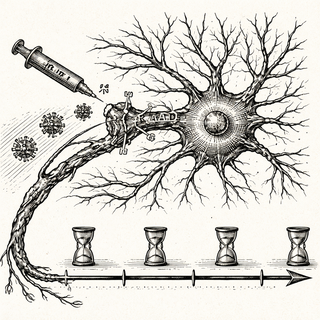
DREADDs (Designer Receptors Exclusively Activated by Designer Drugs) are the neuroscience equivalent of installing a remote control system in neurons. You inject a virus that makes certain brain cells grow these artificial receptors on their surface. Then, when you give the animal a specific drug, those receptors activate, and boom: you can turn neurons on or off at will. It's like having a universal remote for the brain, except it actually works (unlike the one in your living room that requires a PhD to operate).
The "Are We Still Good?" Question Nobody Wanted to Ask
Here's the thing about fancy molecular tools: they tend to degrade. Proteins break down. Viruses get cleared. Biology is constantly trying to clean house. So when you inject these DREADDs into a monkey brain, everyone kind of assumed there was an expiration date. The question was: how long before your expensive molecular remote control turns into an expensive paperweight?
For mouse studies, this isn't a huge deal. Mice live a couple of years, experiments are short, and if something stops working, you've got plenty of backup mice. (Sorry, mice.) But monkeys? Primate research is expensive, ethically demanding, and scientifically irreplaceable for certain questions. Each monkey represents years of training, millions of dollars, and scientific questions that simply cannot be answered any other way.
So when researchers inject DREADDs into a monkey, they really, really want to know: will this still work in three years when we need it?
Three Years Later: Still Flipping Switches
The study tracked DREADD expression and function in macaques over three years. And here's where the researchers probably did a little happy dance in the lab: the receptors not only stuck around, they kept working. No significant decline in expression. No loss of efficacy. No need for booster shots or re-injection.
Think about that for a second. These artificial receptors, encoded by a virus, expressed by brain cells that are trying to maintain themselves while also doing brain stuff, remained functional for over a thousand days. That's like finding out your phone battery actually gets better with age. It shouldn't happen, but apparently, neurons are better at holding onto things than we gave them credit for.
Why This Matters More Than You'd Think
Here's where it gets exciting for the research community. Many of the juiciest questions in neuroscience take years to answer. How do primates learn complex cognitive tasks? What happens to brain circuits as animals age? How do neurodegenerative diseases progress over time?
Previously, researchers had to wonder: will my tools outlast my experiment? It's hard to study five-year cognitive changes if your molecular toolkit expires at year two. Now they know they can plan ambitious, multi-year studies without worrying their primary manipulation will fizzle out halfway through.
This is the scientific equivalent of finding out your reliable car can actually make it cross-country, not just to the grocery store. Suddenly, longer journeys become possible.
The Boring Validation That Makes Real Science Possible
Let's be honest: "tool still works after three years" isn't going to make headlines or win any awards for excitement. There's no cure here, no breakthrough insight into consciousness, no dramatic revelation about human nature.
But science runs on this kind of methodological grunt work. Before you can answer the big questions, you need to know your equipment is reliable. This study is basically a consumer report for chemogenetics: "Tested extensively. Holds up. Would recommend."
For a field that's increasingly relying on chemogenetic approaches for everything from studying memory to developing potential therapies, knowing the tools have a long shelf life isn't just convenient. It's the foundation that makes the actual discoveries possible.
So the next time someone asks what's new in neuroscience, you can tell them: the remote controls for monkey brains are surprisingly durable. They'll probably look at you funny, but you'll know you're talking about real science.
Reference: Bhattacharyya S. (2025). Probing the staying power of chemogenetics. eLife. doi: 10.7554/eLife.109193 | PMID: 41081356
Disclaimer: The image accompanying this article is for illustrative purposes only and does not depict actual experimental results, data, or biological mechanisms.